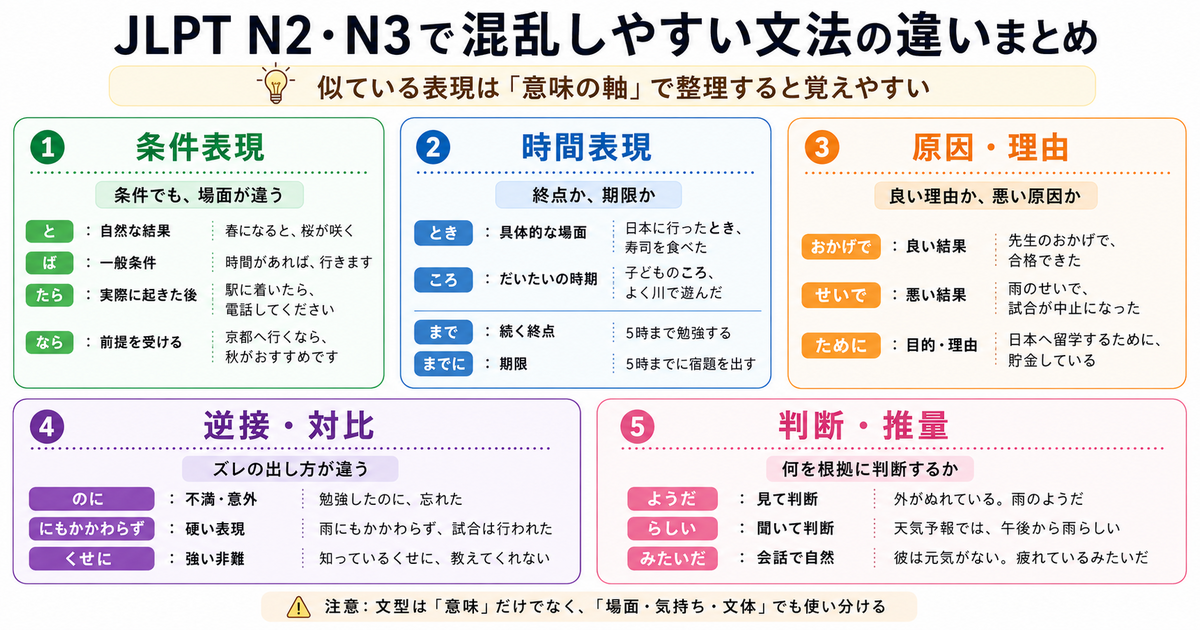
The Key to Passing JLPT N2/N3 Is Learning How to Tell Similar Grammar Apart
When studying JLPT N2/N3 grammar, one of the biggest traps is not always the grammar you do not know at all. More often, it is the grammar you think you know, but confuse with another similar expression.
Have you ever hesitated between expressions like these?
- 「たら」 and 「なら」
- 「まで」 and 「までに」
- 「おかげで」 and 「せいで」
These are expressions that many learners study from the beginner to intermediate level. However, when they appear side by side in a JLPT multiple-choice question, they can both look correct. If your understanding is only vague, these “almost right” options can easily make you lose points on the real test.
This page organizes RJT’s grammar comparison articles by meaning category. First, get a bird’s-eye view of the whole picture, then focus on the areas where you tend to get confused.
How to Use This Page Efficiently
You do not need to read this page from top to bottom.
The fastest way is to jump to the area that matches your weakness or study goal.
If you are not confident with “if” and conditional expressions, start with “Conditional and connecting expressions.”
If you often lose track of the flow in reading passages, focus on “contrast” and “connecting expressions.”
If you struggle with vague N2-style judgment expressions, start with “judgment and inference.”
Each section gives a short explanation of the key difference and links to a detailed article. Start with the expression that feels unclear, and solve one confusion at a time.
Conditional and Connecting Expressions
「と」「ば」「たら」「なら」
Conditional expressions are difficult both on the JLPT and in real conversation. 「と」 often expresses a natural result, 「ば」 expresses a condition, 「たら」 is often used for a specific event or situation, and 「なら」 is often used when responding to what someone has said or assumed.
「たら」 and 「なら」
Both 「たら」 and 「なら」 express conditions, but they are used in different situations. 「たら」 is often used when talking about what happens after something occurs, while 「なら」 is often used when responding to someone’s statement or assumption.
Read more: Tara vs. Nara: What’s the Difference? Japanese Conditional Expressions Explained
「〜ばかりか」
「〜ばかりか」 is an N2 grammar pattern that means “not only that, but also.” It does more than simply add information. It gives the feeling that something is already enough on its own, but there is even more beyond it.
Read more: JLPT N2 Grammar: Bakari ka. Meaning, Usage, and How It Differs from “Not Only”
「〜からして」
「〜からして」 is used when one small part already reveals the overall situation. It often means “even just looking at this one example, you can tell the whole thing is like that.” This pattern is often used together with evaluation or judgment.
Read more: How to Use “kara shite” | A Grammar Pattern That Reveals the Whole from Just One Detail
「〜てはじめて」
「〜てはじめて」 expresses that you realize or understand something only after having a certain experience. The basic flow is: “I did not understand before, but after experiencing it, I finally understood.”
Read more: How to Use “te hajimete” | A Grammar Pattern for Realizations That Come Only Through Experience
「〜か〜ないかのうちに」
「〜か〜ないかのうちに」 expresses that two events happen almost at the same time. The key feeling is speed: “as soon as A happened, B happened right away.”
Read more: How to Use “ka nai ka no uchi ni” | A Grammar Pattern for Actions That Happen Almost Simultaneously
Reading Connector Expressions Correctly
In reading questions, if you only rely on a vague sense of 「でも」 as “but” and 「そして」 as “and,” it becomes easy to miss the difference between contrast, addition, reason, and result. Connector expressions are important not only for grammar questions, but also for improving reading scores.
Time Expressions
「とき」 and 「ころ」
Both 「とき」 and 「ころ」 express time, but they are not the same. 「とき」 often points to a specific situation or timing, while 「ころ」 tends to express an approximate period of time.
Read more: Toki vs. Koro: What’s the Difference? Japanese Time Expressions Explained with Examples
「まで」 and 「までに」
「まで」 marks the endpoint of a continuing action or state, while 「までに」 expresses a deadline. 「5時まで勉強する」 and 「5時までに宿題を出す」 use time in completely different ways.
Read more: What’s the Difference Between “made” and “made ni” in Japanese?
「あいだ」 and 「あいだに」
「あいだ」 expresses something that continues throughout a period, while 「あいだに」 expresses something that happens once or several times during that period. This difference helps you understand how events continue or occur within a time span.
Read more: What’s the Difference Between “Aida” and “Aida ni”? A Clear Guide to Time and Events in Japanese
「〜たとたんに」
「〜たとたんに」 expresses that an unexpected change happens immediately after an action. It is similar to 「〜たら」, but it has a stronger sense of suddenness and surprise.
Read more: Mastering "V-ta totan (ni)": Instant & Unexpected Changes
Expressions for Cause and Reason
「おかげで」 and 「せいで」
「おかげで」 expresses the reason for a good result, while 「せいで」 expresses the cause of a bad result. Both relate to cause and reason, but the speaker’s evaluation is completely opposite.
「ために」 and 「せいで」
「ために」 can express purpose or reason, while 「せいで」 expresses the cause of a negative result. Since 「ために」 can also be used for positive goals or purposes, it should not be treated the same way as 「せいで」.
Read more: What is the difference between 「ために」 and 「せいで」?
「はずだ」 and 「わけだ」
「はずだ」 expresses an expectation or judgment based on information or circumstances. 「わけだ」 expresses the feeling of understanding or accepting the reason behind something. Both involve judgment, but the speaker’s position is different.
Read more: What’s the Difference Between “hazu da” and “wake da”? A Clear Guide to Expectation vs. Realization
Contrast and Comparison Expressions
「ても」 and 「でも」
「ても」 and 「でも」 look similar, but they work differently in a sentence. 「ても」 often creates a conditional or concessive meaning, while 「でも」 can be used after nouns or clauses to show contrast or give examples.
Read more: Temo vs. Demo: What’s the Difference? Japanese Usage Explained with Examples
「のに」「にもかかわらず」「くせに」
All three expressions show that the result is different from what was expected. However, 「のに」 often expresses natural dissatisfaction or surprise, 「にもかかわらず」 is a formal written expression, and 「くせに」 often carries strong blame or emotion.
Read more: Common JLPT Contrast Expressions: What Is the Difference Between "のに", "にもかかわらず", and "くせに"?
「によって」 and 「によっては」
「によって」 broadly expresses differences depending on conditions or subjects. 「によっては」 shows that among those cases, there may be exceptions. It becomes easier to understand if you connect it with the idea of “depending on the case.”
Read more: “Niyotte” vs. “Niyotte wa”: How to Understand General Differences and Exceptional Cases in Japanese
Limitation and Negation Expressions
「しか」 and 「だけ」
Both 「しか」 and 「だけ」 express limitation, but 「しか」 is used together with a negative form and often gives a feeling of insufficiency or dissatisfaction. 「だけ」 can limit the range more neutrally.
Read more: Shika vs. Dake: Mastering the Art of "Only" in 3 Minutes
「わけではない」「とは限らない」「ないことはない」
Weak negative expressions are especially confusing on the JLPT. 「わけではない」 means something is not completely true, 「とは限らない」 shows the possibility of exceptions, and 「ないことはない」 is closer to a weak form of affirmation.
Read more: Confusing Japanese Negative Expressions on the JLPT: 「わけではない」「とは限らない」「ないことはない」
Judgment and Inference Expressions
「ようだ」 and 「みたいだ」
Both 「ようだ」 and 「みたいだ」 express inference or comparison. However, 「ようだ」 is a little more formal and is useful in writing and test contexts. 「みたいだ」 sounds more natural in conversation.
Read more: The Difference Between 「ようだ」 and 「みたいだ」
「ようだ」 and 「らしい」
「ようだ」 often expresses judgment based on what you see or feel, while 「らしい」 is often based on information you heard or on a typical characteristic.
Two Types of 「そうだ」
There are two types of 「そうだ」. One expresses appearance, as in 「雨が降りそうだ」, and the other expresses hearsay, as in 「雨が降るそうだ」. Since the connection pattern is different, you can often identify the meaning from the form.
Read more: Sou Da: Two Types, Two Rules. Mastering Hearsay vs. Appearance in 3 Minutes
Expressions of Intention, Decision, and Change
「つもりだ」 and 「予定だ」
「つもりだ」 expresses the speaker’s intention, while 「予定だ」 expresses an objective plan. Both refer to the future, but one is about what the speaker intends to do, and the other is about a scheduled plan.
Read more: “Tsumori da” vs. “Yotei da”: How to Tell Intention from a Fixed Plan in Japanese
「ようにする」 and 「ことにする」
「ようにする」 expresses making an effort to form a habit, while 「ことにする」 expresses making a decision. 「毎日復習するようにする」 and 「毎日復習することにする」 differ in whether the focus is on continued effort or on the decision itself.
Read more: You ni Suru vs. Koto ni Suru: Effort vs. Decision in Japanese Explained
「ことにする」 and 「ことになる」
「ことにする」 means deciding something by one’s own will, while 「ことになる」 means something is decided by circumstances or the flow of events. Looking at whose will is involved makes the difference easier to understand.
「ようになる」 and 「ことになる」
「ようになる」 expresses a change in ability, habit, or state. 「ことになる」 expresses a decision or outcome. If you ask whether the sentence is about change or decision, the difference becomes clearer.
Read more: You ni Naru vs. Koto ni Naru: Change vs. Decision in Japanese Explained
Summary
For JLPT N2/N3 grammar, it is not enough to memorize grammar patterns one by one. You also need to learn how to distinguish similar expressions.
Expressions related to conditions, time, cause, contrast, negation, and inference often look similar in meaning, so they can be confusing in multiple-choice questions. When you learn the differences, pay attention not only to the meaning of each expression, but also to these points:
- Is the expression used for a good result or a bad result?
- Is it the speaker’s intention or an objective plan?
- Does it refer to a specific point in time or an approximate period?
- Is it a formal written expression or a natural conversational expression?
- Is it a simple negation or a weak negation?
With RJT, you can not only read grammar explanations, but also check your understanding by solving real practice questions. If you often get confused by similar expressions, read the explanations first, then use practice questions to test whether you can really tell them apart.
JLPT%E3%81%A7%E8%BF%B7%E3%81%84%E3%82%84%E3%81%99%E3%81%84%E5%90%A6%E5%AE%9A%E8%A1%A8%E7%8F%BE%E3%81%BE%E3%81%A8%E3%82%81%EF%BC%88%E8%8B%B1%EF%BC%89.png)
JLPT%E3%81%A7%E8%BF%B7%E3%81%84%E3%82%84%E3%81%99%E3%81%84%E5%8E%9F%E5%9B%A0%E3%83%BB%E7%90%86%E7%94%B1%E8%A1%A8%E7%8F%BE%E3%81%BE%E3%81%A8%E3%82%81%EF%BC%88%E8%8B%B1%EF%BC%89.png)
JLPT%E3%81%A7%E8%BF%B7%E3%81%84%E3%82%84%E3%81%99%E3%81%84%E9%99%90%E5%AE%9A%E8%A1%A8%E7%8F%BE%E3%81%BE%E3%81%A8%E3%82%81%EF%BC%88%E8%8B%B1%EF%BC%89.png)
%E8%AA%AD%E8%A7%A3%E3%81%A7%E5%B7%AE%E3%81%8C%E3%81%A4%E3%81%8F%E6%8E%A5%E7%B6%9A%E8%A1%A8%E7%8F%BE%E3%81%BE%E3%81%A8%E3%82%81%EF%BC%88%E8%8B%B1%EF%BC%89.png)
%E8%81%B4%E8%A7%A3%E3%81%A7%E8%81%9E%E3%81%8D%E9%80%83%E3%81%97%E3%82%84%E3%81%99%E3%81%84%E8%A1%A8%E7%8F%BE%E3%81%BE%E3%81%A8%E3%82%81%EF%BC%88%E8%8B%B1%EF%BC%89.png)
JLPT%E3%81%A7%E8%BF%B7%E3%81%84%E3%82%84%E3%81%99%E3%81%84%E5%8E%9F%E5%9B%A0%E3%83%BB%E7%90%86%E7%94%B1%E3%83%BB%E7%B5%90%E6%9E%9C%E8%A1%A8%E7%8F%BE%E3%81%BE%E3%81%A8%E3%82%81%EF%BC%88%E8%8B%B1%EF%BC%89.png)