"I only have 100 yen." In Japanese, there are two ways to say this, and your choice reveals how you feel about your money. Let’s break down the differences between "Shika" and "Dake."
- The Golden Rule: "Shika" Needs a Negative
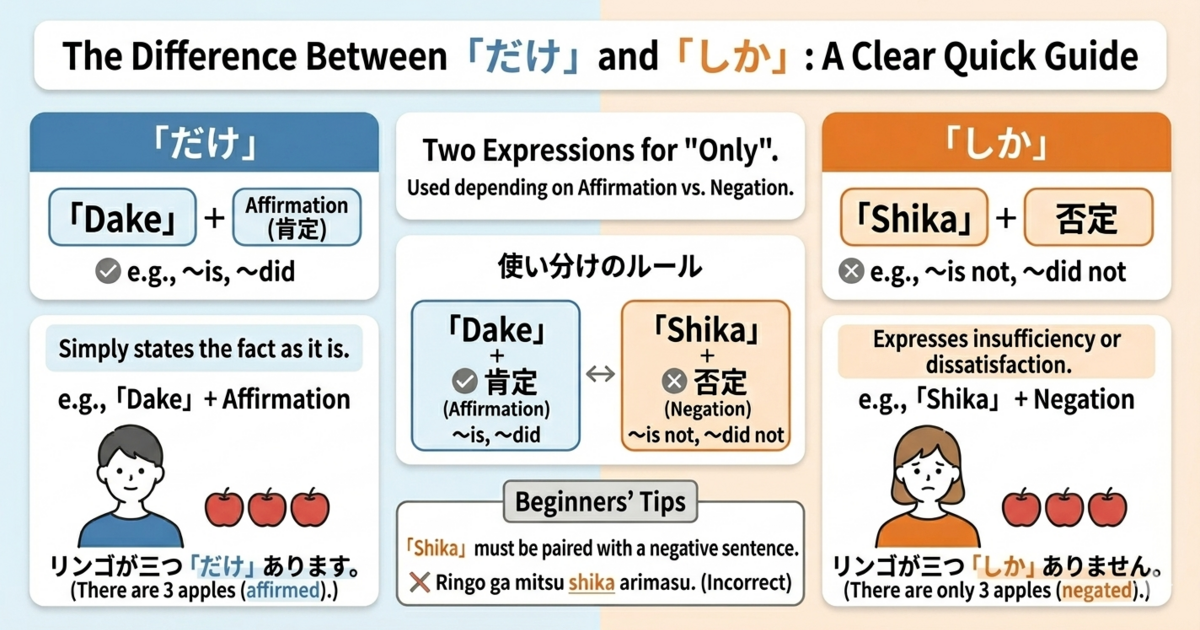
The most important grammatical rule is that "Shika" must always be followed by a negative verb (Nai / Masen).
100-en shika nai. (I only have 100 yen.)
3-nin shika konakatta. (Only 3 people came.)
Using "Shika" with a positive verb is a common mistake for learners.
Incorrect: 3-nin shika kimashita.
- The Nuance: Dissatisfaction vs. Neutrality
"Shika" carries a subjective feeling of "not enough" or "insufficient." It sounds like you are complaining or feeling regretful.
1-jikan shika benkyou dekinakatta. (I could only study for an hour—and I'm not happy about it.)
"Dake" is an objective limit. It simply marks the boundary without adding much emotion.
1-jikan dake benkyou shita. (I studied for just an hour—a simple statement of fact.)
100-en dake aru. (I have just 100 yen—depending on the context, this can even sound slightly positive, like "at least I have 100 yen.")
- "Dake" with Negative Verbs
You can use "Dake" with a negative verb, but be careful—it changes the meaning entirely.
3-nin shika konakatta: Only 3 people showed up (the rest didn't).
3-nin dake konakatta: Only 3 people didn't show up (meaning everyone else did!).
Mixing these up can lead to big mistakes in the JLPT Listening and Reading sections.
Summary: How to Decide
Is the verb negative? Do you feel it's "not enough"? -> Use "Shika."
Is the verb positive? Are you just stating a limit? -> Use "Dake."
At RJT, our grammar exercises help you build the reflexes to spot these patterns instantly. Try our free 100-question set and master the subtle nuances that separate N3/N2 students from native-level speakers.
Related grammar guide: JLPT Negative and Limitation Expressions
For a broader overview of limitation patterns, see the guide to confusing JLPT limitation expressions. Confusing JLPT Limitation Expressions
[▼ Try 100 Grammar Questions for Free]
https://rapid-jt.com/
%E3%80%8C%E5%A7%8B%E6%9C%AB%E3%81%A0%E3%80%8D%E3%81%A8%E3%81%AF%E3%81%A9%E3%81%86%E4%BD%BF%E3%81%86%EF%BC%9F%E6%82%AA%E3%81%84%E7%B5%90%E6%9E%9C%E3%82%92%E5%BC%B7%E3%81%8F%E5%8D%B0%E8%B1%A1%E3%81%A5%E3%81%91%E3%82%8B%E6%96%87%E5%9E%8B%E3%82%92%E7%90%86%E8%A7%A3%E3%81%99%E3%82%8B%EF%BC%88%E8%8B%B1%EF%BC%89.png)
%E3%80%8C%E3%81%BE%E3%81%84%E3%80%8D%E3%81%A8%E3%80%8C%E3%81%AA%E3%81%84%E3%81%A0%E3%82%8D%E3%81%86%E3%80%8D%E3%81%AE%E9%81%95%E3%81%84%E3%81%AF%EF%BC%9F%E5%8F%A4%E3%82%81%E3%81%AE%E5%90%A6%E5%AE%9A%E6%8E%A8%E9%87%8F%E3%81%8C%E5%87%BA%E3%81%9F%E3%81%A8%E3%81%8D%E3%81%AE%E5%AF%BE%E5%87%A6%E6%B3%95%EF%BC%88%E8%8B%B1%EF%BC%89.png)
%E3%80%8C%E3%81%AB%E3%81%97%E3%81%A6%E3%81%AF%E3%80%8D%E3%81%A8%E3%80%8C%E3%82%8F%E3%82%8A%E3%81%AB%E3%80%8D%E3%81%AE%E9%81%95%E3%81%84%E3%81%AF%EF%BC%9F%E5%9F%BA%E6%BA%96%E3%81%A8%E3%81%AE%E3%81%9A%E3%82%8C%E3%82%92%E8%A1%A8%E3%81%99N2%E6%96%87%E5%9E%8B%E3%82%92%E6%95%B4%E7%90%86%EF%BC%88%E8%8B%B1%EF%BC%89.png)
JLPT%E3%81%A7%E6%B7%B7%E4%B9%B1%E3%81%97%E3%82%84%E3%81%99%E3%81%84%E6%9D%A1%E4%BB%B6%E8%A1%A8%E7%8F%BE%E3%81%BE%E3%81%A8%E3%82%81%20%E3%83%BC%E3%80%8C%E3%81%A8%E3%80%8D%E3%80%8C%E3%81%B0%E3%80%8D%E3%80%8C%E3%81%9F%E3%82%89%E3%80%8D%E3%80%8C%E3%81%AA%E3%82%89%E3%80%8D%E3%81%AE%E9%81%95%E3%81%84%E3%82%92%E6%95%B4%E7%90%86%E3%81%99%E3%82%8B%E3%83%BC%EF%BC%88%E8%8B%B1%EF%BC%89.png)