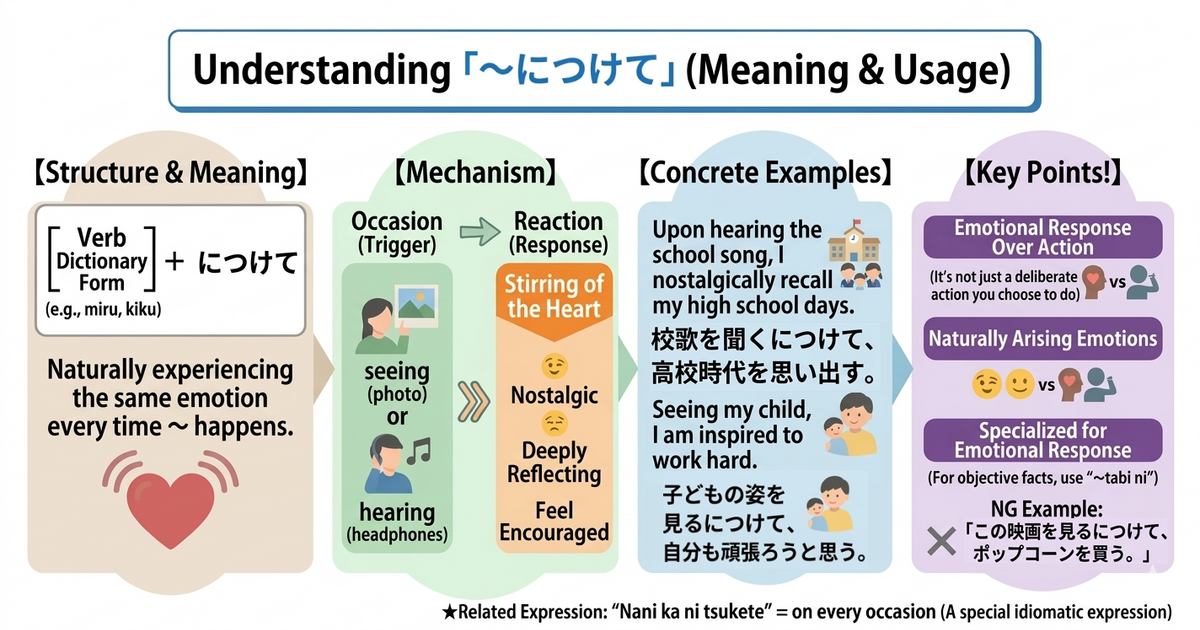
What does 「~につけて」 mean?
Every time you hear a certain song, your heart feels warm.
Every time you look at old photos, nostalgia comes back.
Every time you see someone working hard, you feel that you should try harder too.
In this way, there are moments when something becomes a trigger, and the same feeling comes up again and again.
The grammar pattern 「~につけて」 expresses this movement of the heart in a soft and impressive way.
「~につけて」 is used when seeing, hearing, remembering, or coming into contact with something causes the same emotion or thought to arise each time. It often appears in reading passages, essays, and natural conversations, especially when the speaker wants to express emotion deeply.
Meaning
「~につけて」 means:
- Whenever I do something, I feel the same way
- Every time something becomes a trigger, the same feeling arises
- Each time I come into contact with something, my heart naturally reacts
The important point is that this grammar pattern does not simply describe repeated actions. It describes the feeling or thought that comes up each time.
Formation
「~につけて」 is attached to the dictionary form of a verb.
For example, when it is attached to 「見る」, it becomes 「見るにつけて」, meaning “whenever I see it.” When it is attached to 「聞く」, it becomes 「聞くにつけて」, meaning “whenever I hear it.” You can also say 「思い出すにつけて」, meaning “whenever I remember it,” and 「知るにつけて」, meaning “whenever I learn about it.”
「につけて」 can also appear in the shorter form 「につけ」.
For example, 「聞くにつけ」 and 「思い出すにつけ」 are also possible.
「につけ」 and 「につけて」 are almost the same in meaning. For learners, it is easier to first remember 「につけて」.
Key points of this grammar pattern
1. It is usually followed by an emotional reaction
「~につけて」 is usually followed by a sentence that expresses a feeling, thought, or emotional reaction.
It often appears with expressions such as:
-
うれしくなる
to become happy -
悲しくなる
to become sad -
心配になる
to become worried -
胸が痛む
one’s heart aches -
反省する
to reflect on oneself -
ありがたく思う
to feel grateful -
勇気づけられる
to feel encouraged
In other words, the center of this grammar pattern is not the event itself, but the emotion that is born from that event each time.
2. It is not just a habit; the heart reacts
「~につけて」 does not simply mean that something happens repeatedly.
For example, it is not used for a simple repeated fact like “I watch the news every morning.”
Instead, it is used when the speaker’s feelings move each time, as in:
ニュースを見るにつけて、不安になる。
Whenever I watch the news, I feel anxious.
Because this pattern includes the sense of the heart reacting, it can make a sentence feel deeper and more expressive.
Example sentences
Example 1
この校歌を聞くにつけて、高校時代に夢中で練習した日々を思い出す。
Whenever I hear this school song, I remember the days when I practiced with all my heart in high school.
Example 2
被災地のニュースを見るにつけて、何気ない毎日のありがたさを感じる。
Whenever I see news about disaster-hit areas, I feel grateful for my ordinary everyday life.
Example 3
子どもたちのまっすぐな質問にふれるにつけて、自分ももっと素直に学ばなければと思う。
Whenever I encounter children’s honest questions, I feel that I too should learn more openly and sincerely.
Example 4
季節の変わり目の風を感じるにつけて、時間の流れの早さに驚かされる。
Whenever I feel the wind at the change of seasons, I am surprised by how quickly time passes.
Example 5
恩師のことばを思い出すにつけて、あのときの厳しさが本当は深い愛情だったのだとわかってくる。
Whenever I remember my teacher’s words, I come to understand that the strictness at that time was actually deep affection.
Difference between 「~につけて」 and 「~たびに」
「~たびに」 also means “whenever” or “every time.”
However, 「~たびに」 is used more broadly. It can be used not only for emotions but also for objective facts and repeated changes.
For example, these sentences are natural:
この店に来るたびに、新しい商品が増えている。
Every time I come to this store, there are more new products.
春になるたびに、花粉症がひどくなる。
Every time spring comes, my hay fever gets worse.
By contrast, 「~につけて」 is more suitable when the sentence focuses on feelings or emotional reactions.
Compare the following
「故郷の写真を見るたびに、懐かしくなる。」 is natural and broadly usable.
On the other hand, 「故郷の写真を見るにつけて、懐かしさがこみ上げてくる。」 expresses a deeper emotional movement, as if nostalgia rises up each time.
Both sentences are natural. However, the sentence with 「~につけて」 feels more reflective and emotional.
Difference between 「~を見ると」 and 「~につけて」
「~を見ると」 and 「~を聞くと」 can also express a trigger.
However, these expressions can be used even for a one-time reaction.
On the other hand, 「~につけて」 clearly includes the meaning of “every time” and “whenever it happens.”
Compare the following
「あの写真を見ると、悲しくなる。」 can describe even a one-time reaction.
On the other hand, 「あの写真を見るにつけて、胸が締めつけられる。」 suggests that the same feeling arises every time the speaker sees it.
The second sentence gives a stronger sense of repeated emotional depth.
Meaning of 「何かにつけて」
When learning 「~につけて」, it is also useful to learn the fixed expression 「何かにつけて」.
「何かにつけて」 means:
- whenever there is a chance
- at every opportunity
- on every occasion
This expression is idiomatic. Unlike the usual 「~につけて」, it does not always have to be followed by an emotional reaction.
Example sentences
父は何かにつけて、学生時代に旅した北海道の思い出を話す。
My father talks about his memories of traveling in Hokkaido during his student days whenever he gets the chance.
彼女は何かにつけて、体調管理の大切さをみんなに伝えている。
She tells everyone about the importance of taking care of their health at every opportunity.
部長は何かにつけて、基本に戻れと言う。
The department manager says “go back to the basics” at every opportunity.
「何かにつけて」 is a useful expression that is also relatively common in everyday conversation.
Important notes
1. The following sentence usually expresses a feeling, thought, or emotional reaction
「~につけて」 is most natural when the following part expresses an emotional reaction.
Unnatural example
この映画を見るにつけて、ポップコーンを買う。
Whenever I watch this movie, I buy popcorn.
This is unnatural because buying popcorn is an action, not an emotional reaction.
Natural example
この映画を見るにつけて、家族の大切さをあらためて感じる。
Whenever I watch this movie, I feel again how important family is.
Here, watching the movie becomes a trigger for an emotional reaction, so the sentence sounds natural.
2. It is not suitable for a one-time event
「~につけて」 includes the feeling of “each time” or “whenever.”
For that reason, it is not very suitable for an event that happens only once or a reaction that happens only once.
It is easier to use this grammar pattern naturally when you imagine a situation where the speaker repeatedly encounters something and feels the same way each time.
Common learner mistakes
Because 「~につけて」 is similar to 「~たびに」, learners may feel that they can replace one with the other in any sentence.
However, they are not exactly the same.
「~たびに」 is broadly usable. It can be used for emotions, facts, actions, and changes.
By contrast, 「~につけて」 focuses on emotional reactions. It is suitable for reflective or deeply felt expressions.
If learners can distinguish this difference, their writing and reading comprehension will become much more natural.
Also, 「何かにつけて」 is a slightly different idiomatic expression, so it is better to learn it separately from the regular grammar pattern 「~につけて」.
For a broader view of cause and reason expressions, see the guide to confusing JLPT reason expressions. Confusing JLPT Reason and Cause Expressions
For a broader view of limitation expressions, see the guide to confusing JLPT limitation expressions. Confusing JLPT Limitation Expressions
Summary
「~につけて」 is a grammar pattern used when something becomes a trigger and the same emotion or thought arises each time.
The key points are:
- Each time the speaker comes into contact with something, the same feeling arises
- The following sentence often expresses a feeling, thought, or emotional reaction
- Compared with 「~たびに」, it is more suitable for emotional and reflective expressions
- 「何かにつけて」 is an idiomatic expression meaning “at every opportunity”
Once you can use this pattern well, you will be able to express the feeling of “my heart moves every time this happens” much more naturally in Japanese.
Grammar can feel easy to understand when you only read the meaning.
However, it truly becomes your own expression only when you read example sentences and practice using it in questions.
At RJT, you can practice these subtle differences in grammar through JLPT N3 and N2 questions.
If you want to improve not only grammar but also vocabulary, reading, and listening, please take a look.
%E3%81%B0%E3%81%8B%E3%82%8A%E3%81%8BVS%E3%81%A0%E3%81%91%E3%81%A7%E3%81%AA%E3%81%8F%EF%BC%88%E8%8B%B1%EF%BC%89.png)
%20%E3%80%8C%E3%81%AF%E3%81%9A%E3%81%8C%E3%81%AA%E3%81%84%E3%80%8D%E3%81%A8%E3%80%8C%E3%82%8F%E3%81%91%E3%81%8C%E3%81%AA%E3%81%84%E3%80%8D%E3%81%AE%E9%81%95%E3%81%84%E3%81%AF%EF%BC%9F%E5%BC%B7%E3%81%84%E5%90%A6%E5%AE%9A%E3%82%92%E3%81%A9%E3%81%86%E4%BD%BF%E3%81%84%E5%88%86%E3%81%91%E3%82%8B%EF%BC%9F%EF%BC%88%E8%8B%B1%EF%BC%89.png)
%20%E3%80%8C%E3%82%88%E3%81%86%E3%81%AB%E3%81%AA%E3%82%8B%E3%80%8D%E3%81%A8%E3%80%8C%E3%82%88%E3%81%86%E3%81%AB%E3%81%99%E3%82%8B%E3%80%8D%E3%81%AE%E9%81%95%E3%81%84%E3%81%AF%EF%BC%9F%E8%87%AA%E7%84%B6%E3%81%AA%E5%A4%89%E5%8C%96%E3%81%A8%E5%8A%AA%E5%8A%9B%E3%81%AE%E5%B7%AE%E3%82%92%E7%90%86%E8%A7%A3%E3%81%99%E3%82%8B%EF%BC%88%E8%8B%B1%EF%BC%89.png)