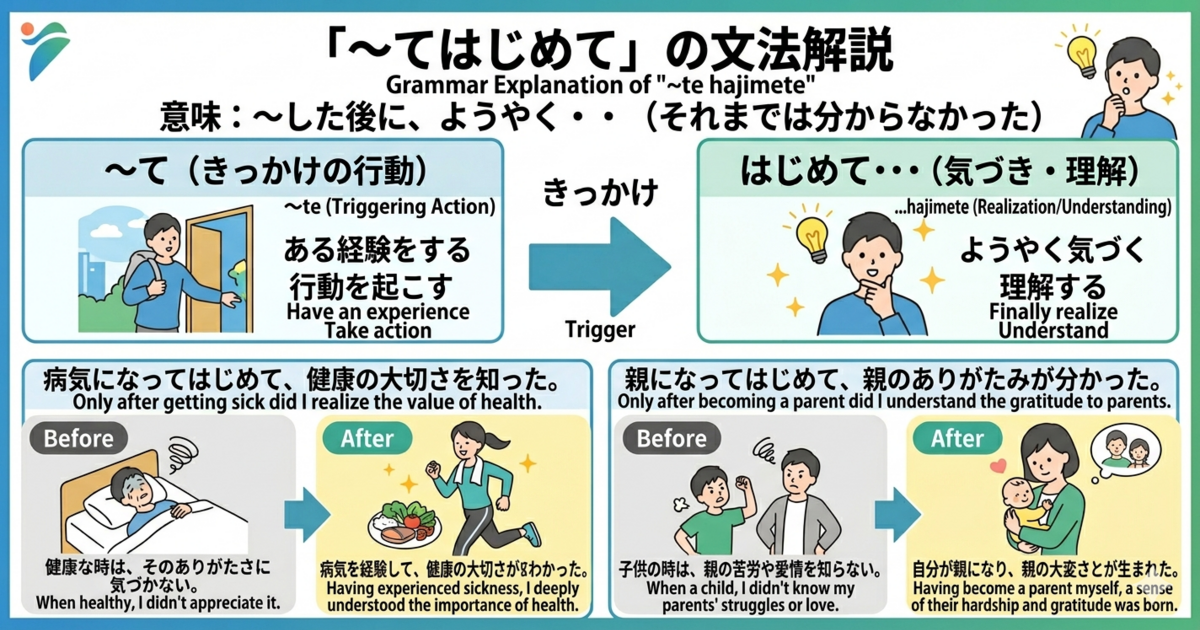
What does 「~てはじめて」 mean?
There are some things people cannot understand just by listening to an explanation.
Only after actually trying something, experiencing it, making mistakes, or standing in that situation do we finally begin to see what it really means.
The Japanese grammar pattern 「~てはじめて」 expresses this flow naturally:
“Only after doing something do you realize something for the first time.”
「~てはじめて」 is used when, after experiencing something, you notice something you did not know before, gain a new perspective, or finally understand something deeply.
It appears often in reading passages and conversation, so it is an important expression for JLPT learners to master.
Meaning
「~てはじめて」 expresses meanings such as:
- “Only after experiencing ~ do you understand”
- “Only after becoming ~ do you realize something new”
- “Only after doing ~ do you finally see something you could not see before”
The key point is that the first event becomes the trigger for a new realization, understanding, or change in the second part.
This pattern does not simply describe chronological order.
It means that because the first experience happened, the realization in the second part became possible.
That is the most important point of 「~てはじめて」.
Connection
Verb て-form + はじめて
Examples
-
住んではじめて
only after living there -
読んではじめて
only after reading it -
使ってはじめて
only after using it -
失敗してはじめて
only after failing
The form itself is simple, but the meaning is very clear.
First, there is an experience.
Then, for the first time, a new realization or understanding appears.
This is the basic structure.
Nuance of this grammar pattern
1. Your way of seeing things changes after experience
「~てはじめて」 does not simply mean “I understood later.”
It carries the feeling of:
“I understood because I actually tried it.”
“I realized it because I experienced that position myself.”
For example:
日本で一人暮らしをしてはじめて、家事を毎日続ける大変さがわかった。
Only after living alone in Japan did I understand how hard it is to keep doing housework every day.
In this sentence, the speaker is not talking about knowledge heard from someone else.
The sentence expresses a real feeling gained through personal experience.
2. The second part often contains a new discovery
After 「~てはじめて」, expressions that show a new realization or change often appear.
Common examples include:
-
気づく
to notice -
わかる
to understand -
実感する
to truly feel or realize -
思うようになる
to come to think -
見えてくる
to come into view, to become clear -
生きてくる
to become meaningful, to start to matter
In other words, the sentence needs the flow:
“After the first event, the second realization is newly born.”
For that reason, 「~てはじめて」 is not very suitable when you are only listing actions in order.
Unnatural example
朝ごはんを食べてはじめて、学校へ行った。
Only after eating breakfast, I went to school.
This sentence only describes the order of actions.
Because there is no new realization or discovery, 「~てはじめて」 does not fit very naturally here.
Example sentences
日本で一人暮らしをしてはじめて、家事を毎日続けることの大変さがわかった。
Only after living alone in Japan did I understand how hard it is to keep doing housework every day.
何度も声に出して練習してはじめて、日本語の発音のリズムが少しずつつかめるようになった。
Only after practicing aloud many times did I gradually begin to grasp the rhythm of Japanese pronunciation.
海外で働いてはじめて、日本の接客の細やかさをあらためて実感した。
Only after working overseas did I truly realize again how detailed Japanese customer service is.
大きな失敗をしてはじめて、準備の大切さが身にしみてわかった。
Only after making a serious mistake did I deeply understand the importance of preparation.
この本を最後まで読んではじめて、作者が本当に伝えたかったことが見えてきた。
Only after reading this book to the end did I begin to see what the author really wanted to say.
What all of these examples have in common is this:
Without the first experience, the realization in the second part would not have appeared.
If you keep this in mind, it becomes much easier to understand when to use 「~てはじめて」.
Difference between 「~てはじめて」 and 「~てから」
「~てから」 means “after doing ~.”
It mainly expresses time order: one thing happens, and then another thing happens.
On the other hand, 「~てはじめて」 is not only about order.
It means that the first experience becomes the trigger for a new understanding, realization, or discovery.
Compare the following sentences:
日本に来てから、日本語をもっと勉強するようになった。
After coming to Japan, I started studying Japanese more.
日本に来てはじめて、日本語が生活の中でどれほど必要か実感した。
Only after coming to Japan did I realize how necessary Japanese is in daily life.
The first sentence simply describes a change that happened after coming to Japan.
The second sentence means that the experience of coming to Japan made the speaker realize something new.
Difference between 「~てはじめて」 and 「~てみて」
「~てみて」 can also express “after trying something.”
However, 「~てはじめて」 gives a stronger feeling that the speaker gained a new and deeper understanding through experience.
Compare:
使ってみて、便利だと思った。
After trying it, I thought it was convenient.
実際に毎日使ってはじめて、このサービスの便利さが本当にわかった。
Only after actually using this service every day did I truly understand how convenient it is.
The second sentence gives a stronger impression that the speaker came to a deeper understanding through repeated or real experience.
Notes
1. The second part often contains a new realization or change
After 「~てはじめて」, expressions such as the following often appear:
-
わかる
to understand -
気づく
to notice -
実感する
to truly realize -
思うようになる
to come to think -
見えてくる
to become visible, to become clear
If the second part only describes the next action, the sentence can sound unnatural.
Unnatural example
駅に着いてはじめて、友だちに会った。
Only after arriving at the station, I met my friend.
This sentence is not completely impossible grammatically.
However, the feeling of “realizing something for the first time” or “something becoming possible because of that experience” is weak.
So it does not sound very typical of 「~てはじめて」.
2. The first experience must be the trigger
In this grammar pattern, the first part should not be just a simple background event.
It must be the trigger that creates the understanding or realization in the second part.
In other words, the sentence needs the relationship:
“Because the first thing happened, the understanding in the second part became possible.”
Common mistakes by learners
「~てはじめて」 looks similar to 「~てから」, so learners sometimes use it only to show time order.
However, the most important point of this pattern is not order.
The key is the new understanding that appears after experience.
If you only want to say “after that, I did something,” 「~てから」 is usually more natural.
When you want to say “only after experiencing it did I finally understand,” 「~てはじめて」 becomes useful.
Once you can distinguish this point, your Japanese writing and reading comprehension will become much more precise.
For a broader view of cause and reason expressions, see the guide to confusing JLPT reason expressions. Confusing JLPT Reason and Cause Expressions
For a broader view of limitation expressions, see the guide to confusing JLPT limitation expressions. Confusing JLPT Limitation Expressions
Summary
「~てはじめて」 is used when you realize something for the first time after an experience or after entering a certain state.
The key points are:
- The first experience becomes the trigger for a new understanding or change
- The second part often contains expressions such as 気づく, わかる, 実感する, 見えてくる
- The main meaning is not simple order, but “only after experiencing it”
This grammar pattern is simple to memorize.
But when you learn how to distinguish it from similar expressions, your Japanese expression becomes much richer.
Grammar can be easy to misunderstand if you only read explanations.
With RJT, you can practice grammar patterns like this through JLPT N3 and N2 questions and check whether you can actually use them correctly.
First, try the free questions and check your understanding.
If you want to improve not only grammar but also vocabulary, reading, and listening, please take a look at RJT.
%20%E3%80%8C%E3%82%88%E3%81%86%E3%81%AB%E3%81%AA%E3%82%8B%E3%80%8D%E3%81%A8%E3%80%8C%E3%82%88%E3%81%86%E3%81%AB%E3%81%99%E3%82%8B%E3%80%8D%E3%81%AE%E9%81%95%E3%81%84%E3%81%AF%EF%BC%9F%E8%87%AA%E7%84%B6%E3%81%AA%E5%A4%89%E5%8C%96%E3%81%A8%E5%8A%AA%E5%8A%9B%E3%81%AE%E5%B7%AE%E3%82%92%E7%90%86%E8%A7%A3%E3%81%99%E3%82%8B%EF%BC%88%E8%8B%B1%EF%BC%89.png)
%E3%81%B0%E3%81%8B%E3%82%8A%E3%81%8BVS%E3%81%A0%E3%81%91%E3%81%A7%E3%81%AA%E3%81%8F%EF%BC%88%E8%8B%B1%EF%BC%89.png)
%E3%80%8C%E6%9C%9F%E9%99%90%E3%82%92%E5%AE%88%E3%82%8B%E3%80%8D%E3%81%A8%E3%80%8C%E7%B7%A0%E3%82%81%E5%88%87%E3%82%8A%E3%81%AB%E9%96%93%E3%81%AB%E5%90%88%E3%81%86%E3%80%8D%E3%81%AE%E9%81%95%E3%81%84%EF%BC%88%E8%8B%B1%EF%BC%89.png)
%E3%80%8C%E4%BA%88%E5%AE%9A%E3%81%8C%E5%85%A5%E3%82%8B%E3%80%8D%E3%81%A8%E3%80%8C%E4%BA%88%E5%AE%9A%E3%82%92%E5%85%A5%E3%82%8C%E3%82%8B%E3%80%8D%E3%81%AE%E9%81%95%E3%81%84%EF%BC%88%E8%8B%B1%EF%BC%89.png)