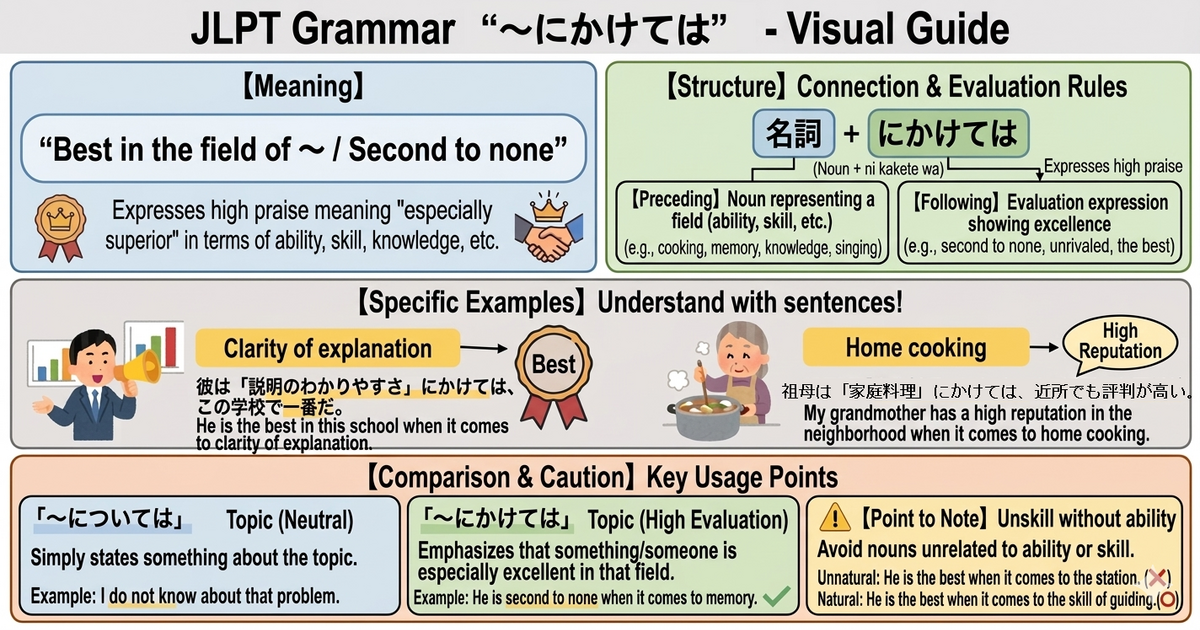
What is the JLPT grammar pattern 「〜にかけては」?
「〜にかけては」 is a Japanese grammar pattern used to mean:
“When it comes to that field, someone is very skilled.”
“In that area, no one can beat them.”
It is used when you want to emphasize that someone is especially good at a certain ability, skill, knowledge area, or field of experience.
For example, this expression is perfect when talking about someone who is especially good at sports, someone who explains things very clearly, or someone who is excellent at cooking.
Meaning
Simply put, 「〜にかけては」 means:
“When it comes to 〜, someone is excellent.”
“In the field of 〜, someone is the best.”
However, it does not simply mean “about 〜” in a neutral way.
It includes a strong positive evaluation, such as:
「その分野なら特にすごい」
“In that field, they are especially impressive.”
「そこでは群を抜いている」
“They stand out in that area.”
This positive evaluation is the key point of 「〜にかけては」.
Formation
名詞 + にかけては
noun + にかけては
The noun before 「にかけては」 is often a word related to ability, skill, knowledge, experience, or a field.
Examples of nouns used with 「にかけては」
料理にかけては
when it comes to cooking
記憶力にかけては
when it comes to memory
交渉術にかけては
when it comes to negotiation skills
日本史の知識にかけては
when it comes to knowledge of Japanese history
The sentence after 「〜にかけては」 often contains an expression that shows excellence.
Common expressions that follow
誰にも負けない
no one can beat them
右に出る者はいない
there is no one better
一番だ
is the best
抜群だ
is outstanding
Example sentences
彼は説明のわかりやすさにかけては、この学校で一番だ。
When it comes to explaining things clearly, he is the best in this school.
祖母は家庭料理にかけては、近所でも評判が高い。
When it comes to home cooking, my grandmother has a very good reputation in the neighborhood.
あの選手は試合の流れを読む力にかけては、誰にも負けない。
When it comes to reading the flow of a game, that player is second to none.
彼女は短い時間で要点をまとめることにかけては、本当に優れている。
When it comes to summarizing key points in a short time, she is truly excellent.
うちの先生は発音指導にかけては、右に出る者がいない。
When it comes to pronunciation instruction, no one is better than our teacher.
父は値段の安い材料でおいしい料理を作る工夫にかけては、かなりの腕前だ。
When it comes to creatively making delicious food with inexpensive ingredients, my father is quite skilled.
Difference between 「〜にかけては」 and 「〜については」
Learners often confuse 「〜にかけては」 with 「〜については」.
「〜については」 simply introduces a topic.
It does not necessarily include a positive evaluation.
Examples of 「〜については」
私はその問題については知りません。
I do not know about that problem.
彼の意見については後で聞きましょう。
Let’s ask about his opinion later.
On the other hand, 「〜にかけては」 means that someone is especially skilled or highly evaluated in that field.
Examples of 「〜にかけては」
彼は記憶力にかけては誰にも負けない。
When it comes to memory, no one can beat him.
彼女は接客にかけては非常に評判がいい。
When it comes to customer service, she has an excellent reputation.
In short:
「〜については」 introduces a topic.
「〜にかけては」 gives high praise in a person’s strong area.
This is the main difference.
Points to be careful about
「〜にかけては」 cannot be used with just any noun.
It is usually used with things where superiority or skill can be evaluated, such as ability, technique, knowledge, experience, or a specialized field.
For example, the following sentence is unnatural:
駅にかけては彼が一番だ。
When it comes to the station, he is the best.
This is unnatural because 「駅」, station, is not a field of ability or skill.
More natural sentences would be:
案内のうまさにかけては彼が一番だ。
When it comes to giving good directions, he is the best.
地図を読む力にかけては彼が一番だ。
When it comes to reading maps, he is the best.
Also, the sentence after 「〜にかけては」 usually expresses excellence.
For this reason, it may sound unnatural if it is followed by a negative statement or a simple neutral fact.
Common expressions used with 「〜にかけては」
「〜にかけては」 is often used together with expressions such as:
誰にも負けない
no one can beat them
右に出る者はいない
there is no one better
一番だ
is the best
抜群だ
is outstanding
評価が高い
is highly evaluated
If you remember these combinations, it will be easier to understand this grammar pattern in reading passages and conversations.
JLPT study point
For the JLPT, it is not enough to know only the meaning of this grammar pattern.
You should also pay attention to:
What kind of noun comes before 「にかけては」.
What kind of evaluation expression comes after it.
In particular, if you see a noun related to ability or skill before 「にかけては」, and a high evaluation after it, there is a good chance that this grammar pattern is being used.
For a broader view of similar inference and judgment expressions, see the guide to confusing JLPT inference expressions. JLPT Inference and Judgment Expressions
For a broader view of Japanese negative expressions, see the guide to confusing JLPT negative expressions. Confusing JLPT Negative Expressions
Summary
「〜にかけては」 means:
“In that field, someone is especially excellent.”
“When it comes to that, no one can beat them.”
It is often used when giving high praise for someone’s ability, skill, knowledge, or experience.
Unlike 「〜については」, it does not simply introduce a topic.
The key point is that it strongly expresses excellence.
If you remember this pattern together with short example sentences, it will become easier to use in JLPT questions and real reading passages.
If you want to learn JLPT grammar through practice questions, please take a look at RJT.
%20%E3%80%8C%E3%82%88%E3%81%86%E3%81%AB%E3%81%AA%E3%82%8B%E3%80%8D%E3%81%A8%E3%80%8C%E3%82%88%E3%81%86%E3%81%AB%E3%81%99%E3%82%8B%E3%80%8D%E3%81%AE%E9%81%95%E3%81%84%E3%81%AF%EF%BC%9F%E8%87%AA%E7%84%B6%E3%81%AA%E5%A4%89%E5%8C%96%E3%81%A8%E5%8A%AA%E5%8A%9B%E3%81%AE%E5%B7%AE%E3%82%92%E7%90%86%E8%A7%A3%E3%81%99%E3%82%8B%EF%BC%88%E8%8B%B1%EF%BC%89.png)
%E3%81%B0%E3%81%8B%E3%82%8A%E3%81%8BVS%E3%81%A0%E3%81%91%E3%81%A7%E3%81%AA%E3%81%8F%EF%BC%88%E8%8B%B1%EF%BC%89.png)
%E3%80%8C%E6%9C%9F%E9%99%90%E3%82%92%E5%AE%88%E3%82%8B%E3%80%8D%E3%81%A8%E3%80%8C%E7%B7%A0%E3%82%81%E5%88%87%E3%82%8A%E3%81%AB%E9%96%93%E3%81%AB%E5%90%88%E3%81%86%E3%80%8D%E3%81%AE%E9%81%95%E3%81%84%EF%BC%88%E8%8B%B1%EF%BC%89.png)
%E3%80%8C%E4%BA%88%E5%AE%9A%E3%81%8C%E5%85%A5%E3%82%8B%E3%80%8D%E3%81%A8%E3%80%8C%E4%BA%88%E5%AE%9A%E3%82%92%E5%85%A5%E3%82%8C%E3%82%8B%E3%80%8D%E3%81%AE%E9%81%95%E3%81%84%EF%BC%88%E8%8B%B1%EF%BC%89.png)