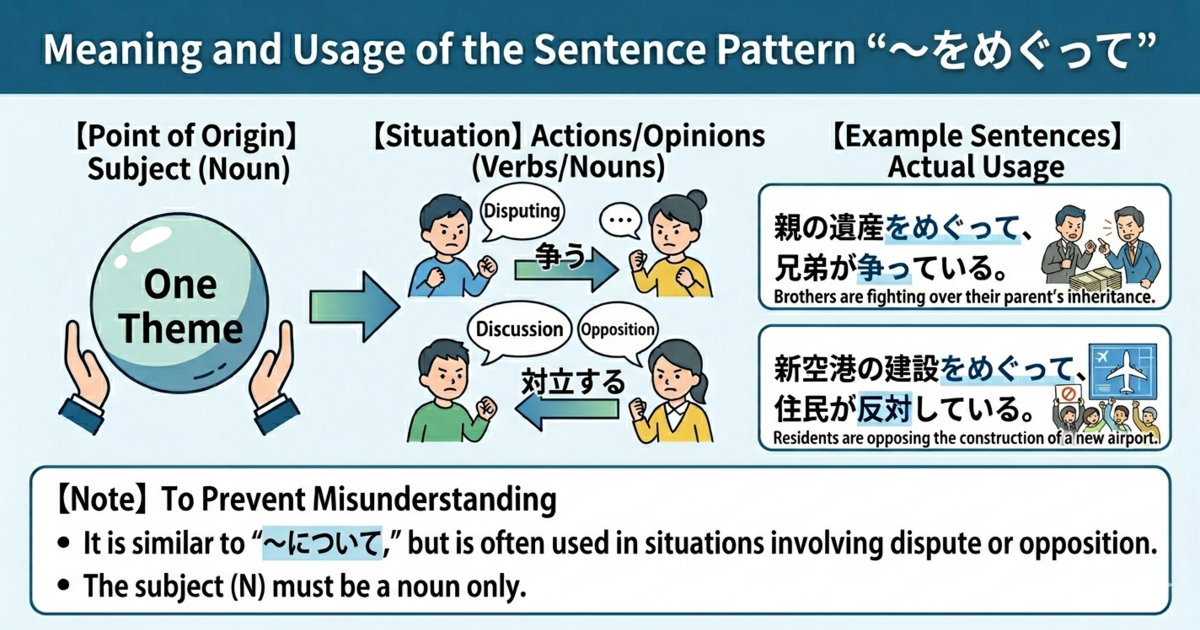
What does 「~をめぐって」 mean?
In news reports, meetings, and family discussions, one topic can move people, create debate, and sometimes even cause conflict.
For example, an inheritance issue.
For example, a tax system.
For example, someone’s reputation.
When multiple people discuss, argue, or spread rumors around one central topic, Japanese often uses the expression 「~をめぐって」.
「~をめぐって」 is a slightly formal expression. It is more common in news, explanatory writing, articles, reports, and formal discussions than in casual daily conversation. It often appears in JLPT N2, so learners should be able to understand it in both reading and listening.
Meaning
「~をめぐって」 means that discussion, conflict, confusion, rumors, or similar movement occurs around a certain topic, problem, person, or event.
The key image is this:
A certain topic is at the center, and several people or groups move around it in some way.
Compared with 「~について」, which simply means “about”, 「~をめぐって」 has more movement. It gives the feeling that people, opinions, interests, or emotions are involved around the topic.
Structure
名詞+をめぐって
Noun + をめぐって
名詞+をめぐる+名詞
Noun + をめぐる + noun
Examples
-
土地をめぐって争う
to fight over land -
環境問題をめぐって議論する
to discuss environmental issues -
彼の発言をめぐる批判
criticism surrounding his remarks -
新制度をめぐる混乱
confusion surrounding the new system
When is 「~をめぐって」 used?
「~をめぐって」 is often used in the following situations.
When opinions are opposed
相続、政治、制度、予算、方針などをめぐって対立する。
People or groups come into conflict over inheritance, politics, systems, budgets, policies, and so on.
When discussion spreads
ある発言や決定をめぐって議論が続く。
Discussion continues around a certain remark or decision.
When rumors or speculation spread
誰かの行動や発言をめぐってうわさが出る。
Rumors arise around someone’s actions or words.
When a socially important event attracts attention
事件、報道、ルール変更などをめぐって世間が騒ぐ。
Society reacts strongly to an incident, news report, rule change, and so on.
Example Sentences
駅前の再開発計画をめぐって、住民と市の意見が対立している。
Residents and the city are in conflict over the redevelopment plan in front of the station.
新しい入試制度をめぐって、教育現場ではさまざまな議論が起きている。
Various discussions are taking place in the education field over the new entrance examination system.
人気俳優の突然の引退発表をめぐって、ネット上では多くの憶測が飛び交った。
Many speculations spread online around the sudden retirement announcement of a popular actor.
祖父が残した家をめぐって、親族の話し合いは何度も延期された。
The family discussions over the house left by the grandfather were postponed many times.
会社の人事異動をめぐるうわさが、昼休みのあいだに一気に広まった。
Rumors surrounding the company’s personnel changes spread quickly during lunch break.
その判定をめぐって、試合後もファンの間で激しい議論が続いた。
Even after the game, heated debate continued among fans over that decision.
学校の校則見直しをめぐる議論は、保護者の間にも広がっている。
The debate over revising school rules has also spread among parents.
新しい観光開発をめぐって、地域の期待と不安がぶつかっている。
Local hopes and concerns are clashing over the new tourism development.
Difference between 「~をめぐって」 and 「~について」
This is a very important point.
「~について」 simply means “about” or “concerning” a certain topic.
On the other hand, 「~をめぐって」 means that discussion, conflict, rumors, or other movement is happening around that topic.
For example:
消費税について話し合う
to discuss consumption tax
This simply means that consumption tax is the topic of discussion.
消費税をめぐって議論が続いている
Debate over consumption tax is continuing.
This sentence gives the feeling that people with different positions are involved and that opinions are clashing.
In short, 「~をめぐって」 is not just a neutral “about”. It expresses movement, tension, or involvement around a topic.
Verbs often used with 「~をめぐって」
After 「~をめぐって」, verbs and expressions involving multiple people or groups often appear.
Common examples include:
-
争う
to fight, to dispute -
対立する
to oppose each other, to be in conflict -
議論する
to discuss, to debate -
話し合う
to talk things over -
批判する
to criticize -
うわさする
to gossip, to spread rumors -
混乱する
to become confused -
揺れる
to be shaken, to be unsettled -
注目が集まる
to attract attention
Because of this, 「~をめぐって」 does not usually fit quiet actions done by only one person.
Unnatural example
彼はその本をめぐって考えた。
He thought around that book.
This sounds unnatural because there is no sense of multiple people or social movement.
Natural example
その本の内容をめぐって、学生たちは活発に意見を交わした。
The students actively exchanged opinions about the content of the book.
Be careful with the form 「~をめぐる」
When modifying a noun, use the form 「~をめぐる+名詞」.
Examples
-
土地をめぐる争い
a dispute over land -
発言をめぐる批判
criticism surrounding a remark -
新ルールをめぐる議論
debate over the new rules -
相続をめぐる問題
problems surrounding inheritance
This form often appears in reading passages. Even if it appears in the middle of a sentence, learners should be able to recognize the meaning quickly.
Common mistakes learners make
1. Do not use it for every light topic
「~をめぐって」 is slightly formal and is not very suitable for casual small talk.
Unnatural example
昨日のランチをめぐって友達と話した。
I talked with my friend over yesterday’s lunch.
This sounds too serious for a light topic.
Natural example
新しい学食メニューをめぐって、学生の間で意見が分かれている。
Students are divided in their opinions over the new cafeteria menu.
2. It is hard to use for only one person’s action
「~をめぐって」 is basically used when multiple people, groups, or positions are involved.
3. It goes well with active situations
It is more natural with discussion, conflict, rumors, attention, confusion, and other situations where people or society are moving around a topic.
Key points for JLPT
For JLPT N2, it is not enough to only know the rough meaning.
Try to remember these three points:
- You can explain the difference between 「~をめぐって」 and 「~について」
- You know that it is often used with news and social issues
- You can understand the noun-modifying form 「~をめぐる+名詞」
In reading passages, 「~をめぐって」 often appears with themes such as politics, education, the environment, inheritance, and company policies. Since it is common in formal writing, it is important to read it smoothly without stopping.
Related grammar guide: JLPT Formal and Written Expressions
Summary
「~をめぐって」 is a grammar pattern used when discussion, conflict, rumors, confusion, or attention occurs around a certain topic or problem.
It is different from the simple 「~について」. The important point is that there is movement, involvement, or tension around the topic.
The structure is:
名詞+をめぐって
Noun + をめぐって
When modifying a noun, use:
名詞+をめぐる+名詞
Noun + をめぐる + noun
It is a slightly formal expression, but it is very common in news, reading passages, and explanatory writing. At the N2 level, learners should understand not only the meaning but also the situations where it sounds natural.
For learners who want to master N2 grammar through practice
Even if you feel you understand a grammar pattern after reading an explanation, you may still hesitate when solving actual questions.
Rapid Japanese Training helps you study N2 and N3 grammar, vocabulary, reading, and listening efficiently through practical exercises. With audio functions and dictionary functions, you can connect the grammar you understand directly to test-taking ability.
Try the free practice questions first and check your current level.
%20%E3%80%8C%E3%82%88%E3%81%86%E3%81%AB%E3%81%AA%E3%82%8B%E3%80%8D%E3%81%A8%E3%80%8C%E3%82%88%E3%81%86%E3%81%AB%E3%81%99%E3%82%8B%E3%80%8D%E3%81%AE%E9%81%95%E3%81%84%E3%81%AF%EF%BC%9F%E8%87%AA%E7%84%B6%E3%81%AA%E5%A4%89%E5%8C%96%E3%81%A8%E5%8A%AA%E5%8A%9B%E3%81%AE%E5%B7%AE%E3%82%92%E7%90%86%E8%A7%A3%E3%81%99%E3%82%8B%EF%BC%88%E8%8B%B1%EF%BC%89.png)
%E8%AA%AD%E8%A7%A3%E3%81%AE%E6%AD%A3%E8%A7%A3%E7%8E%87%E3%81%8C%E4%B8%8A%E3%81%8C%E3%82%89%E3%81%AA%E3%81%84%E4%BA%BA%E3%81%B8%E3%80%82%E6%9C%80%E5%88%9D%E3%81%AB%E8%A6%8B%E3%82%8B%E3%81%B9%E3%81%8D%E3%81%AF%E6%9C%AC%E6%96%87%E3%81%A7%E3%81%AF%E3%81%AA%E3%81%8F%E8%A8%AD%E5%95%8F%EF%BC%88%E8%8B%B1%EF%BC%89.png)
%20%E3%80%8C%E3%81%8C%E6%9C%80%E5%BE%8C%E3%80%8D%E3%81%A8%E3%80%8C%E3%81%9F%E3%81%A8%E3%81%9F%E3%82%93%E3%81%AB%E3%80%8D%E3%81%AE%E9%81%95%E3%81%84%E3%81%AF%EF%BC%9F%E4%B8%80%E5%BA%A6%E3%81%9D%E3%81%86%E3%81%AA%E3%82%8C%E3%81%B0%E6%AD%A2%E3%81%BE%E3%82%89%E3%81%AA%E3%81%84%E6%84%9F%E8%A6%9A%E3%81%A8%E3%81%AF%EF%BC%9F%EF%BC%88%E8%8B%B1%EF%BC%89.png)
%20%E3%80%8C%E3%81%9F%E3%81%A8%E3%81%93%E3%82%8D%E3%81%A7%E3%80%8D%E3%81%A8%E3%80%8C%E3%81%A6%E3%82%82%E3%80%8D%E3%81%AE%E9%81%95%E3%81%84%E3%81%AF%EF%BC%9F%E7%84%A1%E6%84%8F%E5%91%B3%E3%83%BB%E9%99%90%E7%95%8C%E3%82%92%E8%A1%A8%E3%81%99%E3%83%8B%E3%83%A5%E3%82%A2%E3%83%B3%E3%82%B9%E3%82%92%E6%95%B4%E7%90%86%EF%BC%88%E8%8B%B1%EF%BC%89.png)