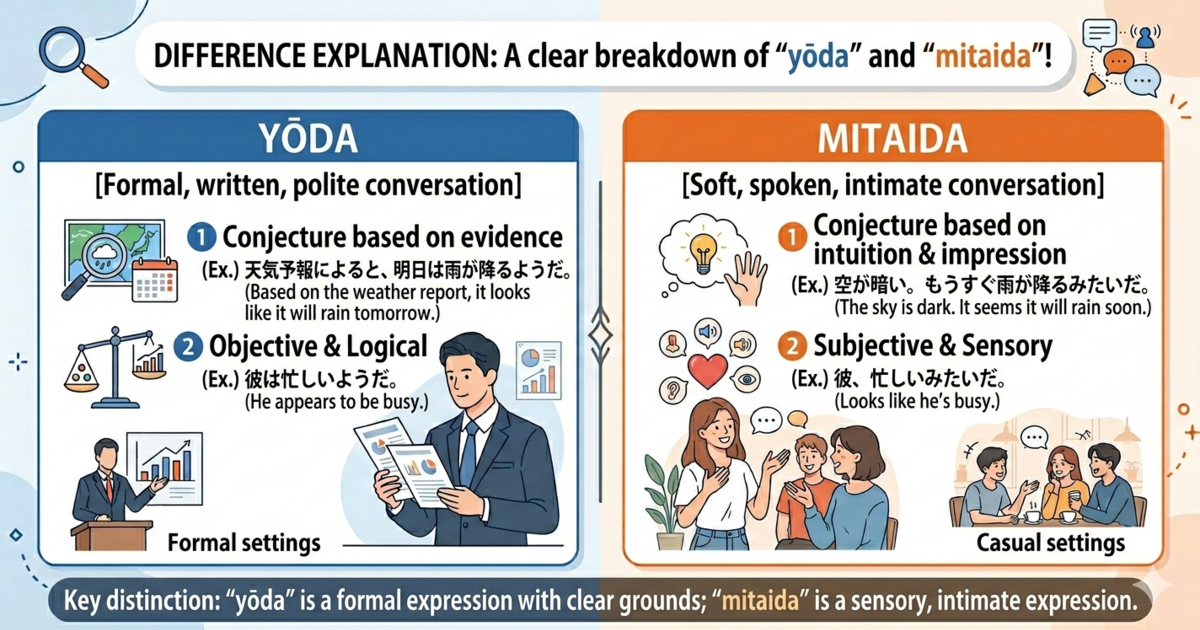
When studying Japanese, you may come across expressions that seem very close in meaning, such as:
雨が降るようです。
It seems that it will rain.
雨が降るみたいです。
It looks like it will rain.
Among these similar expressions, 「ようだ」 and 「みたいだ」 are especially easy for learners to confuse.
Both can express meanings like “it seems,” “it looks like,” “probably,” or “as if.” At first, they may look almost the same.
However, in real Japanese, there are differences in formality, suitable situations, and the impression they give to the listener or reader.
Once you understand this difference, your conversation will sound more natural, and you will be able to choose expressions more confidently in reading and writing.
First, the conclusion
「ようだ」 is a slightly formal expression.
「みたいだ」 is a casual spoken expression.
In other words, their core meaning is quite similar, but their style is different.
For example:
彼は忙しいようです。
It seems that he is busy.
彼、忙しいみたいです。
Looks like he’s busy.
Both sentences mean “he is probably busy.”
However, the first sentence sounds more explanatory and calm, while the second sounds more conversational and friendly.
「ようだ」 is a calm and polished expression
「ようだ」 is easy to use in writing, explanations, presentations, lessons, exams, and slightly formal conversations.
It gives the feeling that the speaker is observing something from a little distance and making a judgment based on that observation.
Example sentences
外は静かなようだ。
It seems quiet outside.
この薬はよく効くようです。
This medicine seems to work well.
彼は日本で長く働いていたようだ。
It seems that he worked in Japan for a long time.
In these examples, the speaker is making a somewhat objective judgment based on what they saw, heard, or learned.
「ようだ」 can also be used in conversation, but it has a more organized and polished sound.
For that reason, it fits reports, explanations, teacher talk, news-like sentences, and written Japanese.
「みたいだ」 sounds natural in conversation
On the other hand, 「みたいだ」 is very common in everyday conversation.
It has a lighter spoken feeling, like “it kind of seems that way” or “from what I can tell, it looks like that.”
Example sentences
あの人、少し疲れてるみたいだね。
That person looks a little tired, doesn’t he?
この店、人気みたいですよ。
This shop seems to be popular.
彼、もう帰ったみたい。
Looks like he already went home.
「みたいだ」 feels very natural when it appears in the flow of conversation.
Among friends, family members, or in casual chat, 「みたいだ」 often sounds much more natural than 「ようだ」.
Why do learners get confused?
Learners often get confused because both expressions can be used in similar roles.
1. Inference
This is when you see or hear something and say “probably.”
彼は来ないようだ。
It seems that he will not come.
彼は来ないみたいだ。
Looks like he won’t come.
2. Appearance
This is when something looks a certain way based on what you can see.
空が暗い。雨が降るようだ。
The sky is dark. It looks like it will rain.
空が暗い。雨が降るみたいだ。
The sky is dark. Looks like it will rain.
3. Comparison
This is when you compare something to something else.
雪のように白い。
White like snow.
子どもみたいに笑う。
Laugh like a child.
However, this does not mean that they are completely the same.
Depending on the type of sentence and the situation, 「ようだ」 may sound more stable, while 「みたいだ」 may sound more natural and conversational.
The most important point is the situation
The best way to use 「ようだ」 and 「みたいだ」 correctly is not to focus too much on tiny differences in meaning at first.
Instead, think about the situation.
Situations where 「ようだ」 fits well
When writing an article or essay
When explaining something in class
When you want to sound safe and natural in an exam
In slightly formal conversation
Situations where 「みたいだ」 fits well
Conversation with friends
Everyday small talk
When you want to sound soft and casual
When you want natural spoken Japanese
For example, if a teacher says something in class, this sounds natural:
この表現は感情の変化を表すようです。
This expression seems to show a change in emotion.
Among friends, this sounds more conversational:
この表現、気持ちの変化を表してるみたいだね。
This expression seems to show a change in feelings, doesn’t it?
Which one should you choose in exams?
In JLPT, writing, or formal exercises, if you are unsure, 「ようだ」 is often the safer choice.
The reason is that 「ようだ」 sounds more structured and is easy to use in written Japanese.
On the other hand, 「みたいだ」 is not wrong, but because it has a strong conversational feeling, it may sound too casual in some contexts.
Of course, in dialogue questions or casual exchanges, 「みたいだ」 may be more natural.
However, in explanatory writing or general composition, 「ようだ」 is usually less risky.
Subtle nuance difference
「ようだ」 has the feeling of judging from a little distance.
「みたいだ」 has the feeling of saying something softly based on the speaker’s immediate impression.
For example:
彼は怒っているようだ。
It seems that he is angry.
彼、怒ってるみたいだ。
Looks like he’s angry.
The first sentence sounds like a calm observation.
The second sentence sounds like a casual comment based on what the speaker sees or feels in the moment.
This difference may look small, but in real conversation, it can change the impression quite a lot.
Cases where they can be exchanged, and cases where they cannot
In many cases, 「ようだ」 and 「みたいだ」 can be exchanged.
However, when you exchange them, the tone of the sentence changes.
Examples where both are mostly possible
彼は風邪をひいたようだ。
It seems that he caught a cold.
彼は風邪をひいたみたいだ。
Looks like he caught a cold.
The meaning is almost the same.
The difference is formality and conversational tone.
Examples where 「ようだ」 fits better
調査の結果、この方法が最も効果的なようだ。
According to the investigation, this method seems to be the most effective.
この現象は温度の変化によって起こるようです。
This phenomenon seems to occur due to changes in temperature.
In explanatory sentences like these, 「みたいだ」 can sound too conversational.
Examples where 「みたいだ」 sounds more natural
あ、電車来たみたい。
Oh, looks like the train came.
彼、まだ寝てるみたいだよ。
Looks like he’s still sleeping.
In light everyday conversation like this, 「ようだ」 can sound a little too polished.
A common mistake learners make
A common mistake is thinking:
“They have similar meanings, so I can use either one anywhere.”
But in Japanese, it is not enough for a sentence to be grammatically correct.
It also has to fit the situation.
A sentence may be grammatically possible, but it may sound:
a little too formal
a little too casual
unsuitable for an explanation
unnatural in conversation
The difference between 「ようだ」 and 「みたいだ」 is exactly this kind of difference.
In one sentence
「ようだ」 is polished Japanese.
「みたいだ」 is conversational Japanese.
If you remember this image, it becomes much easier to use them correctly.
Rather than trying to make the meaning difference too large, it is more practical to ask:
Is this written language or spoken language?
Is the relationship with the listener close?
Is the situation formal or casual?
Do I want to sound polished or conversational?
Thinking this way will help you choose naturally.
Summary
「ようだ」 and 「みたいだ」 are similar expressions that can both express inference, appearance, and comparison.
However, they are not exactly the same.
「ようだ」 is slightly formal and fits explanations and writing.
「みたいだ」 is softer and fits conversation.
Just being aware of this difference can make your Japanese sound much more natural.
Once you move from “using correct grammar” to “choosing grammar that fits the situation,” your expressive ability will improve greatly.
When you are unsure whether to use 「ようだ」 or 「みたいだ」, first look at the situation, not just the meaning.
That one step is a shortcut to more natural Japanese.
If you want to learn subtle Japanese nuances through examples and practice questions, check actual usage with RJT.
Related grammar guide: JLPT Inference and Judgment Expressions
%E3%80%8C%E6%9C%9F%E9%99%90%E3%82%92%E5%AE%88%E3%82%8B%E3%80%8D%E3%81%A8%E3%80%8C%E7%B7%A0%E3%82%81%E5%88%87%E3%82%8A%E3%81%AB%E9%96%93%E3%81%AB%E5%90%88%E3%81%86%E3%80%8D%E3%81%AE%E9%81%95%E3%81%84%EF%BC%88%E8%8B%B1%EF%BC%89.png)
%E3%80%8C%E4%BA%88%E5%AE%9A%E3%81%8C%E5%85%A5%E3%82%8B%E3%80%8D%E3%81%A8%E3%80%8C%E4%BA%88%E5%AE%9A%E3%82%92%E5%85%A5%E3%82%8C%E3%82%8B%E3%80%8D%E3%81%AE%E9%81%95%E3%81%84%EF%BC%88%E8%8B%B1%EF%BC%89.png)
%E3%80%8C%E8%87%AA%E4%BF%A1%E3%81%8C%E3%81%82%E3%82%8B%E3%80%8D%E3%81%A8%E3%80%8C%E8%87%AA%E4%BF%A1%E3%82%92%E6%8C%81%E3%81%A4%E3%80%8D%E3%81%AE%E9%81%95%E3%81%84%EF%BC%88%E8%8B%B1%EF%BC%89.png)
%E3%80%8C%E5%BF%85%E8%A6%81%E3%81%8C%E3%81%82%E3%82%8B%E3%80%8D%E3%81%A8%E3%80%8C%E5%BF%85%E8%A6%81%E3%81%AB%E3%81%AA%E3%82%8B%E3%80%8D%E3%81%AE%E9%81%95%E3%81%84%EF%BC%88%E8%8B%B1%EF%BC%89.png)
%E3%80%8C%E5%8F%AF%E8%83%BD%E6%80%A7%E3%81%8C%E9%AB%98%E3%81%84%E3%80%8D%E3%81%A8%E3%80%8C%E5%8F%AF%E8%83%BD%E6%80%A7%E3%81%8C%E3%81%82%E3%82%8B%E3%80%8D%E3%81%AE%E9%81%95%E3%81%84%EF%BC%88%E8%8B%B1%EF%BC%89.png)
%E3%80%8C%E7%B5%90%E8%AB%96%E3%82%92%E5%87%BA%E3%81%99%E3%80%8D%E3%81%A8%E3%80%8C%E7%B5%90%E8%AB%96%E3%81%AB%E9%81%94%E3%81%99%E3%82%8B%E3%80%8D%E3%81%AE%E9%81%95%E3%81%84%EF%BC%88%E8%8B%B1%EF%BC%89.png)