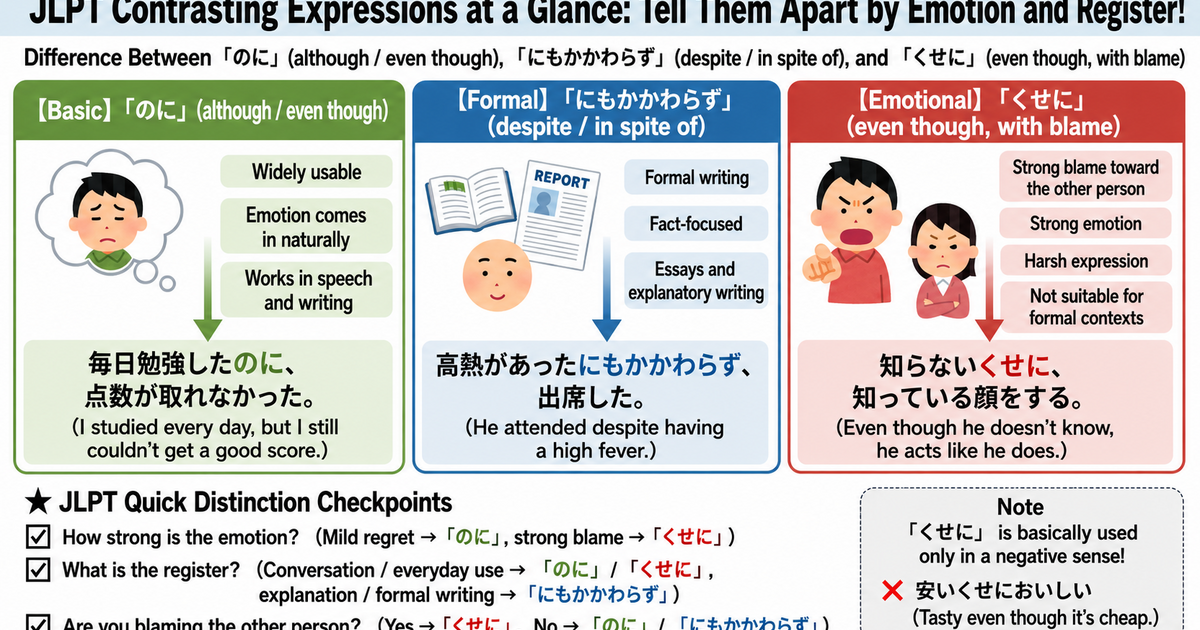
Have you ever felt unsure about contrast expressions in JLPT grammar or reading questions?
You understand that the first half and the second half of the sentence do not match as expected. But then you stop and wonder which expression to choose: 「のに」, 「にもかかわらず」, or 「くせに」. This is a common difficulty for many Japanese learners.
All three expressions mean that, considering the condition in the first part, the result in the second part is unexpected or unusual. That is why they look very similar at first. However, the emotion inside the sentence, the situation where the expression is used, and the level of formality are quite different.
In short, there are three points to notice.
- How much emotion is included?
- Is there a feeling of blaming someone?
- Is the expression more suitable for conversation or written language?
Once you understand these three points, it becomes much easier to organize these contrast expressions.
First, let’s roughly organize the differences
「のに」 is the most basic contrast expression. It is easy to use when the result is different from what was expected. It can naturally include emotion, and it is widely used in both conversation and writing.
「にもかかわらず」 is close in meaning to 「のに」, but it sounds more formal. It has a more objective tone and is often used to state facts calmly. It is suitable for explanatory writing, essays, reports, and formal texts.
「くせに」 strongly expresses dissatisfaction, criticism, or blame toward someone. It is used in conversation, but it can sound harsh. It is not a soft expression.
In simple terms, 「のに」 is the basic and widely usable form, 「にもかかわらず」 is formal and written, and 「くせに」 strongly carries a blaming tone.
Meaning and use of 「のに」
「のに」 is used when the result is different from what was expected. It is a very common and useful contrast expression in everyday conversation and writing.
For example:
雨なのに、人が多い。
Even though it is raining, there are many people.
毎日勉強したのに、思ったより点が取れなかった。
Even though I studied every day, I did not get as many points as I expected.
駅から近いのに、この店はあまり知られていない。
Even though this restaurant is close to the station, it is not very well known.
「のに」 naturally carries feelings such as surprise, disappointment, or mild dissatisfaction. However, it does not blame someone as strongly as 「くせに」.
Features of 「のに」
- It can be used in many situations.
- Emotion can naturally be included.
- It is easy to use in both conversation and writing.
- The blaming tone is not very strong.
For JLPT study, it is useful to think of 「のに」 as the basic contrast expression first.
Meaning and use of 「にもかかわらず」
「にもかかわらず」 is used to calmly and objectively say that, despite a certain condition, the result was different from what would normally be expected.
For example:
悪天候にもかかわらず、多くの観客が集まった。
Despite the bad weather, many spectators gathered.
十分な準備があったにもかかわらず、結果はよくなかった。
Despite sufficient preparation, the result was not good.
高熱があったにもかかわらず、彼は会議に出席した。
Despite having a high fever, he attended the meeting.
The meaning is close to 「のに」, but the tone is much more formal. This expression sounds natural in news articles, essays, reports, and explanatory writing.
Features of 「にもかかわらず」
- It is often used in formal writing.
- The focus is on contrast between facts, not emotion.
- It sounds objective and explanatory.
- It may sound somewhat stiff in casual conversation.
When this expression appears in a reading passage, pay attention not only to the meaning but also to the style of the text. It often appears in calm, explanatory writing.
Meaning and use of 「くせに」
「くせに」 has the strongest emotional tone among these three expressions. It clearly expresses dissatisfaction, anger, slight contempt, or blame.
For example:
何もしないくせに、文句ばかり言う。
Even though you do nothing, you only complain.
知らないくせに、知っているような顔をしている。
Even though he does not know, he acts as if he knows.
約束したくせに、来なかった。
Even though he promised, he did not come.
Here, the sentence is not just showing an unexpected result. The speaker’s feeling of “That is wrong” or “I am angry about that” comes forward strongly.
Features of 「くせに」
- It strongly blames someone.
- The speaker’s emotion is very clear.
- It is conversational and can sound harsh.
- It is not suitable for formal situations.
In natural Japanese, you need to be careful about who you use this expression with and in what situation. Even if the grammar is correct, it can damage the atmosphere of a relationship.
Comparing them with example sentences
Even when the basic content is the same, the impression changes a lot depending on the expression.
Example 1
彼は忙しいのに、毎日日本語を勉強している。
Even though he is busy, he studies Japanese every day.
彼は忙しいにもかかわらず、毎日日本語を勉強している。
Despite being busy, he studies Japanese every day.
彼は忙しいくせに、毎日日本語を勉強している。
Even though he is busy, he studies Japanese every day.
The first sentence sounds natural. It gives a feeling of surprise or admiration.
The second sentence sounds more formal, like a report or explanation.
The third sentence sounds unnatural in many situations. There is usually no reason to blame someone for studying Japanese even though they are busy.
Example 2
彼は約束したのに、来なかった。
Even though he promised, he did not come.
彼は約束したにもかかわらず、来なかった。
Despite having promised, he did not come.
彼は約束したくせに、来なかった。
Even though he promised, he did not come.
The first sentence expresses ordinary dissatisfaction.
The second sentence sounds formal and factual.
The third sentence strongly shows anger or blame.
As you can see, even when the meaning is close, the speaker’s attitude is very different.
Tips for recognizing them on the JLPT
In the exam, memorizing expressions mechanically is not enough. You need to look at the atmosphere of the whole sentence.
1. Look at the strength of the emotion
If the sentence expresses mild disappointment or surprise, 「のに」 is natural.
If there is clear criticism or blame, 「くせに」 becomes more likely.
2. Look at the level of formality
In conversation, 「のに」 and 「くせに」 are more likely to appear.
In explanatory writing, essays, or reports, 「にもかかわらず」 often fits better.
3. Check whether the speaker is blaming someone
If the sentence has the feeling of “Considering your position, that is wrong,” it is probably 「くせに」.
If the sentence simply contrasts two facts without blaming someone, 「のに」 or 「にもかかわらず」 is more likely.
Common mistakes learners make
The most common mistake is remembering 「くせに」 as just another contrast expression.
However, 「くせに」 contains emotion. If you ignore this emotion, it is easy to make unnatural sentences.
For example:
この店は安いくせに、おいしい。
Even though this restaurant is cheap, it is delicious.
この本は短いくせに、わかりやすい。
Even though this book is short, it is easy to understand.
Grammatically, these sentences can be formed. But normally, you are not blaming the restaurant or the book. So the sentences feel strange.
In these cases, 「のに」 is more natural.
この店は安いのに、おいしい。
Even though this restaurant is cheap, it is delicious.
この本は短いのに、とてもわかりやすい。
Even though this book is short, it is very easy to understand.
With contrast expressions, it is important to learn not only the meaning but also the speaker’s feeling.
Which one should you use in conversation?
In real conversation, 「のに」 is the safest and easiest expression to use.
「にもかかわらず」 is correct, but it may sound a little written or formal.
「くせに」 carries strong emotion, so depending on your relationship with the listener, it can sound quite harsh.
In Japanese, it is not enough for a sentence to be grammatically correct. You also need to think about how it sounds to the other person. If you pay attention to the emotional temperature of expressions while studying for the JLPT, your Japanese ability will grow more naturally.
For a broader view of similar inference and judgment expressions, see the guide to confusing JLPT inference expressions. JLPT Inference and Judgment Expressions
For a broader view of cause and reason expressions, see the guide to confusing JLPT reason expressions. Confusing JLPT Reason and Cause Expressions
Summary
「のに」, 「にもかかわらず」, and 「くせに」 all express contrast, but they are not the same.
「のに」 is the most widely usable basic contrast expression.
「にもかかわらず」 is formal, objective, and suitable for written language.
「くせに」 is emotional and strongly expresses dissatisfaction or blame.
Once you can see these differences, you will make fewer mistakes in reading and writing. Especially on the JLPT, the correct answer often depends not only on grammar itself, but also on whether you can understand the atmosphere of the sentence and the speaker’s attitude.
Simply memorizing similar expressions one by one can leave you confused in real exam situations. What matters is to compare similar expressions and understand their differences together.
Confusing grammar points such as contrast expressions become much easier when you organize and compare them. With RJT, you can efficiently learn these easily confused points together with clear example sentences.
%E3%80%8C%E6%9C%9F%E9%99%90%E3%82%92%E5%AE%88%E3%82%8B%E3%80%8D%E3%81%A8%E3%80%8C%E7%B7%A0%E3%82%81%E5%88%87%E3%82%8A%E3%81%AB%E9%96%93%E3%81%AB%E5%90%88%E3%81%86%E3%80%8D%E3%81%AE%E9%81%95%E3%81%84%EF%BC%88%E8%8B%B1%EF%BC%89.png)
%E3%80%8C%E4%BA%88%E5%AE%9A%E3%81%8C%E5%85%A5%E3%82%8B%E3%80%8D%E3%81%A8%E3%80%8C%E4%BA%88%E5%AE%9A%E3%82%92%E5%85%A5%E3%82%8C%E3%82%8B%E3%80%8D%E3%81%AE%E9%81%95%E3%81%84%EF%BC%88%E8%8B%B1%EF%BC%89.png)
%E3%80%8C%E8%87%AA%E4%BF%A1%E3%81%8C%E3%81%82%E3%82%8B%E3%80%8D%E3%81%A8%E3%80%8C%E8%87%AA%E4%BF%A1%E3%82%92%E6%8C%81%E3%81%A4%E3%80%8D%E3%81%AE%E9%81%95%E3%81%84%EF%BC%88%E8%8B%B1%EF%BC%89.png)
%E3%80%8C%E5%BF%85%E8%A6%81%E3%81%8C%E3%81%82%E3%82%8B%E3%80%8D%E3%81%A8%E3%80%8C%E5%BF%85%E8%A6%81%E3%81%AB%E3%81%AA%E3%82%8B%E3%80%8D%E3%81%AE%E9%81%95%E3%81%84%EF%BC%88%E8%8B%B1%EF%BC%89.png)
%E3%80%8C%E5%8F%AF%E8%83%BD%E6%80%A7%E3%81%8C%E9%AB%98%E3%81%84%E3%80%8D%E3%81%A8%E3%80%8C%E5%8F%AF%E8%83%BD%E6%80%A7%E3%81%8C%E3%81%82%E3%82%8B%E3%80%8D%E3%81%AE%E9%81%95%E3%81%84%EF%BC%88%E8%8B%B1%EF%BC%89.png)
%E3%80%8C%E7%B5%90%E8%AB%96%E3%82%92%E5%87%BA%E3%81%99%E3%80%8D%E3%81%A8%E3%80%8C%E7%B5%90%E8%AB%96%E3%81%AB%E9%81%94%E3%81%99%E3%82%8B%E3%80%8D%E3%81%AE%E9%81%95%E3%81%84%EF%BC%88%E8%8B%B1%EF%BC%89.png)