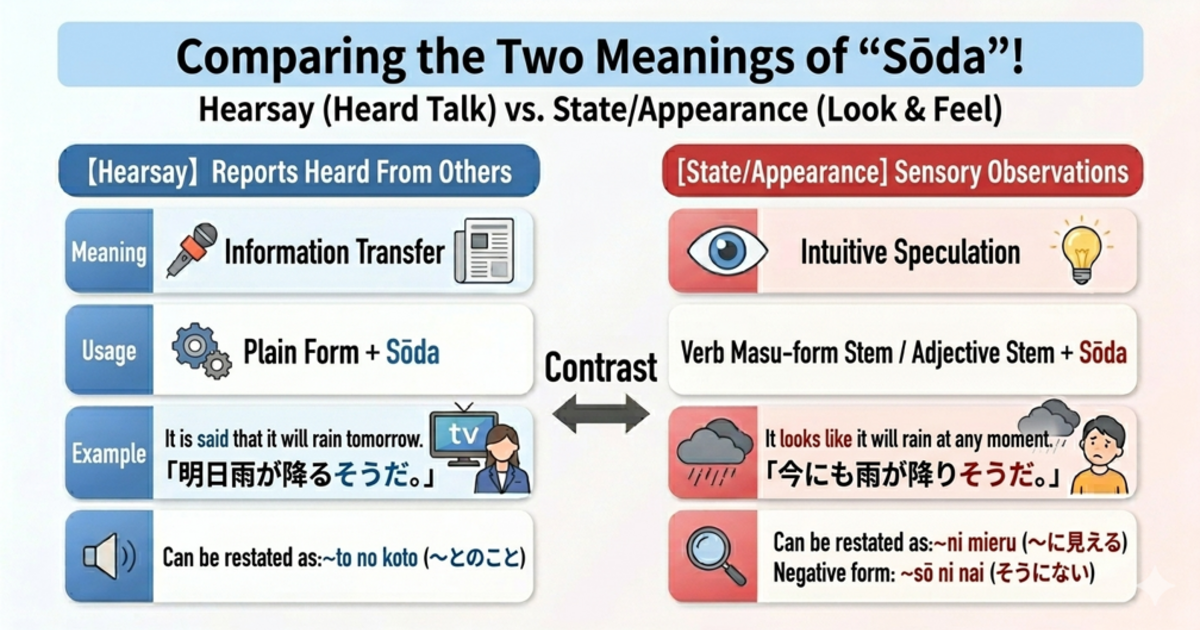
"Ame ga furi sou da" vs. "Ame ga furu sou da."
One means you're looking at the clouds; the other means you're watching the news. While they look similar, the grammar rules for connecting them are completely different. Let's break them down so you can spot the difference in 0.5 seconds.
- Hearsay (Denbun): "I heard that..."
Use this for information from a third party, the news, or rumors.
Rule: Plain Form + Sou da
(Nouns and Na-adjectives must keep the "da")
Example: Ashita wa ame da sou da. (I heard it will rain tomorrow.)
Example: Tanaka-san wa konai sou da. (I heard Tanaka isn't coming.)
The sentence stays in its complete form before adding "Sou da."
- Appearance (Youtai): "It looks like..."
Use this for your own visual judgment or intuition about what is about to happen.
Rule: Verb Masu-stem / Adjective Stem + Sou da
(Drop the "Masu," "i," or "na" before adding "Sou da")
Example: Ame ga furi sou da. (It looks like it's going to rain—based on the dark sky.)
Example: Kono ke-ki wa oishi sou da. (This cake looks delicious.)
[N3/N2 Alert] The Adjective Exceptions
This is the most common trap on the JLPT. When using "Appearance" (looks like...), these two adjectives change their form:
Ii (Good) + Sou da = Yosasou da
Nai (None/Not) + Sou da = Nasasou da
Saying "ii sou da" or "nai sou da" for appearance is incorrect. Memorizing these two will save you an easy point.
Summary: The Fast Check
Complete Sentence (Plain Form) + Sou da = Hearsay (I heard)
Shortened Stem (No Masu/i/na) + Sou da = Appearance (It looks like)
At Rapid Japanese (Beta), our drills are designed to help you recognize these "connection rules" reflexively. Practice with our free 100-question grammar set and build the intuition needed to ace the JLPT.
Related grammar guide: JLPT Inference and Judgment Expressions
For more reading connectors, see the guide to Japanese connection expressions that improve JLPT reading. Connection Expressions That Improve JLPT Reading
[▼ Take the 100-Question Challenge for Free]
https://rapid-jt.com/
JLPT%E3%81%A7%E6%B7%B7%E4%B9%B1%E3%81%97%E3%82%84%E3%81%99%E3%81%84%E6%9D%A1%E4%BB%B6%E8%A1%A8%E7%8F%BE%E3%81%BE%E3%81%A8%E3%82%81%20%E3%83%BC%E3%80%8C%E3%81%A8%E3%80%8D%E3%80%8C%E3%81%B0%E3%80%8D%E3%80%8C%E3%81%9F%E3%82%89%E3%80%8D%E3%80%8C%E3%81%AA%E3%82%89%E3%80%8D%E3%81%AE%E9%81%95%E3%81%84%E3%82%92%E6%95%B4%E7%90%86%E3%81%99%E3%82%8B%E3%83%BC%EF%BC%88%E8%8B%B1%EF%BC%89.png)
%E3%81%B0%E3%81%8B%E3%82%8A%E3%81%8BVS%E3%81%A0%E3%81%91%E3%81%A7%E3%81%AA%E3%81%8F%EF%BC%88%E8%8B%B1%EF%BC%89.png)
%E3%80%8C%E6%9C%9F%E9%99%90%E3%82%92%E5%AE%88%E3%82%8B%E3%80%8D%E3%81%A8%E3%80%8C%E7%B7%A0%E3%82%81%E5%88%87%E3%82%8A%E3%81%AB%E9%96%93%E3%81%AB%E5%90%88%E3%81%86%E3%80%8D%E3%81%AE%E9%81%95%E3%81%84%EF%BC%88%E8%8B%B1%EF%BC%89.png)
%E3%80%8C%E4%BA%88%E5%AE%9A%E3%81%8C%E5%85%A5%E3%82%8B%E3%80%8D%E3%81%A8%E3%80%8C%E4%BA%88%E5%AE%9A%E3%82%92%E5%85%A5%E3%82%8C%E3%82%8B%E3%80%8D%E3%81%AE%E9%81%95%E3%81%84%EF%BC%88%E8%8B%B1%EF%BC%89.png)