%E3%81%A6%E3%82%82VS%E3%81%A7%E3%82%82%EF%BC%88%E8%8B%B1%EF%BC%89small.png)
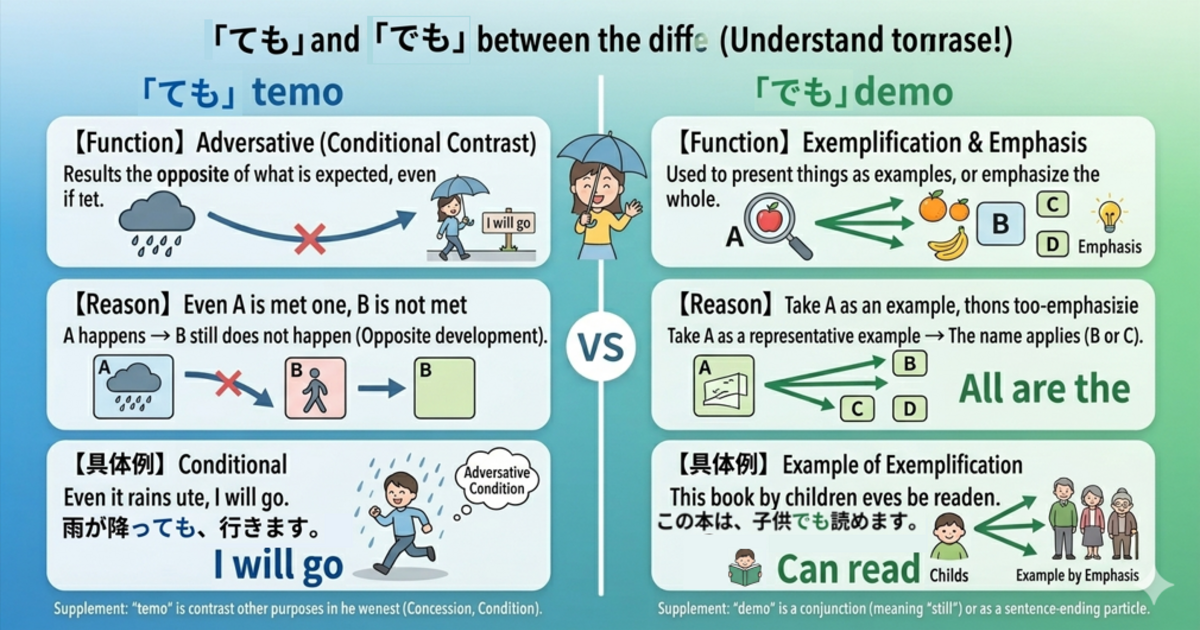
“Temo” and “demo” look similar, but they do not do the same job
When learning Japanese, you often run into expressions that look similar and sound similar, so it is easy to assume they work in almost the same way.
One pair that often confuses learners is “temo” and “demo.”
For example:
雨が降っても行きます。
Even if it rains, I will go.
コーヒーでも飲みませんか。
Would you like to have coffee or something?
At first glance, both seem to contain the same “demo” sound. But in fact, they play very different roles in a sentence.
If this difference stays vague, you may still understand the rough meaning when reading, but using them naturally in your own speech and writing becomes much harder.
So let’s sort it out clearly.
“Temo” shows that the result does not change, even if a condition exists
First, let’s look at “temo.”
“Temo” attaches to verbs, adjectives, and related forms, and shows that even if a certain condition exists, the result does not change.
For example:
雨が降っても行きます。
Even if it rains, I will go.
Here, “rain” is the condition, but the result, “I will go,” stays the same.
Here are more examples:
高くても買いたいです。
Even if it is expensive, I want to buy it.
忙しくても勉強します。
Even if I am busy, I study.
静かでも眠れません。
Even if it is quiet, I cannot sleep.
So “temo” expresses the idea of “even if” or “regardless of that condition.”
“Demo” often follows nouns and is used for suggestion or giving an example
Now let’s look at “demo.”
In many everyday conversations, “demo” works very differently from “temo.”
It often follows a noun and gives a soft example or suggestion.
For example:
お茶でも飲みましょう。
Let’s have tea or something.
映画でも見に行きませんか。
Why don’t we go see a movie or something?
週末でも大丈夫です。
The weekend would also be fine.
In these sentences, “demo” does not mean “even if.” Instead, it suggests one possible option in a light, flexible way.
It has a feeling close to “for example,” “or something,” or “how about.”
That already shows how different it is from “temo.”
The biggest difference is what they attach to
A very useful way to tell them apart is to look at what comes before them.
“Temo” usually attaches to a conjugated verb or adjective form.
For example:
行っても
even if someone goes
高くても
even if it is expensive
静かでも
even if it is quiet
By contrast, “demo” often attaches to a noun.
For example:
お茶でも
tea or something
映画でも
a movie or something
日曜日でも
Sunday would also be fine
So even at the grammar level, they begin from different places.
That alone makes them much easier to separate.
Think of “temo” as a concessive condition, and “demo” as example or suggestion
If you want a simple summary of the meaning difference, this helps:
“Temo” = concessive condition
Even if the condition exists, the result still holds.
“Demo” = example or suggestion
It names one possible thing in a soft, non-pushy way.
For example:
忙しくても行きます。
Even if I am busy, I will go.
Here, “busy” is an unfavorable condition, but the result does not change.
On the other hand:
時間があるなら、映画でも見ませんか。
If you have time, why don’t we watch a movie or something?
Here, “movie” is just one suggested option. It does not mean a movie is the only choice.
Once you feel this contrast, the sentence becomes much easier to understand.
Learners often get confused because the sounds are so close
One big reason “temo” and “demo” are confusing is simply that they sound very close.
And when learners see something like 「静かでも」, it may look as if the “demo” from suggestion has appeared again, which makes things feel even messier.
But what matters is not the surface sound. What matters is the structure of the sentence.
For example:
静かでも眠れません。
Even if it is quiet, I cannot sleep.
Here, 「でも」 comes from the na-adjective 「静かだ」 and functions with the meaning of “even if it is quiet.” So this belongs with the concessive “temo” group, not the example-or-suggestion “demo.”
By contrast:
静かなカフェでも行きませんか。
Why don’t we go to a quiet café or something?
Here, 「でも」 follows the noun 「カフェ」 and gives a light suggestion.
So even when the sound is identical, the position and role in the sentence are what matter most.
Comparing examples makes the difference much clearer
Let’s compare a few sentences.
雨が降っても、試合はあります。
Even if it rains, the game will take place.
Here, “rain” is a condition, but the event still happens.
Now look at this:
雨の日でも、この店は混んでいます。
Even on rainy days, this shop is crowded.
This one needs a little more attention. Here, 「でも」 follows the noun phrase 「雨の日」, but the meaning is close to “even on rainy days,” so it also carries a concessive feeling.
This is one reason Japanese can feel tricky: expressions may look similar on the surface, but their explanation depends on what kind of word they are built from.
That is why it helps so much to ask:
Is this attached to a verb or adjective form?
Or is it attached to a noun?
In conversation, the suggestion-type “demo” is especially useful
In real conversation, “demo” is extremely handy.
It is perfect when you want to sound softer, less direct, and more natural.
For example:
少し休みでも取りましょう。
Let’s take a little break or something.
帰りにコンビニでも寄りますか。
Shall we stop by a convenience store or something on the way back?
時間があるし、散歩でもしませんか。
We have some time, so how about going for a walk or something?
These expressions leave room for the other person. They do not sound forceful.
By contrast, “temo” is more often used when explaining conditions, personal determination, or situations.
疲れていてもやります。
Even if I am tired, I will do it.
難しくても挑戦したいです。
Even if it is difficult, I want to try.
少し遅れても大丈夫です。
It is okay even if you are a little late.
These are not suggestions. They describe a condition and what still remains true.
On tests, looking at the second half of the sentence helps a lot
If you are unsure on a grammar question, do not look only at the beginning of the sentence. Look at what comes after.
If the sentence says that a decision, result, or judgment still holds despite the earlier condition, then “temo” is a strong candidate.
If the sentence gives a light invitation or suggestion, then “demo” is often the better answer.
For example:
忙しくても、毎日少しずつ勉強したほうがいいです。
Even if you are busy, it is better to study a little every day.
コーヒーでも飲みながら話しましょう。
Let’s talk over coffee or something.
These sentences move in completely different directions.
The first is about a result that still stands despite a condition.
The second is about gently suggesting one possible option.
That perspective can make JLPT-style questions much easier.
Conclusion
“Temo” expresses a concessive condition: even if that condition exists, the result does not change.
“Demo” often follows nouns and expresses things like example, option, or soft suggestion.
Because they look and sound similar, it is important not to treat them as “basically the same.” Instead, pay attention to what they attach to and what role they play in the sentence.
Japanese gets stronger step by step when you truly master these small but important differences.
If you want to organize grammar points like “temo” and “demo” more clearly through real practice, try learning with RJT. Through vocabulary, grammar, reading, and listening exercises, you can steadily build natural, usable Japanese.
https://rapid-jt.com/
For a broader view of similar inference and judgment expressions, see the guide to confusing JLPT inference expressions. JLPT Inference and Judgment Expressions
For a broader view of cause and reason expressions, see the guide to confusing JLPT reason expressions. Confusing JLPT Reason and Cause Expressions
%E3%80%8C%E6%9C%9F%E9%99%90%E3%82%92%E5%AE%88%E3%82%8B%E3%80%8D%E3%81%A8%E3%80%8C%E7%B7%A0%E3%82%81%E5%88%87%E3%82%8A%E3%81%AB%E9%96%93%E3%81%AB%E5%90%88%E3%81%86%E3%80%8D%E3%81%AE%E9%81%95%E3%81%84%EF%BC%88%E8%8B%B1%EF%BC%89.png)
%E3%80%8C%E4%BA%88%E5%AE%9A%E3%81%8C%E5%85%A5%E3%82%8B%E3%80%8D%E3%81%A8%E3%80%8C%E4%BA%88%E5%AE%9A%E3%82%92%E5%85%A5%E3%82%8C%E3%82%8B%E3%80%8D%E3%81%AE%E9%81%95%E3%81%84%EF%BC%88%E8%8B%B1%EF%BC%89.png)
%E3%80%8C%E8%87%AA%E4%BF%A1%E3%81%8C%E3%81%82%E3%82%8B%E3%80%8D%E3%81%A8%E3%80%8C%E8%87%AA%E4%BF%A1%E3%82%92%E6%8C%81%E3%81%A4%E3%80%8D%E3%81%AE%E9%81%95%E3%81%84%EF%BC%88%E8%8B%B1%EF%BC%89.png)
%E3%80%8C%E5%BF%85%E8%A6%81%E3%81%8C%E3%81%82%E3%82%8B%E3%80%8D%E3%81%A8%E3%80%8C%E5%BF%85%E8%A6%81%E3%81%AB%E3%81%AA%E3%82%8B%E3%80%8D%E3%81%AE%E9%81%95%E3%81%84%EF%BC%88%E8%8B%B1%EF%BC%89.png)
%E3%80%8C%E5%8F%AF%E8%83%BD%E6%80%A7%E3%81%8C%E9%AB%98%E3%81%84%E3%80%8D%E3%81%A8%E3%80%8C%E5%8F%AF%E8%83%BD%E6%80%A7%E3%81%8C%E3%81%82%E3%82%8B%E3%80%8D%E3%81%AE%E9%81%95%E3%81%84%EF%BC%88%E8%8B%B1%EF%BC%89.png)
%E3%80%8C%E7%B5%90%E8%AB%96%E3%82%92%E5%87%BA%E3%81%99%E3%80%8D%E3%81%A8%E3%80%8C%E7%B5%90%E8%AB%96%E3%81%AB%E9%81%94%E3%81%99%E3%82%8B%E3%80%8D%E3%81%AE%E9%81%95%E3%81%84%EF%BC%88%E8%8B%B1%EF%BC%89.png)