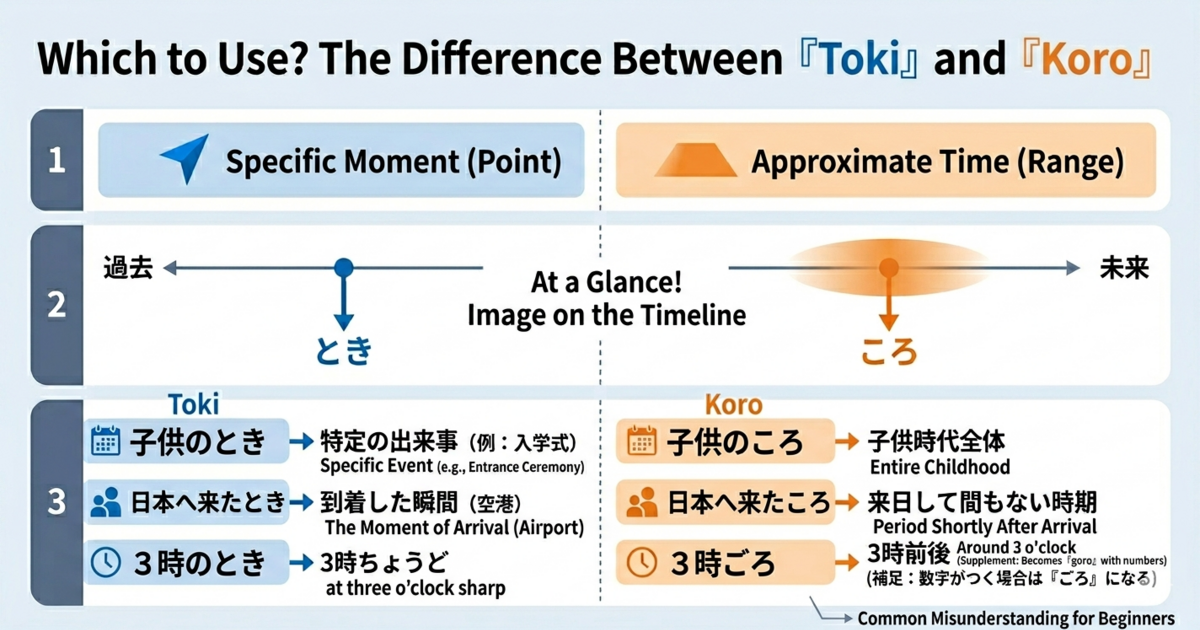
Both "Toki" and "Koro" refer to time, but they paint very different pictures in the mind of a native speaker. The secret to choosing correctly is simple: is it a "Point" or a "Range"?
- Toki: A Precise Point in Time
"Toki" cuts out a specific moment, like pointing at a calendar or a clock.
Nihon ni kita toki... (When I came to Japan...) -> The specific event of arrival.
Neru toki... (When I sleep...) -> The exact timing of going to bed.
Use "Toki" when you are talking about a specific action or a factual occurrence.
- Koro: An Approximate Range or Era
"Koro" refers to a general timeframe, a vague period, or "around" a certain time. It often carries a nostalgic tone when discussing the past.
Kodomo no koro... (In my childhood days...) -> Not a single moment, but a period of years.
San-ji goro... (Around 3 o'clock...) -> Not exactly 3:00, but the window surrounding it.
Note: When attached to a specific clock time, it changes to "Goro."
Subtle Shifts in Meaning
Notice how the "vibe" changes based on your choice:
Daigakusei no toki: A factual statement. "When I was a university student (the period)."
Daigakusei no koro: A nostalgic focus. "Back in my university days (the atmosphere of that era)."
If you want to say you felt nervous at the exact start of an exam, "Toki" is better. Using "Koro" would make it sound like you were nervous vaguely around that whole afternoon.
Summary: The Golden Rule
Ask yourself one question: Is this a "Single Point" or "Approximately"?
Single Point: Toki
Approximately: Koro
At RJT, we provide practical grammar exercises that help you distinguish these tricky nuances instantly. Test your intuition with our free 100-question set and stop second-guessing yourself on exam day.
For a broader view of cause and reason expressions, see the guide to confusing JLPT reason expressions. Confusing JLPT Reason and Cause Expressions
[▼ Try 100 Grammar Questions for Free]
https://rapid-jt.com/
%E3%80%8C%E5%A7%8B%E6%9C%AB%E3%81%A0%E3%80%8D%E3%81%A8%E3%81%AF%E3%81%A9%E3%81%86%E4%BD%BF%E3%81%86%EF%BC%9F%E6%82%AA%E3%81%84%E7%B5%90%E6%9E%9C%E3%82%92%E5%BC%B7%E3%81%8F%E5%8D%B0%E8%B1%A1%E3%81%A5%E3%81%91%E3%82%8B%E6%96%87%E5%9E%8B%E3%82%92%E7%90%86%E8%A7%A3%E3%81%99%E3%82%8B%EF%BC%88%E8%8B%B1%EF%BC%89.png)
%E3%80%8C%E3%81%BE%E3%81%84%E3%80%8D%E3%81%A8%E3%80%8C%E3%81%AA%E3%81%84%E3%81%A0%E3%82%8D%E3%81%86%E3%80%8D%E3%81%AE%E9%81%95%E3%81%84%E3%81%AF%EF%BC%9F%E5%8F%A4%E3%82%81%E3%81%AE%E5%90%A6%E5%AE%9A%E6%8E%A8%E9%87%8F%E3%81%8C%E5%87%BA%E3%81%9F%E3%81%A8%E3%81%8D%E3%81%AE%E5%AF%BE%E5%87%A6%E6%B3%95%EF%BC%88%E8%8B%B1%EF%BC%89.png)
%E3%80%8C%E3%81%AB%E3%81%97%E3%81%A6%E3%81%AF%E3%80%8D%E3%81%A8%E3%80%8C%E3%82%8F%E3%82%8A%E3%81%AB%E3%80%8D%E3%81%AE%E9%81%95%E3%81%84%E3%81%AF%EF%BC%9F%E5%9F%BA%E6%BA%96%E3%81%A8%E3%81%AE%E3%81%9A%E3%82%8C%E3%82%92%E8%A1%A8%E3%81%99N2%E6%96%87%E5%9E%8B%E3%82%92%E6%95%B4%E7%90%86%EF%BC%88%E8%8B%B1%EF%BC%89.png)
JLPT%E3%81%A7%E6%B7%B7%E4%B9%B1%E3%81%97%E3%82%84%E3%81%99%E3%81%84%E6%9D%A1%E4%BB%B6%E8%A1%A8%E7%8F%BE%E3%81%BE%E3%81%A8%E3%82%81%20%E3%83%BC%E3%80%8C%E3%81%A8%E3%80%8D%E3%80%8C%E3%81%B0%E3%80%8D%E3%80%8C%E3%81%9F%E3%82%89%E3%80%8D%E3%80%8C%E3%81%AA%E3%82%89%E3%80%8D%E3%81%AE%E9%81%95%E3%81%84%E3%82%92%E6%95%B4%E7%90%86%E3%81%99%E3%82%8B%E3%83%BC%EF%BC%88%E8%8B%B1%EF%BC%89.png)