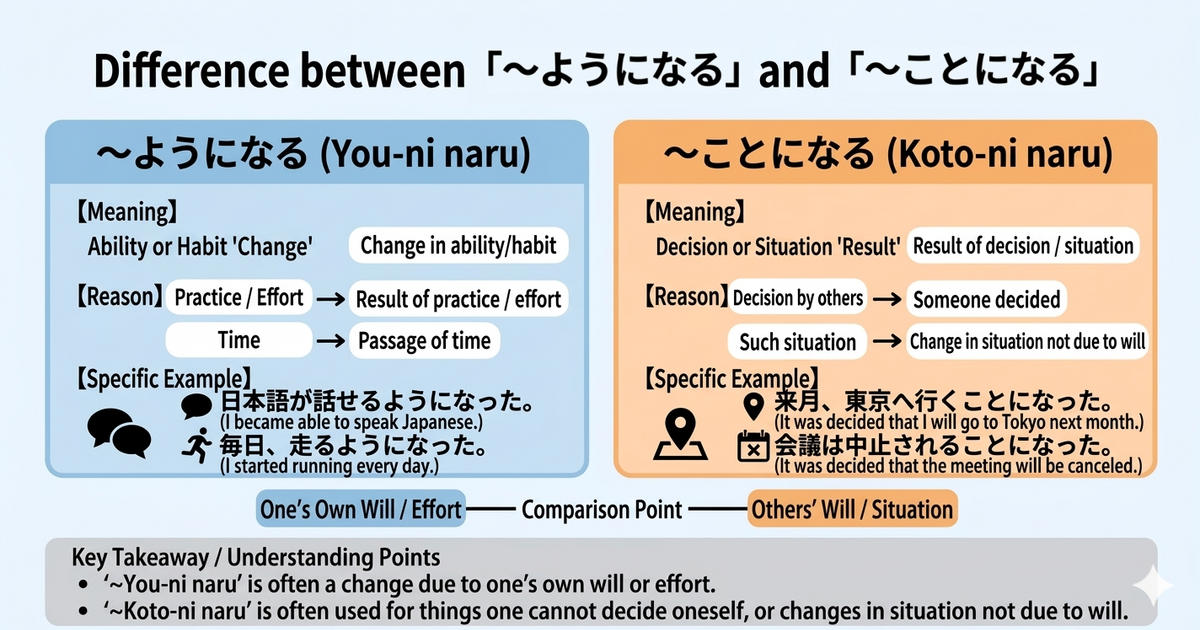
When studying Japanese, you sometimes meet expressions that look similar in form but point in completely different directions in meaning.
One common pair is 「ようになる」 and 「ことになる」.
Both often appear at the end of a sentence, and both can give the feeling that “something becomes that way.”
However, the point they focus on is different.
「ようになる」 focuses on change.
「ことになる」 focuses on decision, arrangement, or how something comes to be decided.
Once you understand this difference, both conversation and reading become much easier.
This is also an important point often tested in the JLPT, so let’s organize it clearly here.
What Does 「ようになる」 Mean?
「ようになる」 is used when something that was not possible becomes possible, when someone starts doing something they did not do before, or when a change becomes visible.
In other words, it expresses a change in a person, ability, habit, or situation.
Example Sentences
-
日本語のニュースが少しずつ聞き取れるようになりました。
I have gradually become able to understand Japanese news. -
野菜を毎日食べるようになりました。
I have started eating vegetables every day. -
このアプリを使ってから、勉強の習慣が続くようになりました。
Since I started using this app, I have become able to keep up my study habit.
In these sentences, the present is different from the past.
Before, the speaker could not do it.
Before, the situation was not that way.
But now, it has changed.
The expression that shows this change is 「ようになる」.
There are two especially common patterns.
Change in Ability
-
話せるようになる
to become able to speak -
読めるようになる
to become able to read -
わかるようになる
to become able to understand
Change in Habit or Behavior
-
早く寝るようになる
to start going to bed early -
運動するようになる
to start exercising -
日本語でメモを取るようになる
to start taking notes in Japanese
In this way, 「ようになる」 is used when you want to say what has changed compared with before.
What Does 「ことになる」 Mean?
On the other hand, 「ことになる」 is used to express something that has been decided by someone, something that has been arranged because of the surrounding situation, or something that has become a rule or schedule.
Rather than focusing on an internal change, it focuses on an external decision, arrangement, or result.
Example Sentences
-
来月から大阪支社で働くことになりました。
It has been decided that I will work at the Osaka branch from next month. -
会議は午後三時から始まることになっています。
The meeting is scheduled to start at 3 p.m. -
今年から授業では辞書を使わないことになりました。
It has been decided that dictionaries will not be used in class from this year.
These sentences are not describing a change in the speaker’s feelings or ability.
They describe something decided by a company order, schedule, rule, or discussion.
In other words, 「ことになる」 expresses a decision, rule, arrangement, or result of how things developed.
The Difference in One Sentence
Grammar Pattern Main Focus ようになる Change ことになる Decision or arrangementJust remembering this basic contrast makes the difference much easier to see.
「ようになる」 looks at how a person or situation has changed.
「ことになる」 looks at what has been decided or how something has come to be arranged.
Let’s Compare with Examples
Let’s compare them using the familiar topic of Japanese learning.
Comparison 1
-
毎日練習して、日本語が話せるようになりました。
By practicing every day, I became able to speak Japanese. -
来月から、日本語でスピーチをすることになりました。
It has been decided that I will give a speech in Japanese from next month.
The first sentence describes a change in ability.
As a result of practice, the speaker became able to speak Japanese.
That is why 「ようになる」 is natural.
The second sentence describes a schedule or decision.
Maybe it was decided by a class, event, or teacher.
In any case, it means “it has been decided that I will do this.”
That is why 「ことになる」 is natural.
Comparison 2
-
最近、朝早く起きるようになりました。
Recently, I have started getting up early. -
来週から、毎朝七時に出社することになりました。
It has been decided that I will come to work at 7 every morning from next week.
The first sentence describes a change in lifestyle.
The speaker did not do this before, but now they do.
This is 「ようになる」.
The second sentence describes a work rule or schedule that has been decided.
It is not simply the speaker’s personal habit. It feels like something determined by an outside situation.
This is 「ことになる」.
Common Mistakes Learners Make
Both expressions contain 「なる」, so they may look similar at first.
However, their core meanings are different, so replacing one with the other can sound unnatural.
Unnatural Example
来月から東京へ転勤するようになりました。
I have become transferred to Tokyo from next month.
This sounds unnatural.
A job transfer is not a change in ability or habit.
It is usually something decided by a company or organization.
Natural Sentence
来月から東京へ転勤することになりました。
It has been decided that I will be transferred to Tokyo from next month.
On the other hand, the following sentence is also usually unnatural.
Unnatural Example
スマホで漢字が読めることになりました。
It has been decided that I can read kanji on my smartphone.
Becoming able to read kanji is a change in ability.
So the following sentence is more natural.
Natural Sentence
スマホで漢字が読めるようになりました。
I have become able to read kanji on my smartphone.
However, depending on the context, 「ことになる」 can sometimes be used in a broader way.
For example, if you are talking about a system change or a new app feature, the following sentence may be possible.
Possible in the Right Context
このアプリでは、来月から音声をゆっくり再生できることになりました。
In this app, it has been decided that audio can be played slowly starting next month.
In this case, the meaning is “this has been decided as a feature or service rule.”
The important point is to judge whether the sentence is about change or decision.
Situations Where 「ようになる」 Is Often Used
「ようになる」 is especially common in the following situations:
- When you gain a new ability through study or practice
- When your lifestyle habit changes
- When your physical or emotional condition changes
- When you want to talk about the difference between before and now
Example Sentences
-
ひらがなだけでなく、漢字も少し読めるようになった。
I became able to read not only hiragana but also some kanji. -
最近は、寝る前に日本語の日記を書くようになった。
Recently, I have started writing a Japanese diary before going to bed. -
この薬を飲んでから、よく眠れるようになった。
Since I started taking this medicine, I have been able to sleep well. -
何度も練習して、人前でも落ち着いて話せるようになった。
After practicing many times, I became able to speak calmly even in front of people.
All of these sentences show a difference from the past.
That is why 「ようになる」 fits well.
Situations Where 「ことになる」 Is Often Used
「ことになる」 is often used in the following situations:
- When a schedule is decided at school or work
- When explaining a rule or policy
- When reporting the result of a discussion
- When saying that something happens as a result of circumstances
Example Sentences
-
次のテストは六月十日に行うことになりました。
It has been decided that the next test will be held on June 10. -
この部屋では、日本語だけを使うことになっています。
In this room, it is the rule that only Japanese is used. -
雨のため、試合は中止ということになりました。
Because of the rain, it was decided that the game would be canceled. -
来年度から、新しい教材を使うことになりました。
It has been decided that we will use new teaching materials from next year.
Here, the focus is not on a personal change.
The focus is on a decided matter or an external situation.
That is why 「ことになる」 is natural.
How Should You Remember 「ようになる」 and 「ことになる」?
When you are not sure which one to use, ask yourself:
Is this something that changed compared with before?
Or is it something that someone decided, or a rule or schedule?
If it is a change compared with before, use 「ようになる」.
If it is a decision, rule, or schedule, use 「ことになる」.
This way of thinking makes the difference much easier to organize.
How Are They Tested in the JLPT?
In the JLPT, these two expressions may appear directly in grammar questions.
They also appear naturally in reading and listening passages.
The important point is not only to look at the end of the sentence, but also to read the surrounding context.
If the context includes effort, practice, growth, habit, or change, 「ようになる」 is likely to appear.
If the context includes a meeting, company, school, rule, schedule, decision, or announcement, 「ことになる」 is likely to appear.
If you only memorize the forms, you may get confused in the exam.
But if you understand the direction of meaning, it becomes much easier to choose the right answer.
Similar in Form, Different in Direction
「ようになる」 and 「ことになる」 are both important grammar patterns that are used very often.
However, they do not look in the same direction.
「ようになる」 looks at change in a person or situation.
「ことになる」 tells us about a decision, rule, or course of events.
Once you understand this difference, your Japanese expressions will become much more natural.
In conversation, writing, and reading, you will be able to understand the meaning more clearly.
Grammar becomes much stronger when you learn not only the form, but also the situation in which it is used.
Organizing similar grammar patterns one by one is a shortcut to JLPT success.
If you want to master confusing grammar points like 「ようになる」 and 「ことになる」 through practical exercises, try studying with RJT.
You can prepare for the JLPT efficiently while organizing grammar differences as usable knowledge, not just as vague intuition.
For a broader overview of reason and cause patterns, see the JLPT reason and cause expression guide. Confusing JLPT Reason and Cause Expressions
%E3%80%8C%E6%9C%9F%E9%99%90%E3%82%92%E5%AE%88%E3%82%8B%E3%80%8D%E3%81%A8%E3%80%8C%E7%B7%A0%E3%82%81%E5%88%87%E3%82%8A%E3%81%AB%E9%96%93%E3%81%AB%E5%90%88%E3%81%86%E3%80%8D%E3%81%AE%E9%81%95%E3%81%84%EF%BC%88%E8%8B%B1%EF%BC%89.png)
%E3%80%8C%E4%BA%88%E5%AE%9A%E3%81%8C%E5%85%A5%E3%82%8B%E3%80%8D%E3%81%A8%E3%80%8C%E4%BA%88%E5%AE%9A%E3%82%92%E5%85%A5%E3%82%8C%E3%82%8B%E3%80%8D%E3%81%AE%E9%81%95%E3%81%84%EF%BC%88%E8%8B%B1%EF%BC%89.png)
%E3%80%8C%E8%87%AA%E4%BF%A1%E3%81%8C%E3%81%82%E3%82%8B%E3%80%8D%E3%81%A8%E3%80%8C%E8%87%AA%E4%BF%A1%E3%82%92%E6%8C%81%E3%81%A4%E3%80%8D%E3%81%AE%E9%81%95%E3%81%84%EF%BC%88%E8%8B%B1%EF%BC%89.png)
%E3%80%8C%E5%BF%85%E8%A6%81%E3%81%8C%E3%81%82%E3%82%8B%E3%80%8D%E3%81%A8%E3%80%8C%E5%BF%85%E8%A6%81%E3%81%AB%E3%81%AA%E3%82%8B%E3%80%8D%E3%81%AE%E9%81%95%E3%81%84%EF%BC%88%E8%8B%B1%EF%BC%89.png)
%E3%80%8C%E5%8F%AF%E8%83%BD%E6%80%A7%E3%81%8C%E9%AB%98%E3%81%84%E3%80%8D%E3%81%A8%E3%80%8C%E5%8F%AF%E8%83%BD%E6%80%A7%E3%81%8C%E3%81%82%E3%82%8B%E3%80%8D%E3%81%AE%E9%81%95%E3%81%84%EF%BC%88%E8%8B%B1%EF%BC%89.png)
%E3%80%8C%E7%B5%90%E8%AB%96%E3%82%92%E5%87%BA%E3%81%99%E3%80%8D%E3%81%A8%E3%80%8C%E7%B5%90%E8%AB%96%E3%81%AB%E9%81%94%E3%81%99%E3%82%8B%E3%80%8D%E3%81%AE%E9%81%95%E3%81%84%EF%BC%88%E8%8B%B1%EF%BC%89.png)