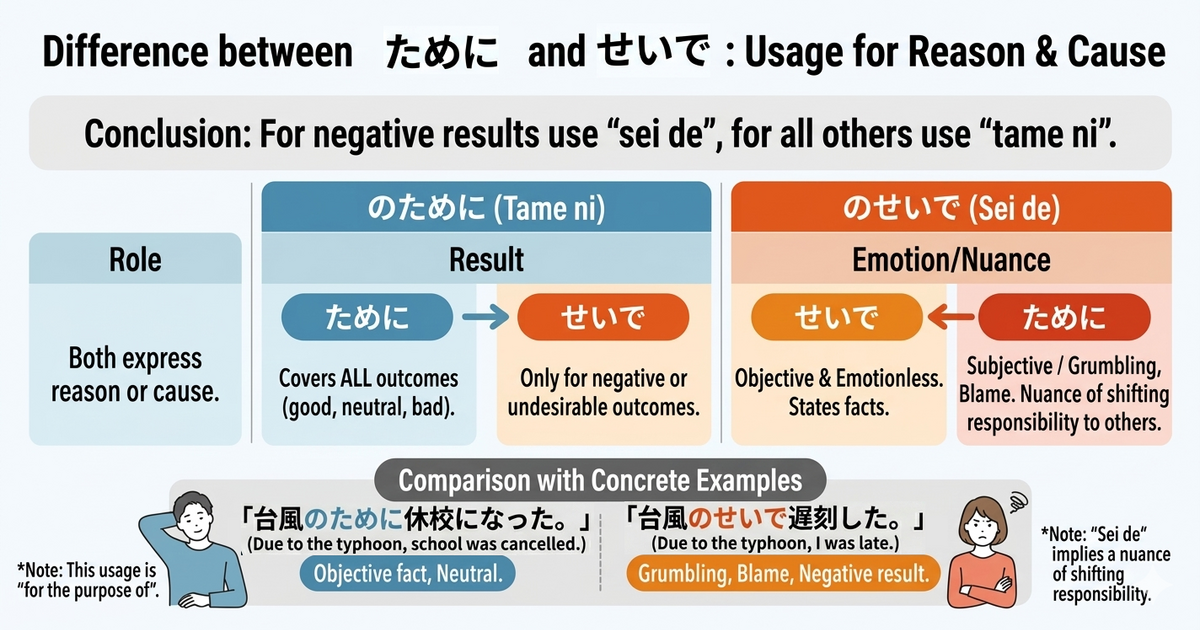
When you study Japanese, you often meet expressions that look similar at first, but actually point in very different emotional directions.
A good example is 「ために」 and 「せいで」.
For example:
「日本で働くために、日本語を勉強しています。」
“I am studying Japanese in order to work in Japan.”
「電車が遅れたせいで、会議に間に合いませんでした。」
“Because the train was late, I could not make it to the meeting on time.”
In both sentences, the first part is related to the reason for the second part.
However, the feeling is very different.
「ために」 often expresses a purpose or a positive reason.
「せいで」 is used when something causes a bad result.
In other words, these expressions do not only show a reason. They also show how the speaker feels about that reason.
「ために」 expresses purpose or a forward-looking reason
「ために」 is a very common expression, but learners should first remember two main uses.
- Purpose
- Reason or cause
The most important use in conversation and writing is the purpose meaning of 「ために」.
Purpose: 「ために」
This pattern means “because I want to achieve this, I do that.”
Examples:
-
「日本の大学に入るために、毎日漢字を勉強しています。」
“I study kanji every day in order to enter a Japanese university.” -
「健康のために、毎朝ジョギングをしています。」
“I jog every morning for my health.” -
「旅行を楽しむために、会話表現を覚えました。」
“I learned conversation expressions in order to enjoy my trip.”
This use of 「ために」 has a forward-looking feeling.
There is a goal, and the person is taking action toward that goal.
Reason: 「ために」
「ために」 can also express a reason or cause. In this use, it sounds a little formal.
Examples:
-
「大雨のために、試合は中止になりました。」
“The game was canceled because of heavy rain.” -
「事故のために、道路が混んでいます。」
“The road is crowded because of an accident.” -
「機械の故障のために、今日は工場が止まっています。」
“The factory is stopped today because of a machine failure.”
In this case, 「ために」 is often seen in news, notices, and formal explanations.
It does not strongly show emotion. It simply explains the situation.
「せいで」 expresses the cause of a bad result
「せいで」 also expresses a cause, but it often includes the speaker’s feeling of regret, dissatisfaction, or trouble.
Examples:
-
「雨のせいで、遠足に行けませんでした。」
“Because of the rain, we could not go on the school trip.” -
「寝坊したせいで、授業に遅れました。」
“Because I overslept, I was late for class.” -
「スマホを見すぎたせいで、目が痛くなりました。」
“Because I looked at my smartphone too much, my eyes started to hurt.”
The important point is that 「せいで」 is usually used with a bad result.
When you use 「せいで」, you are not only explaining the cause. You are also naturally saying, “Because of that, something troublesome happened.”
The key difference is the direction of feeling
The difference between these two expressions can be summarized as the direction of feeling.
「ために」
Purpose, necessity, explanation, forward-looking reason
「せいで」
Bad result, complaint, troublesome cause
Compare these two sentences:
-
「家族のために、働いています。」
“I work for my family.” -
「家族のせいで、働けません。」
“Because of my family, I cannot work.”
The first sentence shows care, responsibility, or purpose toward the family.
The second sentence means that the family is the cause of a problem.
The form may look somewhat similar, but the meaning can become almost opposite.
The same situation can sound different depending on the expression
Even when the cause is the same, the impression changes depending on the expression.
For example, with rain:
-
「雨のために、試合は中止になりました。」
“The game was canceled because of the rain.” -
「雨のせいで、試合は中止になりました。」
“Because of the rain, the game was canceled.”
Both sentences are understandable.
But the impression is not the same.
「雨のために」 sounds like a calm explanation of the fact.
「雨のせいで」 brings the speaker’s disappointment more to the front.
So, 「ために」 is closer to explanation.
「せいで」 is closer to emotion.
When you understand this difference, you can read the emotional temperature of Japanese sentences much more clearly.
Common mistakes learners make
1. Using 「せいで」 for a good result
For example:
「先生のせいで、日本語が好きになりました。」
“Because of my teacher, I came to like Japanese.”
Grammatically, the meaning can be understood, but it sounds quite unnatural.
Since 「せいで」 is usually used for bad results, this sentence may sound as if you are blaming the teacher.
A more natural sentence is:
「先生のおかげで、日本語が好きになりました。」
“Thanks to my teacher, I came to like Japanese.”
2. Using 「せいで」 for a purpose
「日本で働くせいで、日本語を勉強しています。」
“Because of working in Japan, I am studying Japanese.”
This sounds unnatural.
Working in Japan is a goal, so 「ために」 should be used.
The correct sentence is:
「日本で働くために、日本語を勉強しています。」
“I am studying Japanese in order to work in Japan.”
3. Using only 「ために」 when you want to show a bad result
Of course, 「ために」 can express a reason, so it is not always wrong.
However, when you want to show a feeling of trouble or dissatisfaction, 「せいで」 often sounds more natural.
For example:
「スマホのために、あまり眠れませんでした。」
“Because of my smartphone, I could not sleep much.”
This is understandable, but the following sounds more natural:
「スマホのせいで、あまり眠れませんでした。」
“Because of my smartphone, I could not sleep much.”
The second sentence clearly shows that the smartphone caused a problem.
How to choose between them
When you are not sure which one to use, ask yourself:
“Is this a goal?”
“Or is this the cause of a bad result?”
If it is a goal, use 「ために」.
If it is the cause of a bad result, use 「せいで」.
You can also remember it this way:
「ために」 looks forward.
「せいで」 looks at the problem that happened.
With this image, the difference becomes much easier to understand.
Let’s compare more examples
-
「将来、通訳になるために、語彙を増やしています。」
“I am increasing my vocabulary in order to become an interpreter in the future.” -
「発音が悪いせいで、何度も聞き返されました。」
“Because my pronunciation was poor, people asked me to repeat myself many times.”
The first sentence shows action toward a goal.
The second sentence shows the cause of an unsuccessful result.
Here is one more pair:
-
「生活のために、アルバイトをしています。」
“I work part-time in order to support my life.” -
「アルバイトが忙しいせいで、勉強時間が足りません。」
“Because my part-time job is busy, I do not have enough time to study.”
In the first sentence, there is a purpose: supporting one’s life.
In the second sentence, the busyness causes a bad result.
Final thoughts
「ために」 and 「せいで」 are both related to reasons and causes.
However, they point in different directions.
「ために」 is used for goals, necessity, and calm explanations.
「せいで」 is used for bad results, troublesome causes, and feelings of dissatisfaction.
Once you understand this difference, you can express yourself more naturally in both writing and conversation.
You will also become better at reading the feelings behind Japanese sentences.
Related grammar guide: JLPT Reason, Cause, and Result Expressions
To practice subtle Japanese differences like this with examples and questions, visit https://rapid-jt.com/ and build your understanding step by step.
For a broader overview of reason and cause patterns, see the JLPT reason and cause expression guide. Confusing JLPT Reason and Cause Expressions
%E3%80%8C%E6%9C%9F%E9%99%90%E3%82%92%E5%AE%88%E3%82%8B%E3%80%8D%E3%81%A8%E3%80%8C%E7%B7%A0%E3%82%81%E5%88%87%E3%82%8A%E3%81%AB%E9%96%93%E3%81%AB%E5%90%88%E3%81%86%E3%80%8D%E3%81%AE%E9%81%95%E3%81%84%EF%BC%88%E8%8B%B1%EF%BC%89.png)
%E3%80%8C%E4%BA%88%E5%AE%9A%E3%81%8C%E5%85%A5%E3%82%8B%E3%80%8D%E3%81%A8%E3%80%8C%E4%BA%88%E5%AE%9A%E3%82%92%E5%85%A5%E3%82%8C%E3%82%8B%E3%80%8D%E3%81%AE%E9%81%95%E3%81%84%EF%BC%88%E8%8B%B1%EF%BC%89.png)
%E3%80%8C%E8%87%AA%E4%BF%A1%E3%81%8C%E3%81%82%E3%82%8B%E3%80%8D%E3%81%A8%E3%80%8C%E8%87%AA%E4%BF%A1%E3%82%92%E6%8C%81%E3%81%A4%E3%80%8D%E3%81%AE%E9%81%95%E3%81%84%EF%BC%88%E8%8B%B1%EF%BC%89.png)
%E3%80%8C%E5%BF%85%E8%A6%81%E3%81%8C%E3%81%82%E3%82%8B%E3%80%8D%E3%81%A8%E3%80%8C%E5%BF%85%E8%A6%81%E3%81%AB%E3%81%AA%E3%82%8B%E3%80%8D%E3%81%AE%E9%81%95%E3%81%84%EF%BC%88%E8%8B%B1%EF%BC%89.png)
%E3%80%8C%E5%8F%AF%E8%83%BD%E6%80%A7%E3%81%8C%E9%AB%98%E3%81%84%E3%80%8D%E3%81%A8%E3%80%8C%E5%8F%AF%E8%83%BD%E6%80%A7%E3%81%8C%E3%81%82%E3%82%8B%E3%80%8D%E3%81%AE%E9%81%95%E3%81%84%EF%BC%88%E8%8B%B1%EF%BC%89.png)
%E3%80%8C%E7%B5%90%E8%AB%96%E3%82%92%E5%87%BA%E3%81%99%E3%80%8D%E3%81%A8%E3%80%8C%E7%B5%90%E8%AB%96%E3%81%AB%E9%81%94%E3%81%99%E3%82%8B%E3%80%8D%E3%81%AE%E9%81%95%E3%81%84%EF%BC%88%E8%8B%B1%EF%BC%89.png)