%E3%81%82%E3%81%84%E3%81%A0VS%E9%96%93%E3%81%AB%EF%BC%88%E8%8B%B1%EF%BC%89.png)
When studying Japanese, you often meet expressions that look similar but are difficult to use correctly.
One common pair is 「あいだ」 and 「あいだに」.
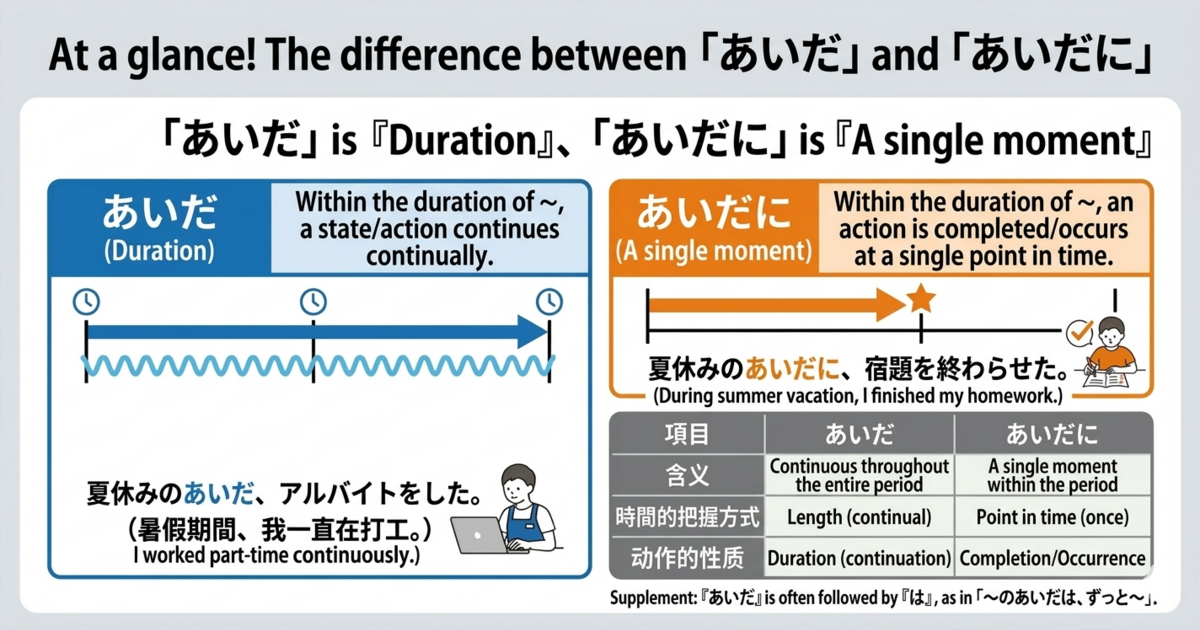
Both expressions refer to “within a certain period of time,” but the point of view is different.
Once you understand this difference, sentences become much clearer in both reading and conversation.
Today, let’s organize the difference between 「あいだ」 and 「あいだに」 in a simple, image-based way.
The key is not to think only about “afterward,” but to focus on how the action or state continues during that time.
What Does 「あいだ」 Mean?
「あいだ」 refers to the whole period during which a state or action continues.
The image is that something continues throughout that time.
Connection
- Verb dictionary form / ている form + あいだ
- い-adjective + あいだ
- な-adjective な / noun の + あいだ
Example Sentences
-
母が料理しているあいだ、私は宿題をしていた。
While my mother was cooking, I was doing my homework. -
夏休みのあいだ、毎日日本語を勉強した。
During summer vacation, I studied Japanese every day. -
日本にいるあいだ、日本語だけで生活してみたい。
While I am in Japan, I want to try living only in Japanese.
The important point here is that actions or states such as 「宿題をしていた」, 「毎日勉強した」, and 「生活してみたい」 continue over that period.
In other words, 「あいだ」 shines light on the whole stretch of time.
What Does 「あいだに」 Mean?
「あいだに」 refers to one event, change, or completed action that happens within a certain period of time.
It does not focus on something continuing the whole time. Instead, it focuses on something that happens or is completed during that period.
Connection
- Verb dictionary form / ている form + あいだに
- い-adjective + あいだに
- な-adjective な / noun の + あいだに
Example Sentences
-
母が料理しているあいだに、私は買い物に行った。
While my mother was cooking, I went shopping. -
留学しているあいだに、できるだけ多くの友達を作りたい。
While studying abroad, I want to make as many friends as possible. -
先生がいないあいだに、このプリントを終わらせましょう。
Let’s finish this handout while the teacher is away.
Here, actions such as 「買い物に行った」, 「友達を作りたい」, and 「プリントを終わらせる」 are events or goals that happen within the time period.
It is helpful to think of 「あいだに」 as focusing on a point inside a longer period of time.
The Difference in One Sentence
Expression Main Meaning あいだ Something continues throughout that time あいだに Something happens during that timeOnce you understand this contrast, it becomes much easier to choose the correct expression.
Let’s Compare
Comparison 1
-
子どもが寝ているあいだ、母は本を読んでいた。
While the child was sleeping, the mother was reading a book. -
子どもが寝ているあいだに、母は夕食の準備を終えた。
While the child was sleeping, the mother finished preparing dinner.
In the first sentence, 「本を読んでいた」 is an action that continued for some time.
In the second sentence, 「準備を終えた」 is a completed event.
Comparison 2
-
日本にいるあいだ、日本語をできるだけたくさん使いたい。
While I am in Japan, I want to use Japanese as much as possible. -
日本にいるあいだに、富士山を見に行きたい。
While I am in Japan, I want to go see Mt. Fuji.
The first sentence refers to using Japanese throughout the period of staying in Japan.
The second sentence refers to doing one thing during that stay.
Comparison 3
-
先生が説明しているあいだ、学生たちは静かに聞いていた。
While the teacher was explaining, the students were listening quietly. -
先生が説明しているあいだに、わからない点をメモした。
While the teacher was explaining, I wrote down the points I did not understand.
The first sentence shows continuation: 「静かに聞いていた」.
The second sentence shows an action done during that time: 「メモした」.
Common Mistakes Learners Make
A common mistake is using 「あいだ」 for a completed action or one-time event.
Example That May Sound Unnatural
日本にいるあいだ、京都へ行った。
During my stay in Japan, I went to Kyoto.
This can sound unnatural because 「京都へ行った」 is a one-time event.
More Natural Sentence
日本にいるあいだに、京都へ行った。
During my stay in Japan, I went to Kyoto.
When something happens once within a period of time, 「あいだに」 is more natural.
On the other hand, when the content continues, 「あいだ」 is appropriate.
Example That May Sound Unnatural
試験のあいだに、ずっと緊張していた。
During the exam, I was nervous the whole time.
More Natural Sentence
試験のあいだ、ずっと緊張していた。
During the exam, I was nervous the whole time.
「ずっと緊張していた」 is a state that continued during the exam, so 「あいだ」 is more natural.
Why This Matters for the JLPT
In the JLPT, similar grammar patterns like these are often tested.
It is not enough to memorize the form. You need to judge whether the meaning is “something continues” or “something happens during that time.”
This difference is also useful in reading comprehension.
For example, words related to plans, wishes, completion, discovery, or arrival often go well with 「あいだに」.
On the other hand, expressions such as 「ずっと」, 「毎日」, 「静かに」, and 「使い続ける」 often suggest continuation, so 「あいだ」 is more natural.
A Simple Way to Remember
When you are not sure which one to use, ask yourself:
Does the action or state continue throughout that time?
Or does something happen once during that time?
This question alone can make the choice much easier.
For a broader view of similar inference and judgment expressions, see the guide to confusing JLPT inference expressions. JLPT Inference and Judgment Expressions
For a broader view of cause and reason expressions, see the guide to confusing JLPT reason expressions. Confusing JLPT Reason and Cause Expressions
Summary
「あいだ」 and 「あいだに」 are basic Japanese grammar patterns, but using them correctly makes your Japanese much more natural.
The difference may seem small, but it greatly affects how the sentence is understood.
Understanding these subtle differences one by one is a shortcut to JLPT success.
Instead of choosing by feeling, learn to choose based on meaning.
If you want to master grammar points like 「あいだ」 and 「あいだに」 through practical exercises, try studying with RJT.
Through JLPT-style practice questions, you can organize grammar differences clearly and efficiently.
%E3%80%8C%E6%9C%9F%E9%99%90%E3%82%92%E5%AE%88%E3%82%8B%E3%80%8D%E3%81%A8%E3%80%8C%E7%B7%A0%E3%82%81%E5%88%87%E3%82%8A%E3%81%AB%E9%96%93%E3%81%AB%E5%90%88%E3%81%86%E3%80%8D%E3%81%AE%E9%81%95%E3%81%84%EF%BC%88%E8%8B%B1%EF%BC%89.png)
%E3%80%8C%E4%BA%88%E5%AE%9A%E3%81%8C%E5%85%A5%E3%82%8B%E3%80%8D%E3%81%A8%E3%80%8C%E4%BA%88%E5%AE%9A%E3%82%92%E5%85%A5%E3%82%8C%E3%82%8B%E3%80%8D%E3%81%AE%E9%81%95%E3%81%84%EF%BC%88%E8%8B%B1%EF%BC%89.png)
%E3%80%8C%E8%87%AA%E4%BF%A1%E3%81%8C%E3%81%82%E3%82%8B%E3%80%8D%E3%81%A8%E3%80%8C%E8%87%AA%E4%BF%A1%E3%82%92%E6%8C%81%E3%81%A4%E3%80%8D%E3%81%AE%E9%81%95%E3%81%84%EF%BC%88%E8%8B%B1%EF%BC%89.png)
%E3%80%8C%E5%BF%85%E8%A6%81%E3%81%8C%E3%81%82%E3%82%8B%E3%80%8D%E3%81%A8%E3%80%8C%E5%BF%85%E8%A6%81%E3%81%AB%E3%81%AA%E3%82%8B%E3%80%8D%E3%81%AE%E9%81%95%E3%81%84%EF%BC%88%E8%8B%B1%EF%BC%89.png)
%E3%80%8C%E5%8F%AF%E8%83%BD%E6%80%A7%E3%81%8C%E9%AB%98%E3%81%84%E3%80%8D%E3%81%A8%E3%80%8C%E5%8F%AF%E8%83%BD%E6%80%A7%E3%81%8C%E3%81%82%E3%82%8B%E3%80%8D%E3%81%AE%E9%81%95%E3%81%84%EF%BC%88%E8%8B%B1%EF%BC%89.png)
%E3%80%8C%E7%B5%90%E8%AB%96%E3%82%92%E5%87%BA%E3%81%99%E3%80%8D%E3%81%A8%E3%80%8C%E7%B5%90%E8%AB%96%E3%81%AB%E9%81%94%E3%81%99%E3%82%8B%E3%80%8D%E3%81%AE%E9%81%95%E3%81%84%EF%BC%88%E8%8B%B1%EF%BC%89.png)