Can you clearly explain the difference between “made” and “made ni”?
When learning Japanese, you often come across expressions that look similar but mean very different things.
A classic example is “made” and “made ni.”
Both are used with time expressions, so many learners first assume they mean almost the same thing. But in fact, they reflect two very different ways of looking at time.
If this difference stays unclear, your Japanese may sound slightly unnatural in conversation or writing.
So let’s make it simple and clear.
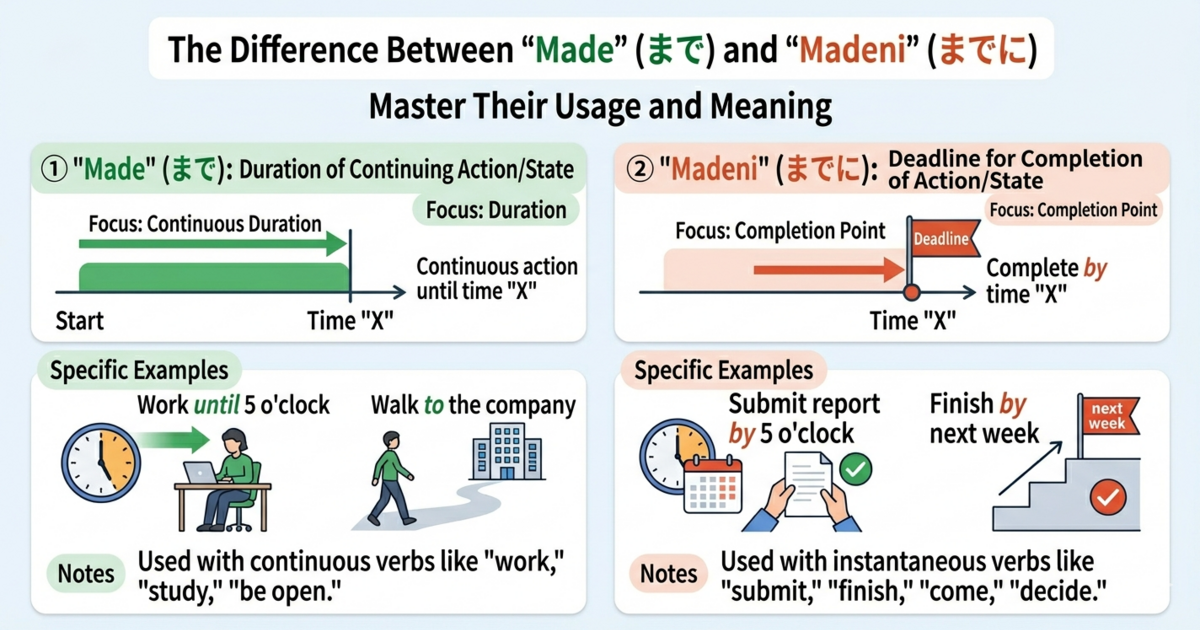
“Made” means something continues up to a point
“Made” shows that an action or state continues until a certain point in time.
The key idea is duration.
For example:
I study until 3 o’clock.
In Japanese:
3時まで勉強します。
This means the action of studying continues up to 3 o’clock.
Here are more examples:
I will stay in Japan until next week.
I will work part-time until summer vacation.
In all of these, “made” marks the end point of a continuing action or state.
In other words, it means “continuing up to that point.”
“Made ni” means something must be completed before a point
“Made ni,” on the other hand, shows a deadline.
The key idea is completion before a certain time.
For example:
Please submit the report by 3 o’clock.
In Japanese:
3時までにレポートを出してください。
This does not mean you keep submitting the report until 3 o’clock. It means the report must be submitted at some point before 3 o’clock.
Here are more examples:
I will do my homework by tomorrow.
Please contact me by Friday.
I will apply for the JLPT by next month.
All of these express a deadline or completion point.
So “made ni” means “finish it before that time.”
Think of “made” as a line, and “made ni” as a point
This difference becomes much easier if you picture it this way.
“Made” is like a line.
An action or state continues along time until a certain endpoint.
“Made ni” is like a point.
That point is the deadline, and the action must be completed before reaching it.
Compare these:
I will study until 10 p.m.
This sounds natural because studying is something that continues over time.
But:
I will submit the report until 10 p.m.
This sounds strange, because submitting a report is usually a one-time completed action.
So the natural sentence is:
I will submit the report by 10 p.m.
A useful shortcut: Is the action continuing, or finishing?
When you are unsure which one to use, look at the verb.
If the action continues over a period of time, “made” often fits better.
Examples:
stay, study, work, live
If the action is completed at one point, “made ni” is often the natural choice.
Examples:
submit, send, arrive, finish
Of course, context matters, but this simple idea helps a lot.
Let’s compare a few pairs
I will be at the office until 5.
This means my presence at the office continues until 5.
I will go to the office by 5.
This means I will arrive there before 5.
My mother was cooking until nighttime.
This shows the cooking continued for some time.
My mother finished cooking by nighttime.
This shows the cooking was completed before night.
Once you start noticing whether the action continues or finishes, the difference becomes much easier to feel.
This small difference matters a lot
“Made” and “made ni” appear everywhere in daily conversation and on the JLPT.
Because the words themselves look simple, many learners move on without fully understanding the difference.
But in Japanese, small grammar choices can greatly affect how natural and precise your sentence sounds.
That is why it is so important to learn not only the form, but also the image behind the form.
Remember this:
“Made” = continuation
“Made ni” = deadline
That one contrast can make grammar, reading, and writing much more stable.
Conclusion
“Made” expresses that an action or state continues up to a certain point.
“Made ni” expresses that something is completed before a certain point.
They look similar, but they express very different views of time.
Japanese becomes much easier when you stop memorizing forms alone and start understanding the image each form creates.
Once you learn differences like this one by one, your Japanese becomes more natural, more accurate, and much more confident.
「まで」と「までに」のような、似ているけれど意味が違う文法をしっかり整理したい方は、RJTで実際の問題を解きながら学んでみてください。語彙・文法・読解・聴解を通して、使える日本語を少しずつ身につけていけます。
https://rapid-jt.com/
For a broader view of similar inference and judgment expressions, see the guide to confusing JLPT inference expressions. JLPT Inference and Judgment Expressions
For a broader view of cause and reason expressions, see the guide to confusing JLPT reason expressions. Confusing JLPT Reason and Cause Expressions
%E3%80%8C%E5%A7%8B%E6%9C%AB%E3%81%A0%E3%80%8D%E3%81%A8%E3%81%AF%E3%81%A9%E3%81%86%E4%BD%BF%E3%81%86%EF%BC%9F%E6%82%AA%E3%81%84%E7%B5%90%E6%9E%9C%E3%82%92%E5%BC%B7%E3%81%8F%E5%8D%B0%E8%B1%A1%E3%81%A5%E3%81%91%E3%82%8B%E6%96%87%E5%9E%8B%E3%82%92%E7%90%86%E8%A7%A3%E3%81%99%E3%82%8B%EF%BC%88%E8%8B%B1%EF%BC%89.png)
%E3%80%8C%E3%81%BE%E3%81%84%E3%80%8D%E3%81%A8%E3%80%8C%E3%81%AA%E3%81%84%E3%81%A0%E3%82%8D%E3%81%86%E3%80%8D%E3%81%AE%E9%81%95%E3%81%84%E3%81%AF%EF%BC%9F%E5%8F%A4%E3%82%81%E3%81%AE%E5%90%A6%E5%AE%9A%E6%8E%A8%E9%87%8F%E3%81%8C%E5%87%BA%E3%81%9F%E3%81%A8%E3%81%8D%E3%81%AE%E5%AF%BE%E5%87%A6%E6%B3%95%EF%BC%88%E8%8B%B1%EF%BC%89.png)
%E3%80%8C%E3%81%AB%E3%81%97%E3%81%A6%E3%81%AF%E3%80%8D%E3%81%A8%E3%80%8C%E3%82%8F%E3%82%8A%E3%81%AB%E3%80%8D%E3%81%AE%E9%81%95%E3%81%84%E3%81%AF%EF%BC%9F%E5%9F%BA%E6%BA%96%E3%81%A8%E3%81%AE%E3%81%9A%E3%82%8C%E3%82%92%E8%A1%A8%E3%81%99N2%E6%96%87%E5%9E%8B%E3%82%92%E6%95%B4%E7%90%86%EF%BC%88%E8%8B%B1%EF%BC%89.png)
JLPT%E3%81%A7%E6%B7%B7%E4%B9%B1%E3%81%97%E3%82%84%E3%81%99%E3%81%84%E6%9D%A1%E4%BB%B6%E8%A1%A8%E7%8F%BE%E3%81%BE%E3%81%A8%E3%82%81%20%E3%83%BC%E3%80%8C%E3%81%A8%E3%80%8D%E3%80%8C%E3%81%B0%E3%80%8D%E3%80%8C%E3%81%9F%E3%82%89%E3%80%8D%E3%80%8C%E3%81%AA%E3%82%89%E3%80%8D%E3%81%AE%E9%81%95%E3%81%84%E3%82%92%E6%95%B4%E7%90%86%E3%81%99%E3%82%8B%E3%83%BC%EF%BC%88%E8%8B%B1%EF%BC%89.png)