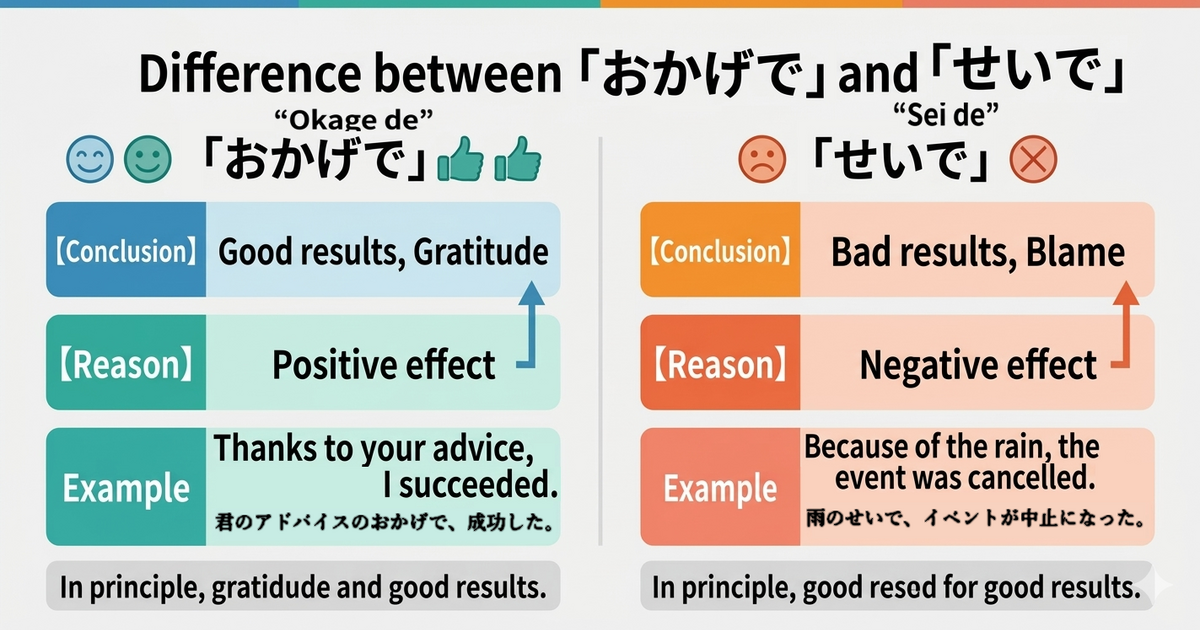
In Japanese, some expressions may look similar at first, but the feelings behind them are completely different.
A perfect example is “okagede” and “seide.”
Both can be used to talk about a cause or reason.
But the word you choose changes depending on how the speaker feels about the result.
If the result is positive, Japanese often uses “okagede.”
If the result is negative, Japanese often uses “seide.”
Once you understand this difference, your Japanese will sound much more natural.
It also helps a lot in reading comprehension, because these expressions reveal the speaker’s feelings very clearly.
They are important for the JLPT as well, so this is a grammar point worth understanding well.
What is “okagede”?
“Okagede” is used when something leads to a good result.
It carries a feeling of gratitude, appreciation, or positive evaluation.
For example:
- Thanks to my teacher, I came to like Japanese.
先生のおかげで、日本語が好きになりました。 - Thanks to practicing every day, my conversation became more natural than before.
毎日練習したおかげで、会話が前より自然になりました。 - Thanks to my friend helping me, I finished moving quickly.
友だちが手伝ってくれたおかげで、引っ越しが早く終わりました。
In all of these sentences, the result is positive.
The speaker feels thankful or happy about what happened.
So “okagede” is not just a neutral way to explain a cause.
It shows that the cause is seen as helpful, valuable, or something to be grateful for.
What is “seide”?
“Seide,” on the other hand, is used when something causes a bad result.
It carries a feeling of frustration, inconvenience, complaint, or negative evaluation.
For example:
- Because of the rain, the game was canceled.
雨のせいで、試合が中止になりました。 - Because of lack of sleep, my head feels heavy all day today.
寝不足のせいで、今日はずっと頭が重いです。 - Because the train was delayed, I couldn’t make it to the meeting on time.
電車が遅れたせいで、会議に間に合いませんでした。
Here, the results are negative.
That is why “seide” sounds natural.
In many cases, “seide” also carries a slight feeling of blaming the cause.
That is why it can sound strong, especially when it is used about another person.
The difference in one line
- “Okagede”: A good result
- “Seide”: A bad result
That is the simplest way to remember them.
But to be even more precise, the difference is not only in the result itself.
It is also in the speaker’s feeling.
- “Okagede” shows appreciation, relief, or happiness.
- “Seide” shows disappointment, trouble, annoyance, or blame.
That emotional difference is the heart of this grammar point.
Let’s compare them
Here is a simple comparison:
- Thanks to my teacher explaining carefully, I became able to read kanji.
先生が丁寧に教えてくれたおかげで、漢字が読めるようになりました。 - Because I stayed up late, I got sleepy during class.
夜ふかししたせいで、授業中に眠くなりました。
In the first sentence, the teacher’s help leads to a positive result.
So “okagede” is perfect.
In the second sentence, staying up late leads to an unpleasant result.
So “seide” is natural.
Here is another pair:
- Thanks to my family’s support, I was able to keep going until the end.
家族の応援のおかげで、最後まで頑張れました。 - Because of the typhoon, all of my travel plans changed.
台風のせいで、旅行の予定が全部変わってしまいました。
The first sentence includes gratitude.
The second includes disappointment and inconvenience.
That is exactly the difference between “okagede” and “seide.”
A common learner mistake
Many learners think of both expressions as simply meaning “because of.”
But in Japanese, they are not emotionally neutral in the same way.
For example:
雨のおかげで、遠足に行けませんでした。
This sounds unnatural in most situations.
Not being able to go on the excursion is not a positive result.
So the natural sentence is:
雨のせいで、遠足に行けませんでした。
Now look at this:
友だちのせいで、宿題が終わりました。
This is also usually unnatural.
If finishing the homework is a good result, then Japanese would normally say:
友だちのおかげで、宿題が終わりました。
So it is not enough to look only at the grammar pattern.
You also need to think about how the speaker feels about the result.
“Okagede” is a natural expression of gratitude
“Okagede” is very common in everyday Japanese.
It is especially useful when you want to express appreciation in a soft and natural way.
For example:
- Thanks to everyone, we were able to finish the event safely.
皆さんのおかげで、無事にイベントを終えることができました。 - Thanks to my teacher, I became able to speak with confidence.
先生のおかげで、自信を持って話せるようになりました。 - Thanks to practicing with RJT every day, I now understand grammar differences much better than before.
RJTで毎日練習したおかげで、文法の違いが前よりよくわかるようになりました。
As you can see, “okagede” fits very naturally when support, effort, or help leads to visible progress.
“Seide” expresses trouble or dissatisfaction
“Seide” is often used with things like failure, delay, illness, schedule changes, or discomfort.
For example:
- Because the roads were crowded, I was late for the appointment.
道が混んでいたせいで、約束の時間に遅れました。 - Because of my cold, I couldn’t eat anything yesterday.
風邪のせいで、昨日は何も食べられませんでした。 - Because I looked at my smartphone too much, my eyes got tired.
スマホを見すぎたせいで、目が疲れました。
These sentences clearly show what caused the problem.
However, when “seide” is used directly toward a person, it can sound quite strong.
It’s your fault that I failed.
あなたのせいで失敗した。
This sounds like direct blame.
In conversation, depending on the situation, it may be better to soften the wording.
Are there any exceptions?
The basic rule is simple:
- Use “okagede” for good results.
- Use “seide” for bad results.
However, Japanese sometimes uses “okagede” sarcastically.
For example:
Thanks to you, I had a terrible day.
あなたのおかげで、今日は大変な一日だったよ。
Here, the surface form is “okagede,” but the speaker is not really expressing gratitude.
Instead, it sounds ironic or sarcastic.
Because this depends heavily on tone and context, learners should first focus on the basic contrast.
How do they connect?
The grammar is not very difficult.
- Noun + no okagede
- Plain form + okagede
- Noun + no seide
- Plain form + seide
Examples:
- Thanks to working hard, I passed.
努力したおかげで、合格できました。 - Thanks to the kind directions, I arrived without getting lost.
親切な案内のおかげで、迷わず着きました。 - Because of the strong wind, the door will not open.
風が強いせいで、ドアが開きません。 - Because I went to bed late yesterday, I could not get up this morning.
昨日寝るのが遅かったせいで、朝起きられませんでした。
It is important to look not only at the form, but also at whether the result is positive or negative.
How do you tell them apart on the JLPT?
On the JLPT, “okagede” and “seide” may appear as answer choices.
When that happens, pay attention to the result and the speaker’s emotion.
Results that often go with “okagede”
- Passed
- Succeeded
- Was saved
- Finished quickly
Results that often go with “seide”
- Was late
- Broke
- Had trouble
- Was canceled
- Got sick
In reading passages, this difference also helps you understand whether the writer feels thankful or frustrated.
So this is not only a grammar question.
It is also about reading emotion correctly.
A simple way to remember them
When you are unsure, ask yourself this:
Does the speaker feel that this cause led to something good?
Or does the speaker feel that this cause created trouble?
If it feels good, use “okagede.”
If it feels bad, use “seide.”
That simple question makes the choice much easier.
Conclusion
“Okagede” and “seide” both express cause, but they point in completely different emotional directions.
- “Okagede” includes gratitude and a positive evaluation.
- “Seide” includes complaint or a negative evaluation.
They may look similar, but in natural Japanese, this difference matters a lot.
Once you can use them correctly, you will be able to express not only facts, but also feelings more naturally.
Grammar becomes much stronger when you learn not only the form, but also the emotion behind it.
If you want to master grammar points like “okagede” and “seide” through practical questions and clear explanations, RJT is a great place to study.
You can organize confusing grammar into real, usable knowledge while building your JLPT skills step by step.
Related grammar guide: JLPT Reason, Cause, and Result Expressions
For a broader overview of reason and cause patterns, see the JLPT reason and cause expression guide. Confusing JLPT Reason and Cause Expressions
%E3%80%8C%E6%9C%9F%E9%99%90%E3%82%92%E5%AE%88%E3%82%8B%E3%80%8D%E3%81%A8%E3%80%8C%E7%B7%A0%E3%82%81%E5%88%87%E3%82%8A%E3%81%AB%E9%96%93%E3%81%AB%E5%90%88%E3%81%86%E3%80%8D%E3%81%AE%E9%81%95%E3%81%84%EF%BC%88%E8%8B%B1%EF%BC%89.png)
%E3%80%8C%E4%BA%88%E5%AE%9A%E3%81%8C%E5%85%A5%E3%82%8B%E3%80%8D%E3%81%A8%E3%80%8C%E4%BA%88%E5%AE%9A%E3%82%92%E5%85%A5%E3%82%8C%E3%82%8B%E3%80%8D%E3%81%AE%E9%81%95%E3%81%84%EF%BC%88%E8%8B%B1%EF%BC%89.png)
%E3%80%8C%E8%87%AA%E4%BF%A1%E3%81%8C%E3%81%82%E3%82%8B%E3%80%8D%E3%81%A8%E3%80%8C%E8%87%AA%E4%BF%A1%E3%82%92%E6%8C%81%E3%81%A4%E3%80%8D%E3%81%AE%E9%81%95%E3%81%84%EF%BC%88%E8%8B%B1%EF%BC%89.png)
%E3%80%8C%E5%BF%85%E8%A6%81%E3%81%8C%E3%81%82%E3%82%8B%E3%80%8D%E3%81%A8%E3%80%8C%E5%BF%85%E8%A6%81%E3%81%AB%E3%81%AA%E3%82%8B%E3%80%8D%E3%81%AE%E9%81%95%E3%81%84%EF%BC%88%E8%8B%B1%EF%BC%89.png)
%E3%80%8C%E5%8F%AF%E8%83%BD%E6%80%A7%E3%81%8C%E9%AB%98%E3%81%84%E3%80%8D%E3%81%A8%E3%80%8C%E5%8F%AF%E8%83%BD%E6%80%A7%E3%81%8C%E3%81%82%E3%82%8B%E3%80%8D%E3%81%AE%E9%81%95%E3%81%84%EF%BC%88%E8%8B%B1%EF%BC%89.png)
%E3%80%8C%E7%B5%90%E8%AB%96%E3%82%92%E5%87%BA%E3%81%99%E3%80%8D%E3%81%A8%E3%80%8C%E7%B5%90%E8%AB%96%E3%81%AB%E9%81%94%E3%81%99%E3%82%8B%E3%80%8D%E3%81%AE%E9%81%95%E3%81%84%EF%BC%88%E8%8B%B1%EF%BC%89.png)