「ていく」 and 「てくる」 are expressions that Japanese learners often encounter, but they can remain confusing for a long time.
For example, 「だんだん暑くなってきた」 sounds natural. But what is the difference between 「これから暑くなってくる」 and 「これから暑くなっていく」?
And what is the difference between 「日本語を勉強していきます」 and 「日本語を勉強してきました」?
The key to understanding these two expressions is actually very simple.
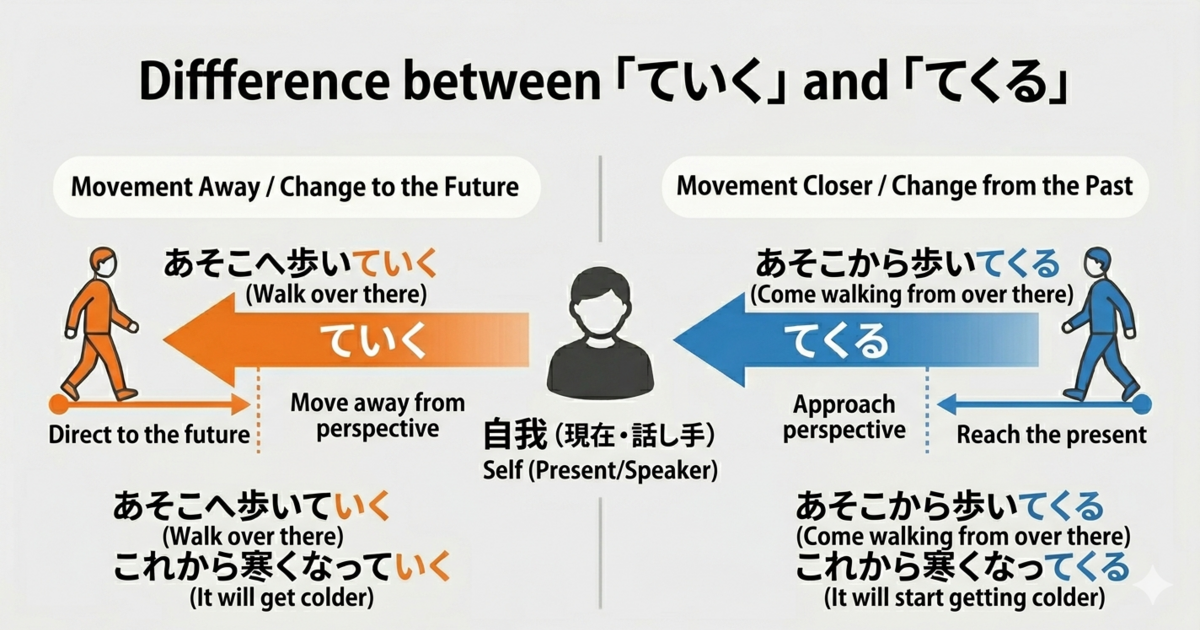
「ていく」 gives the feeling of moving from now toward the future.
「てくる」 gives the feeling of something coming from somewhere toward now.
Once you understand this image, the difference becomes much easier to see.
「ていく」 means moving forward from now
「ていく」 uses the speaker’s “now” as the starting point and looks forward from there.
When it refers to place, it gives the feeling of moving away.
When it refers to time, it gives the feeling of moving into the future.
When it refers to change, it shows that something will continue changing from now on.
For example:
これからもっと日本語を勉強していきます。
I will continue studying Japanese more from now on.
人口はこれから減っていくでしょう。
The population will probably continue to decrease from now on.
彼はあいさつをして、駅のほうへ歩いていった。
He said goodbye and walked away toward the station.
In all of these sentences, there is a feeling that something flows forward from “now” toward what comes next.
「てくる」 means coming toward now from somewhere
On the other hand, 「てくる」 gives the feeling that something comes closer to the speaker’s “now” from another place or from a past point in time.
In terms of space, it means something comes toward here.
In terms of time, it means a change has continued from the past and has reached the present.
For example:
向こうから子どもが走ってきた。
A child came running from over there.
だんだん暑くなってきました。
It has gradually become hot.
日本語の勉強が楽しくなってきた。
Studying Japanese has started to become enjoyable.
In these sentences, 「てくる」 suggests that something has reached the speaker’s current point.
The change has progressed to the point where the speaker can clearly feel it now.
It is easier to understand through the flow of time
「ていく」 and 「てくる」 become much easier to understand when you think about the flow of time.
「ていく」 looks from now toward the future.
The speaker is looking at how something will continue from this point onward.
これから物価は上がっていくと思います。
I think prices will continue to rise from now on.
少子高齢化は今後も進んでいくでしょう。
The declining birthrate and aging population will probably continue to progress.
「てくる」 looks from the past up to now.
It expresses that a change has become noticeable at the present moment.
最近、日本語が前より分かるようになってきました。
Recently, I have started to understand Japanese better than before.
春になって、少しずつ暖かくなってきた。
Spring has come, and it has gradually become warmer.
In other words:
「ていく」 extends from now into the future.
「てくる」 reaches the present from the past.
Thinking this way makes the difference much easier to use.
They can also express changes in feelings and conditions
These two expressions are not only used for physical movement.
They are also often used for changes in feelings, abilities, and social trends.
これから自信をつけていきたい。
I want to build confidence from now on.
勉強を続けてきて、少し自信がついてきた。
After continuing to study, I have started to gain a little confidence.
The first sentence looks at change from now into the future.
The second sentence looks at the change that has developed through past effort and is now being felt.
Even with the same idea of “confidence,” the viewpoint is different.
A common point of confusion
Learners often get confused because both expressions can describe change.
However, the direction of the viewpoint is different.
When the sentence includes 「これから」, meaning “from now on,” 「ていく」 often sounds natural.
これから日本語力を伸ばしていきたい。
I want to improve my Japanese ability from now on.
これからもっと寒くなっていくでしょう。
It will probably continue to get colder from now on.
On the other hand, when the speaker is feeling a change now, words like 「最近」, 「だんだん」, and 「もう」 often go well with 「てくる」.
最近、漢字が読めるようになってきた。
Recently, I have started to be able to read kanji.
だんだん人が増えてきた。
More and more people have started to come.
Even when describing the same kind of event, Japanese changes depending on the speaker’s viewpoint.
That is one of the interesting parts of the language.
For a broader view of cause and reason expressions, see the guide to confusing JLPT reason expressions. Confusing JLPT Reason and Cause Expressions
For a broader view of limitation expressions, see the guide to confusing JLPT limitation expressions. Confusing JLPT Limitation Expressions
Summary
「ていく」 and 「てくる」 are both very common expressions, but their difference is clear.
「ていく」 means from now toward the future.
「てくる」 means from somewhere or some past point toward now.
Once you understand this feeling, your Japanese becomes more natural not only in grammar questions, but also in conversation and writing.
When similar expressions confuse you, the key is not only to think about the meaning, but also to think about the direction of the viewpoint.
RJT helps learners understand confusing grammar differences like this through clear explanations, real example sentences, and practice questions.
If you want to make your sense of Japanese clearer step by step, please visit Rapid Japanese Training.
%E3%80%8C%E6%9C%9F%E9%99%90%E3%82%92%E5%AE%88%E3%82%8B%E3%80%8D%E3%81%A8%E3%80%8C%E7%B7%A0%E3%82%81%E5%88%87%E3%82%8A%E3%81%AB%E9%96%93%E3%81%AB%E5%90%88%E3%81%86%E3%80%8D%E3%81%AE%E9%81%95%E3%81%84%EF%BC%88%E8%8B%B1%EF%BC%89.png)
%E3%80%8C%E4%BA%88%E5%AE%9A%E3%81%8C%E5%85%A5%E3%82%8B%E3%80%8D%E3%81%A8%E3%80%8C%E4%BA%88%E5%AE%9A%E3%82%92%E5%85%A5%E3%82%8C%E3%82%8B%E3%80%8D%E3%81%AE%E9%81%95%E3%81%84%EF%BC%88%E8%8B%B1%EF%BC%89.png)
%E3%80%8C%E8%87%AA%E4%BF%A1%E3%81%8C%E3%81%82%E3%82%8B%E3%80%8D%E3%81%A8%E3%80%8C%E8%87%AA%E4%BF%A1%E3%82%92%E6%8C%81%E3%81%A4%E3%80%8D%E3%81%AE%E9%81%95%E3%81%84%EF%BC%88%E8%8B%B1%EF%BC%89.png)
%E3%80%8C%E5%BF%85%E8%A6%81%E3%81%8C%E3%81%82%E3%82%8B%E3%80%8D%E3%81%A8%E3%80%8C%E5%BF%85%E8%A6%81%E3%81%AB%E3%81%AA%E3%82%8B%E3%80%8D%E3%81%AE%E9%81%95%E3%81%84%EF%BC%88%E8%8B%B1%EF%BC%89.png)
%E3%80%8C%E5%8F%AF%E8%83%BD%E6%80%A7%E3%81%8C%E9%AB%98%E3%81%84%E3%80%8D%E3%81%A8%E3%80%8C%E5%8F%AF%E8%83%BD%E6%80%A7%E3%81%8C%E3%81%82%E3%82%8B%E3%80%8D%E3%81%AE%E9%81%95%E3%81%84%EF%BC%88%E8%8B%B1%EF%BC%89.png)
%E3%80%8C%E7%B5%90%E8%AB%96%E3%82%92%E5%87%BA%E3%81%99%E3%80%8D%E3%81%A8%E3%80%8C%E7%B5%90%E8%AB%96%E3%81%AB%E9%81%94%E3%81%99%E3%82%8B%E3%80%8D%E3%81%AE%E9%81%95%E3%81%84%EF%BC%88%E8%8B%B1%EF%BC%89.png)