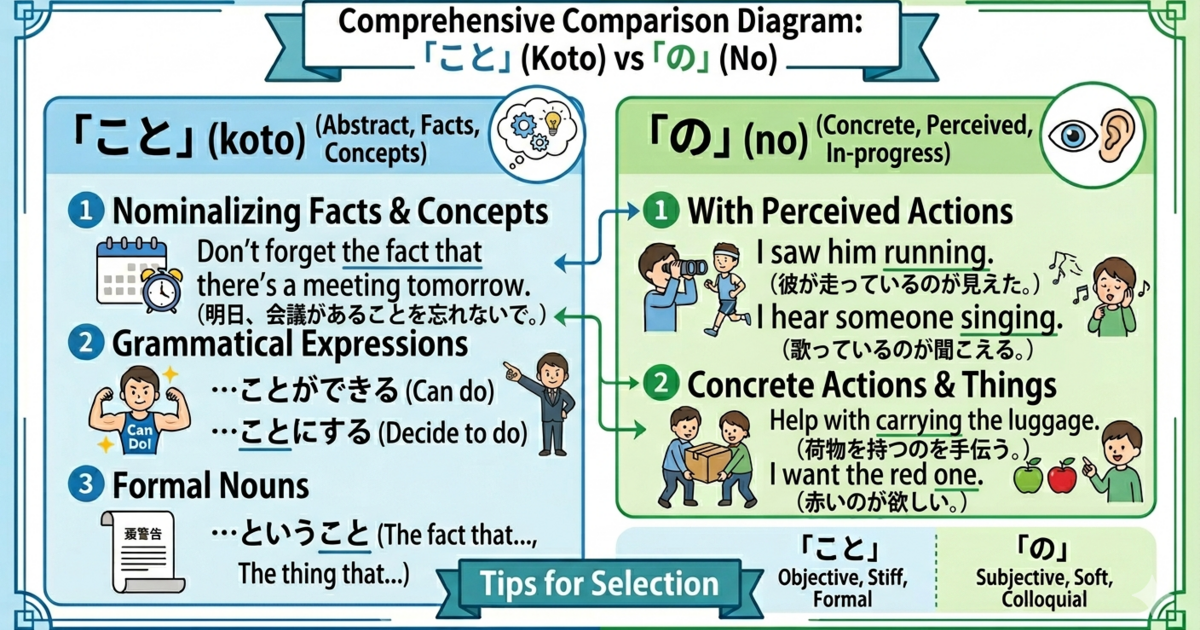
When studying Japanese, learners encounter 「こと」 and 「の」 quite early.
Both are useful forms that can turn verbs or clauses into something like a noun.
For example:
日本語を勉強すること
studying Japanese / the act of studying Japanese
日本語を勉強するの
studying Japanese / the actual experience of studying Japanese
You have probably seen both.
The meanings seem similar.
But when you try to use them yourself, it can be difficult to know which one to choose.
This confusion is completely natural.
「こと」 and 「の」 can sometimes be exchanged, but in many cases, the nuance and naturalness change clearly.
In this article, we will organize the difference between 「こと」 and 「の」 as simply as possible.
Instead of focusing too much on difficult grammar terms, we will look at how they actually feel, and in what situations they are naturally used.
First, the conclusion: 「こと」 is abstract, 「の」 is concrete
The most important point is this:
「こと」 treats the content as a matter, fact, rule, or idea from a little distance.
「の」 makes the action or situation feel closer, more concrete, and more directly connected to the speaker’s feeling.
In simple terms:
- 「こと」 is more explanatory, formal, and abstract.
- 「の」 is more conversational, soft, and concrete.
If you keep this image in mind, the difference becomes much easier to understand.
「こと」 treats the content as one complete matter
「こと」 gives the feeling that an action or state is being treated as one item, fact, or matter.
For example:
日本語を勉強することは大切です。
Studying Japanese is important.
毎日復習することが上達への近道です。
Reviewing every day is the shortcut to improvement.
約束を守ることは信頼につながります。
Keeping promises leads to trust.
In these sentences, the speaker is not talking about one specific action happening right now.
Rather, the speaker is talking about the action as a general idea or matter.
In other words, 「こと」 is useful when you want to explain, evaluate, or state something in a general way.
Situations where 「こと」 fits naturally
「こと」 often fits when you want to:
- State a general idea
- Explain a rule or policy
- Write in a slightly formal or explanatory style
Examples:
外国語は続けることが大切です。
When learning a foreign language, continuing is important.
人の話を最後まで聞くこと。
Listen to people until they finish speaking.
試験では時間を意識することが必要です。
In an exam, it is necessary to be aware of time.
In some of these sentences, 「の」 may not be impossible.
However, 「こと」 sounds much more stable and natural because the sentence is explanatory or general.
「の」 makes the action or situation feel closer
On the other hand, 「の」 feels more concrete.
日本語を勉強するのは楽しいです。
Studying Japanese is fun.
友だちと話すのが好きです。
I like talking with friends.
窓から海が見えるのがうれしいです。
I am happy that I can see the sea from the window.
In these sentences, the action or situation feels close to the speaker’s real experience or emotion.
If 「こと」 is explanation, 「の」 is lived feeling.
Especially with expressions related to emotions and senses, such as 「好き」, 「楽しい」, 「うれしい」, 「嫌だ」, 「見える」, and 「聞こえる」, 「の」 is very natural.
Situations where 「の」 fits naturally
「の」 often fits when you want to:
- Express your own feeling
- Talk about a concrete situation that is easy to imagine
- Speak softly and naturally in conversation
Examples:
本を読むのが好きです。
I like reading books.
一人で旅行するのは少し不安です。
Traveling alone makes me a little nervous.
子どもが笑っているのを見るのが好きです。
I like seeing children smiling.
If you replace all of these with 「こと」, the meaning may still be understandable, but the sentences become a little stiff and explanatory.
Sentences where both are possible, but the feeling changes
This is the most important point.
Even when both 「こと」 and 「の」 are grammatically possible, the impression can be different.
Example 1
日本語を勉強することは楽しいです。
Studying Japanese is fun.
日本語を勉強するのは楽しいです。
Studying Japanese is fun.
Both can be understood.
However, the second sentence with 「の」 sounds more natural.
「楽しい」 is close to the speaker’s actual feeling, so 「の」 matches it better.
Example 2
毎日運動することは大切です。
Exercising every day is important.
毎日運動するのは大切です。
Exercising every day is important.
Here, the first sentence with 「こと」 sounds more natural.
「大切です」 is often used to state a general idea or give advice, so 「こと」 feels more stable.
This means that simply remembering “both make a clause into a noun” is not enough.
You need to ask:
Is this sentence explaining something?
Or is it expressing a personal feeling or concrete experience?
Common patterns where 「こと」 is often used
「こと」 is especially common in the following patterns.
1. Stating importance or necessity
早めに準備することが大切です。
Preparing early is important.
まず相手の話を聞くことが必要です。
It is necessary to first listen to the other person.
2. Writing rules, instructions, or warnings
教室では静かにすること。
Be quiet in the classroom.
宿題は明日までに出すこと。
Submit your homework by tomorrow.
This use is very typical.
On signs, instructions, or written rules, 「の」 would sound quite unnatural.
3. Stating a fact, goal, dream, or defined content
私の趣味は写真を撮ることです。
My hobby is taking photos.
将来の夢は海外で働くことです。
My future dream is to work overseas.
In these sentences, 「こと」 stands firmly as a noun-like expression.
It presents the content as one clear item.
Common patterns where 「の」 is often used
「の」 works very well with conversation and emotion.
1. 好き, 嫌い, 得意, 苦手
料理するのが好きです。
I like cooking.
人前で話すのが苦手です。
I am not good at speaking in front of people.
2. Seeing, hearing, and sensing
子どもが遊んでいるのを見ました。
I saw children playing.
だれかが話しているのが聞こえます。
I can hear someone talking.
3. Softly explaining a reason
遅れたのは、電車が止まったからです。
The reason I was late is that the train stopped.
行かなかったのは、少し熱があったからです。
The reason I did not go is that I had a slight fever.
In these cases, 「の」 sounds more natural than 「こと」 and fits conversation well.
Points that learners often struggle with
Why is 「の」 natural with 「好きです」?
For example:
音楽を聞くのが好きです。
I like listening to music.
音楽を聞くことが好きです。
I like listening to music.
The second sentence is not completely impossible, but it sounds quite unnatural in many ordinary situations.
The reason is that 「好き」 is a very feeling-based expression.
The speaker is not explaining an abstract matter.
The speaker is expressing a feeling directly.
That is why 「の」 sounds more natural.
There are also many sentences where 「ことです」 is stable
For example:
大切なのは続けることです。
The important thing is to continue.
私の目標は日本で働くことです。
My goal is to work in Japan.
In these sentences, 「こと」 gives the sentence a strong structure.
It treats the content as one clear matter or goal.
「の」 would sound weaker or less stable here.
How to choose when you are not sure
When you are not sure which one to use, try thinking in this order.
1. If it is a general idea, explanation, or rule, first consider 「こと」
勉強を続けることが重要です。
Continuing your studies is important.
遅刻しないこと。
Do not be late.
2. If it is emotion, sensation, or conversational feeling, first consider 「の」
勉強するのは楽しいです。
Studying is fun.
一人で行くのはちょっと不安です。
Going alone makes me a little nervous.
3. If you can imagine the scene clearly, 「の」 is strong
猫が寝ているのを見ました。
I saw a cat sleeping.
雨が降っているのがわかります。
I can tell that it is raining.
4. If you want to summarize something as a matter, 「こと」 is strong
留学することを決めました。
I decided to study abroad.
毎日書くことを目標にしています。
I have made writing every day my goal.
How to remember the difference for exams
The memory tip is simple.
- 「こと」 summarizes something as a matter.
- 「の」 looks at something as a close, concrete scene.
「こと」 feels like you are organizing the content from a little distance.
「の」 feels like you are closer to the scene and directly feeling it.
Once you understand this difference in distance, choosing the right form becomes much easier.
For a broader view of cause and reason expressions, see the guide to confusing JLPT reason expressions. Confusing JLPT Reason and Cause Expressions
For a broader view of limitation expressions, see the guide to confusing JLPT limitation expressions. Confusing JLPT Limitation Expressions
Summary
「こと」 and 「の」 are both useful, but they are not the same.
In one sentence:
「こと」 is abstract and explanatory.
「の」 is concrete and feeling-based.
If you learn them without this difference, they may always look interchangeable.
But once you notice whether the sentence is a general explanation or a personal feeling, the choice becomes much clearer.
Grammar is not only about memorizing similar forms.
What really matters is feeling the difference in nuance.
If you want to master subtle differences like 「こと」 and 「の」 through examples and practice questions, try learning with RJT.
You can build not only grammar knowledge, but also the ability to choose the right expression naturally.
%E3%80%8C%E6%9C%9F%E9%99%90%E3%82%92%E5%AE%88%E3%82%8B%E3%80%8D%E3%81%A8%E3%80%8C%E7%B7%A0%E3%82%81%E5%88%87%E3%82%8A%E3%81%AB%E9%96%93%E3%81%AB%E5%90%88%E3%81%86%E3%80%8D%E3%81%AE%E9%81%95%E3%81%84%EF%BC%88%E8%8B%B1%EF%BC%89.png)
%E3%80%8C%E4%BA%88%E5%AE%9A%E3%81%8C%E5%85%A5%E3%82%8B%E3%80%8D%E3%81%A8%E3%80%8C%E4%BA%88%E5%AE%9A%E3%82%92%E5%85%A5%E3%82%8C%E3%82%8B%E3%80%8D%E3%81%AE%E9%81%95%E3%81%84%EF%BC%88%E8%8B%B1%EF%BC%89.png)
%E3%80%8C%E8%87%AA%E4%BF%A1%E3%81%8C%E3%81%82%E3%82%8B%E3%80%8D%E3%81%A8%E3%80%8C%E8%87%AA%E4%BF%A1%E3%82%92%E6%8C%81%E3%81%A4%E3%80%8D%E3%81%AE%E9%81%95%E3%81%84%EF%BC%88%E8%8B%B1%EF%BC%89.png)
%E3%80%8C%E5%BF%85%E8%A6%81%E3%81%8C%E3%81%82%E3%82%8B%E3%80%8D%E3%81%A8%E3%80%8C%E5%BF%85%E8%A6%81%E3%81%AB%E3%81%AA%E3%82%8B%E3%80%8D%E3%81%AE%E9%81%95%E3%81%84%EF%BC%88%E8%8B%B1%EF%BC%89.png)
%E3%80%8C%E5%8F%AF%E8%83%BD%E6%80%A7%E3%81%8C%E9%AB%98%E3%81%84%E3%80%8D%E3%81%A8%E3%80%8C%E5%8F%AF%E8%83%BD%E6%80%A7%E3%81%8C%E3%81%82%E3%82%8B%E3%80%8D%E3%81%AE%E9%81%95%E3%81%84%EF%BC%88%E8%8B%B1%EF%BC%89.png)
%E3%80%8C%E7%B5%90%E8%AB%96%E3%82%92%E5%87%BA%E3%81%99%E3%80%8D%E3%81%A8%E3%80%8C%E7%B5%90%E8%AB%96%E3%81%AB%E9%81%94%E3%81%99%E3%82%8B%E3%80%8D%E3%81%AE%E9%81%95%E3%81%84%EF%BC%88%E8%8B%B1%EF%BC%89.png)