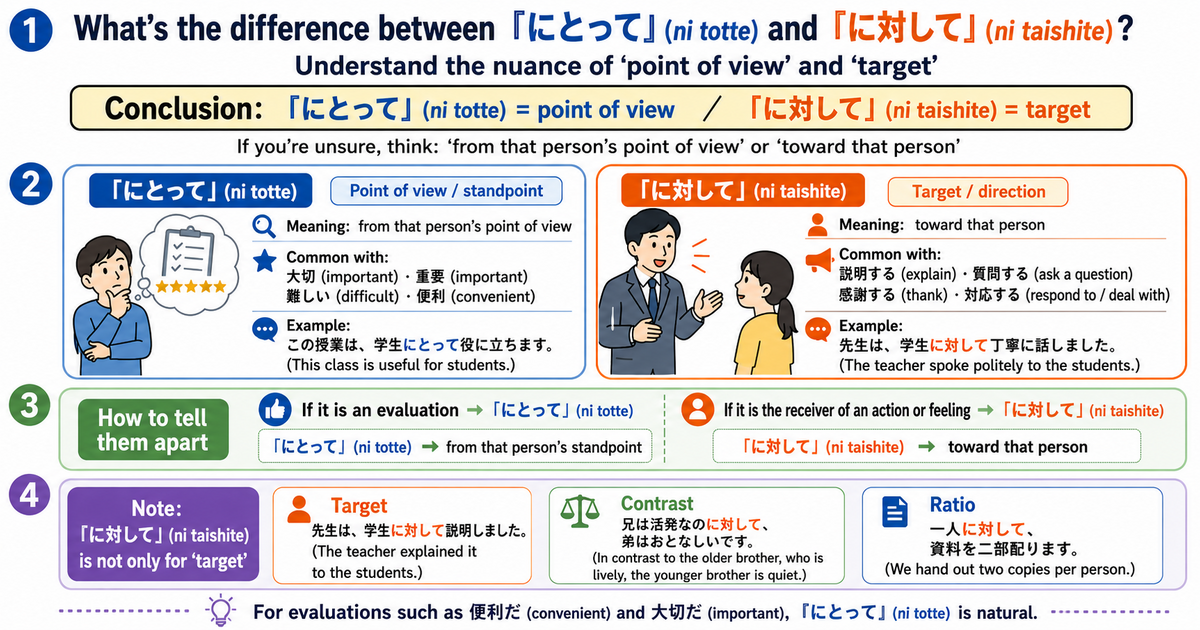
When studying Japanese, you will often encounter grammar patterns that look similar but express completely different directions of meaning.
A common example is the difference between:
- 「にとって」 (ni totte / from the viewpoint of)
- 「に対して」 (ni taishite / toward, in response to, in contrast to)
Consider the following sentences:
「この経験は、私にとって大切なものです。」
This experience is important to me.
「先生は、学生に対して丁寧に説明しました。」
The teacher explained it carefully to the students.
Both expressions appear after a noun. In both cases, the noun may refer to a person.
However, the role of that person is not the same.
With 「にとって」, the person is the viewpoint from which something is evaluated.
With 「に対して」, the person or thing is the target toward which an action, attitude, feeling, or response is directed.
Understanding this difference will help you not only with JLPT grammar questions, but also with reading comprehension questions where small nuances determine the correct answer.
The Key Difference: Viewpoint vs. Target
The simplest way to remember the difference is this:
「にとって」 shows the position from which someone evaluates something.
「に対して」 shows the target toward which something is directed.
Imagine a camera and an arrow.
- 「にとって」 tells you where the camera is positioned.
- 「に対して」 tells you where the arrow is pointing.
When you are unsure which expression to choose, ask yourself:
- Does this mean “from this person’s point of view”?
- Or does it mean “toward this person or thing”?
If it means “from this person’s point of view,” choose 「にとって」.
If it means “toward this person or thing,” choose 「に対して」.
What Does 「にとって」 Mean?
「にとって」 (ni totte) expresses a viewpoint, position, or perspective.
It is used when describing how something is evaluated by a person, group, organization, or other entity.
Basic Pattern
Noun + にとって
Example
「日本語は、私にとって大切な仕事の道具です。」
Japanese is an important work tool for me.
This sentence means:
「私の立場から見ると、日本語は大切な仕事の道具です。」
From my point of view, Japanese is an important work tool.
Nothing is being directed toward “me.”
Instead, the sentence describes the value of Japanese when viewed from my position.
More Examples
「外国人学習者にとって、敬語は難しいと感じることがあります。」
For learners from other countries, honorific language can sometimes feel difficult.
「子どもにとって、家族と過ごす時間はとても大切です。」
For children, time spent with family is very important.
「この試験は、初心者にとっては簡単ではありません。」
This exam is not easy for beginners.
「企業にとって、信頼は大切な財産です。」
For a company, trust is an important asset.
In each sentence, the noun before 「にとって」 identifies the viewpoint from which something is judged.
Words Commonly Used with 「にとって」
The second half of a sentence containing 「にとって」 often includes words expressing evaluation, value, importance, difficulty, or meaning.
Common examples include:
- 大切だ (taisetsu da / important)
- 重要だ (jūyō da / important)
- 必要だ (hitsuyō da / necessary)
- 難しい (muzukashii / difficult)
- 簡単だ (kantan da / easy)
- 便利だ (benri da / convenient)
- 問題だ (mondai da / a problem)
- 意味がある (imi ga aru / meaningful)
- 負担になる (futan ni naru / become a burden)
Examples
「学生にとって、毎日の復習は重要です。」
For students, reviewing every day is important.
「高齢者にとって、この階段は大きな負担になります。」
For elderly people, these stairs are a major burden.
「海外で働く人にとって、現地の言葉を学ぶことは大切です。」
For people working abroad, learning the local language is important.
When the end of the sentence expresses an evaluation, 「にとって」 is often the correct choice.
What Does 「に対して」 Mean?
「に対して」 (ni taishite) often indicates the target of an action, attitude, emotion, statement, or response.
It shows where something is directed.
Basic Pattern
Noun + に対して
Example
「先生は、学生に対して丁寧に説明しました。」
The teacher explained it carefully to the students.
The teacher’s explanation is directed toward the students.
The sentence does not mean “from the students’ point of view.”
The students are the target of the explanation.
More Examples
「店員は、お客様に対して失礼な態度を取ってはいけません。」
Staff members must not behave rudely toward customers.
「会社は、その問題に対してすぐに対応しました。」
The company responded to the problem immediately.
「彼は、環境問題に対して強い関心を持っています。」
He has a strong interest in environmental issues.
「両親に対して感謝の気持ちを伝えました。」
I expressed my gratitude to my parents.
The target does not have to be a person.
A problem, opinion, policy, or social issue can also appear before 「に対して」.
Words Commonly Used with 「に対して」
The second half of a sentence containing 「に対して」 often includes an action, reaction, emotion, or attitude directed toward a target.
Common examples include:
- 説明する (setsumei suru / explain)
- 質問する (shitsumon suru / ask)
- 注意する (chūi suru / warn)
- 反対する (hantai suru / oppose)
- 賛成する (sansei suru / support)
- 対応する (taiō suru / respond)
- 謝る (ayamaru / apologize)
- 感謝する (kansha suru / thank)
- 関心を持つ (kanshin o motsu / take an interest in)
- 不満を持つ (fuman o motsu / feel dissatisfied with)
- 態度を取る (taido o toru / take an attitude)
Examples
「政府の方針に対して、多くの人が反対しました。」
Many people opposed the government’s policy.
「先生は、学生の質問に対して詳しく答えました。」
The teacher answered the students’ questions in detail.
「その会社は、利用者の意見に対して迅速に対応しました。」
The company responded quickly to users’ feedback.
If an action, feeling, or reaction is directed toward a particular target, 「に対して」 is usually the natural choice.
Compare Similar Sentences
The difference becomes clearer when you compare sentences with similar nouns.
Example 1: Students
「この授業は、学生にとって役に立ちます。」
This class is useful for students.
「先生は、学生に対して丁寧に話しました。」
The teacher spoke politely to the students.
In the first sentence, the usefulness of the class is evaluated from the students’ viewpoint.
In the second sentence, the teacher’s speech is directed toward the students.
Example 2: International Residents
「漢字は、外国人にとって難しい場合があります。」
Kanji can be difficult for people from other countries.
「市役所は、外国人に対して生活情報を提供しています。」
The city office provides daily-life information to foreign residents.
In the first sentence, the difficulty of kanji is evaluated from the viewpoint of foreign learners.
In the second sentence, the city office’s service is directed toward foreign residents.
Example 3: Companies
「人材不足は、企業にとって深刻な問題です。」
A labor shortage is a serious problem for companies.
「自治体は、地域の企業に対して支援を行っています。」
The local government provides support to companies in the area.
In the first sentence, the labor shortage is evaluated from the companies’ viewpoint.
In the second sentence, the support is directed toward the companies.
A Useful Substitution Test
When you are unsure during a JLPT question, try replacing the expression with a simple phrase.
Replace 「にとって」 with:
「その人の立場から見ると」
From that person’s point of view
For example:
「子どもにとって、この本は少し難しいです。」
This book is a little difficult for children.
You can rephrase it as:
「子どもの立場から見ると、この本は少し難しいです。」
From a child’s point of view, this book is a little difficult.
The meaning remains natural, so 「にとって」 is correct.
Replace 「に対して」 with:
「その人や物事に向けて」
Toward that person or thing
For example:
「先生は、学生に対して丁寧に説明しました。」
The teacher explained it carefully to the students.
You can understand it as:
「先生は、学生に向けて丁寧に説明しました。」
The teacher explained it carefully toward the students.
The action has a target, so 「に対して」 is correct.
A Common Translation Trap
English speakers sometimes translate both expressions as “for” or “to.”
This can make the difference feel unclear.
Compare:
「この制度は、学生にとって便利です。」
This system is convenient for students.
「学校は、学生に対して支援を行っています。」
The school provides support to students.
In English, both “for” and “to” may appear in similar contexts.
However, in Japanese, the sentence structure is different.
The first sentence evaluates the system from the students’ viewpoint.
The second sentence describes support directed toward the students.
Instead of translating word by word, focus on the direction of meaning.
「に対して」 Can Also Express Contrast
「に対して」 does not always indicate the target of an action.
In JLPT reading passages, it frequently appears when two things are compared or contrasted.
Example
「兄は活発な性格であるのに対して、弟はおとなしい性格です。」
The older brother is energetic, whereas the younger brother is quiet.
「都市部では人口が増えているのに対して、地方では人口が減っています。」
The population is increasing in urban areas, whereas it is decreasing in rural areas.
In these examples, 「に対して」 means:
- whereas
- in contrast
- on the other hand
When the sentences before and after 「に対して」 describe different or opposite situations, the expression is showing contrast.
Reading Tip
When you see 「に対して」, do not immediately assume that it means “toward.”
Check the context.
Ask yourself:
- Is an action directed toward a target?
- Or are two situations being compared?
This habit can prevent mistakes in JLPT reading questions.
「に対して」 Can Also Express a Ratio
「に対して」 is also used to describe a numerical ratio or corresponding quantity.
Examples
「参加者一人に対して、資料を二部配ります。」
Two copies of the document will be distributed per participant.
「社員十人に対して、管理者が一人必要です。」
One manager is needed for every ten employees.
In this use, 「に対して」 means:
- per
- for every
- in relation to
When numbers appear near 「に対して」, check whether the sentence is describing a ratio.
Common Mistakes
Mistake 1: Using 「に対して」 for an Evaluation
「この制度は、学生に対して便利です。」
This sentence sounds unnatural.
The sentence describes how convenient the system is from the students’ viewpoint.
The natural sentence is:
「この制度は、学生にとって便利です。」
This system is convenient for students.
Mistake 2: Using 「にとって」 for the Target of an Action
「先生は、学生にとって注意しました。」
This sentence is unnatural.
The warning is directed toward the students.
The natural sentence is:
「先生は、学生に対して注意しました。」
The teacher warned the students.
Mistake 3: Memorizing Only One Meaning of 「に対して」
「に対して」 has several important uses.
- The target of an action, feeling, or attitude
- A contrast between two situations
- A numerical ratio or corresponding quantity
To choose the correct interpretation, always read the surrounding context.
Quick Practice Questions
Choose either 「にとって」 or 「に対して」.
Question 1
「初心者____、この教材は少し難しいかもしれません。」
Answer:
「初心者にとって、この教材は少し難しいかもしれません。」
For beginners, this learning material may be slightly difficult.
The sentence expresses an evaluation from the viewpoint of beginners.
Question 2
「担当者は、利用者の質問____丁寧に答えました。」
Answer:
「担当者は、利用者の質問に対して丁寧に答えました。」
The person in charge answered the user’s question carefully.
The answer is directed toward the question.
Question 3
「兄はスポーツが得意なの____、弟は音楽が得意です。」
Answer:
「兄はスポーツが得意なのに対して、弟は音楽が得意です。」
The older brother is good at sports, whereas the younger brother is good at music.
The sentence contrasts two people.
Question 4
「受験生一人____、解答用紙を一枚配ってください。」
Answer:
「受験生一人に対して、解答用紙を一枚配ってください。」
Please distribute one answer sheet per examinee.
The sentence expresses a ratio.
A Four-Step Strategy for JLPT Reading Questions
When you find 「にとって」 or 「に対して」 in a reading passage, follow these steps:
- Check whether the second half of the sentence expresses an evaluation.
- Check whether an action, feeling, or attitude is directed toward a target.
- Check whether two situations are being compared.
- Check whether numbers indicate a ratio.
The goal is not to translate each word mechanically.
The goal is to understand the role that the expression plays in the sentence.
For a broader view of similar inference and judgment expressions, see the guide to confusing JLPT inference expressions. JLPT Inference and Judgment Expressions
For a broader view of cause and reason expressions, see the guide to confusing JLPT reason expressions. Confusing JLPT Reason and Cause Expressions
Summary: Look for the Viewpoint and the Direction
「にとって」 and 「に対して」 may look similar, but they point in different directions.
「にとって」 shows the viewpoint from which something is evaluated.
「に対して」 shows the target toward which an action, attitude, or feeling is directed.
Remember that 「に対して」 can also express contrast and numerical ratios.
When reading Japanese, do not stop at the rough meaning of the sentence.
Ask yourself:
- Whose viewpoint is being described?
- What is the action directed toward?
- Are two situations being contrasted?
- Is the sentence showing a numerical ratio?
Once you learn to notice these small signals, difficult JLPT choices become much easier to eliminate.
At RJT (Rapid Japanese Training), you can strengthen this skill by solving practical JLPT questions and checking why each answer is correct.
Do not just read grammar explanations. Turn your understanding into real test-taking ability through practice.
%E3%80%8C%E6%9C%9F%E9%99%90%E3%82%92%E5%AE%88%E3%82%8B%E3%80%8D%E3%81%A8%E3%80%8C%E7%B7%A0%E3%82%81%E5%88%87%E3%82%8A%E3%81%AB%E9%96%93%E3%81%AB%E5%90%88%E3%81%86%E3%80%8D%E3%81%AE%E9%81%95%E3%81%84%EF%BC%88%E8%8B%B1%EF%BC%89.png)
%E3%80%8C%E4%BA%88%E5%AE%9A%E3%81%8C%E5%85%A5%E3%82%8B%E3%80%8D%E3%81%A8%E3%80%8C%E4%BA%88%E5%AE%9A%E3%82%92%E5%85%A5%E3%82%8C%E3%82%8B%E3%80%8D%E3%81%AE%E9%81%95%E3%81%84%EF%BC%88%E8%8B%B1%EF%BC%89.png)
%E3%80%8C%E8%87%AA%E4%BF%A1%E3%81%8C%E3%81%82%E3%82%8B%E3%80%8D%E3%81%A8%E3%80%8C%E8%87%AA%E4%BF%A1%E3%82%92%E6%8C%81%E3%81%A4%E3%80%8D%E3%81%AE%E9%81%95%E3%81%84%EF%BC%88%E8%8B%B1%EF%BC%89.png)
%E3%80%8C%E5%BF%85%E8%A6%81%E3%81%8C%E3%81%82%E3%82%8B%E3%80%8D%E3%81%A8%E3%80%8C%E5%BF%85%E8%A6%81%E3%81%AB%E3%81%AA%E3%82%8B%E3%80%8D%E3%81%AE%E9%81%95%E3%81%84%EF%BC%88%E8%8B%B1%EF%BC%89.png)
%E3%80%8C%E5%8F%AF%E8%83%BD%E6%80%A7%E3%81%8C%E9%AB%98%E3%81%84%E3%80%8D%E3%81%A8%E3%80%8C%E5%8F%AF%E8%83%BD%E6%80%A7%E3%81%8C%E3%81%82%E3%82%8B%E3%80%8D%E3%81%AE%E9%81%95%E3%81%84%EF%BC%88%E8%8B%B1%EF%BC%89.png)
%E3%80%8C%E7%B5%90%E8%AB%96%E3%82%92%E5%87%BA%E3%81%99%E3%80%8D%E3%81%A8%E3%80%8C%E7%B5%90%E8%AB%96%E3%81%AB%E9%81%94%E3%81%99%E3%82%8B%E3%80%8D%E3%81%AE%E9%81%95%E3%81%84%EF%BC%88%E8%8B%B1%EF%BC%89.png)