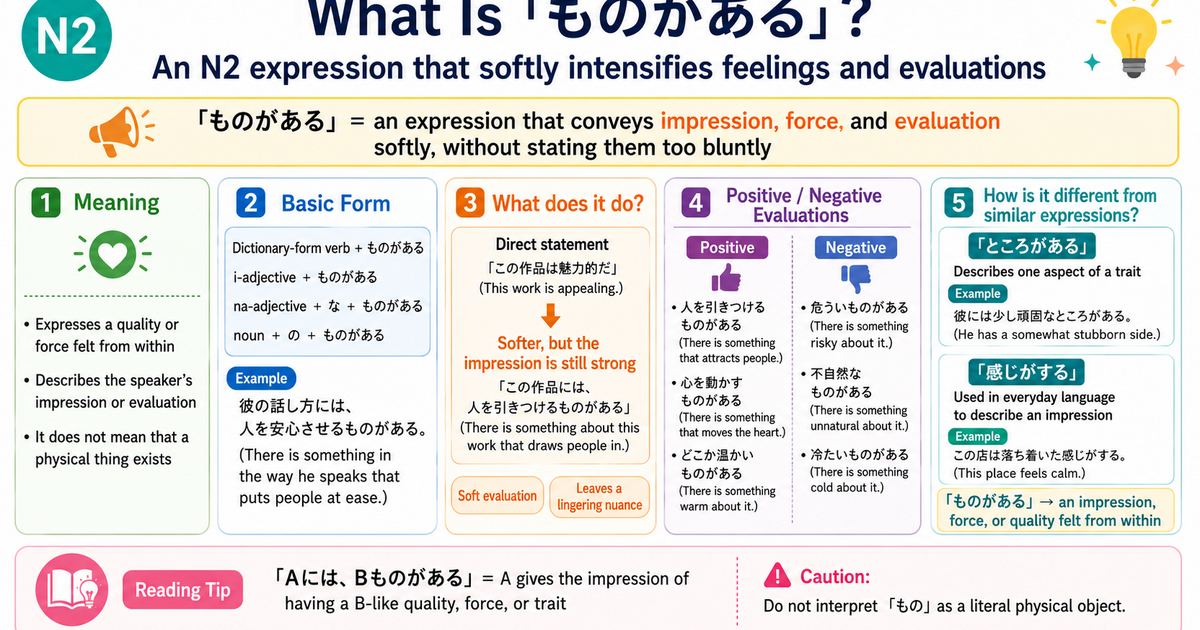
%E3%80%8C%E3%82%82%E3%81%AE%E3%81%8C%E3%81%82%E3%82%8B%E3%80%8D%E3%81%A8%E3%81%AF%E4%BD%95%E3%81%8B%EF%BC%9F%E6%84%9F%E6%83%85%E3%82%84%E8%A9%95%E4%BE%A1%E3%82%92%E3%82%84%E3%82%8F%E3%82%89%E3%81%8B%E3%81%8F%E5%BC%B7%E3%82%81%E3%82%8BN2%E8%A1%A8%E7%8F%BE%EF%BC%88%E8%8B%B1%EF%BC%89.png)
When reading Japanese, especially essays, reviews, or JLPT N2 reading passages, you may come across sentences like these.
彼の話し方には、人を安心させるものがある。
There is something in the way he speaks that makes people feel at ease.
この映画には、何度も見たくなるものがある。
There is something about this movie that makes you want to watch it again and again.
その決断には、少し危ういものがある。
There is something slightly risky about that decision.
In these sentences, 「ものがある」 does not mean that a physical “thing” exists.
Instead, it means that something has a certain quality, impression, power, or feeling that is difficult to describe directly, but can clearly be felt.
In simple terms, 「ものがある」 means:
“There is something about it that feels…”
“It has a certain quality that…”
“It gives the impression of…”
“There is something in it that…”
This article explains the meaning and use of 「ものがある」 as a JLPT N2 grammar pattern, especially how it softly strengthens emotions and evaluations.
「ものがある」 expresses a quality felt inside something
「ものがある」 is used when the speaker senses a certain quality, power, mood, or impression in a person, object, action, work, or situation.
For example:
この小説には、人の心を動かすものがある。
This novel has something that moves people’s hearts.
This sentence means:
この小説には、人の心を動かす力がある。
This novel has the power to move people’s hearts.
But 「ものがある」 sounds softer and more indirect than simply saying 「力がある」.
It suggests that the speaker feels something strongly, even if it is not easy to explain in exact words.
That is why 「ものがある」 often appears in writing that expresses impressions, evaluations, or reflections.
Basic sentence patterns
The basic forms are as follows.
Verb dictionary form + ものがある
い-adjective + ものがある
な-adjective + ものがある
Noun + の + ものがある
Examples:
彼の演奏には、人を引きつけるものがある。
There is something in his performance that attracts people.
この発想には、新しいものがある。
There is something new in this idea.
その説明には、少し不自然なものがある。
There is something slightly unnatural about that explanation.
彼女の言葉には、説得力のようなものがある。
There is something like persuasiveness in her words.
A very common pattern is:
Aには、Bものがある。
There is something B about A.
This means that A gives the speaker a certain impression or contains a certain quality.
「ものがある」 softly strengthens an evaluation
One important point is that 「ものがある」 does not simply describe an impression.
It also softly strengthens an evaluation.
Compare these two sentences.
この作品は魅力的だ。
This work is attractive.
この作品には、人を引きつけるものがある。
There is something about this work that attracts people.
The first sentence gives a direct evaluation.
The second sentence sounds more thoughtful, more literary, and more natural in a review or essay.
It does not feel weak. Rather, it gives the impression that the quality is difficult to explain fully, but clearly present.
This is the special nuance of 「ものがある」.
It is soft, but meaningful.
It is indirect, but still strong.
It can be used for both positive and negative evaluations
「ものがある」 can be used in both positive and negative contexts.
For positive evaluations, it often appears with expressions like these.
人を引きつけるものがある。
There is something that attracts people.
心を動かすものがある。
There is something that moves the heart.
見る人を安心させるものがある。
There is something that makes viewers feel at ease.
どこか温かいものがある。
There is something somehow warm about it.
説得力のあるものがある。
There is something persuasive about it.
For negative or cautious evaluations, it can also be used like this.
この計画には、危ういものがある。
There is something risky about this plan.
彼の説明には、不自然なものがある。
There is something unnatural about his explanation.
その態度には、冷たいものがある。
There is something cold about that attitude.
今回の判断には、疑問を感じさせるものがある。
There is something about this decision that raises questions.
In this way, 「ものがある」 allows the speaker to express an evaluation while keeping some distance.
It does not sound too emotional or too direct, but the evaluation is still clearly conveyed.
Difference between 「ものがある」 and 「ところがある」
A similar expression is 「ところがある」.
彼には少し頑固なところがある。
He has a somewhat stubborn side.
彼の言葉には、人を安心させるものがある。
There is something in his words that makes people feel at ease.
「ところがある」 is often used to describe one aspect or part of someone’s personality or something’s nature.
In contrast, 「ものがある」 expresses a quality, force, or impression that is felt from something.
彼には頑固なところがある。
He has a stubborn side.
This describes one part of his personality.
彼の話し方には、人を引きつけるものがある。
There is something in the way he speaks that attracts people.
This means that his way of speaking gives the impression of having a certain attractive power.
In short:
「ところがある」 points to a certain aspect.
「ものがある」 points to a felt impression, quality, or power.
Difference between 「ものがある」 and 「感じがする」
「ものがある」 is also close to 「感じがする」.
この店には、落ち着いた感じがする。
This shop has a calm feeling.
この店には、どこか落ち着くものがある。
There is something about this shop that makes you feel calm.
「感じがする」 is more casual and directly describes a feeling or impression.
「ものがある」 is more written, more reflective, and often used when giving an evaluation.
That is why 「ものがある」 is common in JLPT N2 reading passages, especially in essays, reviews, commentaries, and explanatory texts.
How to read 「ものがある」 in JLPT N2 passages
When you see 「ものがある」 in an N2 reading passage, do not translate 「もの」 as a physical “thing.”
Instead, look at two points.
First, check what is being evaluated.
彼の言葉には
In his words
この作品には
In this work
今回の対応には
In this response
その町の風景には
In the scenery of that town
Next, check what kind of impression or quality is being described.
説得力のあるものがある。
There is something persuasive.
懐かしいものがある。
There is something nostalgic.
不安を感じさせるものがある。
There is something that makes one feel uneasy.
人を励ますものがある。
There is something that encourages people.
For example:
彼の言葉には、人を前向きにさせるものがある。
There is something in his words that makes people feel positive.
This means:
彼の言葉には、人を前向きにするような力や魅力がある。
His words have a kind of power or appeal that makes people feel positive.
More example sentences
この写真には、見る人を静かな気持ちにさせるものがある。
There is something in this photograph that makes viewers feel calm.
彼の説明には、少し疑問を感じさせるものがある。
There is something in his explanation that makes one feel some doubt.
この町の古い建物には、どこか懐かしいものがある。
There is something somehow nostalgic about the old buildings in this town.
今回の成功には、多くの人を勇気づけるものがある。
There is something in this success that encourages many people.
These examples show that 「ものがある」 is useful when describing impressions, emotions, and evaluations in a natural way.
「ものがある」 makes your Japanese sound more mature
「ものがある」 is not a casual expression used all the time in everyday conversation.
It is more common in written Japanese, reviews, essays, explanations, and thoughtful comments.
For example:
この映画は感動的です。
This movie is moving.
This is correct and natural.
But:
この映画には、人の心に残るものがある。
There is something about this movie that remains in people’s hearts.
This sounds more like a natural review or essay.
Another example:
この計画は危険です。
This plan is dangerous.
This is direct.
この計画には、やや危ういものがある。
There is something somewhat risky about this plan.
This sounds softer, more controlled, and more suitable for written evaluation.
That is why 「ものがある」 is a useful expression for learners who want to understand and produce more natural intermediate to advanced Japanese.
For a broader view of similar inference and judgment expressions, see the guide to confusing JLPT inference expressions. JLPT Inference and Judgment Expressions
For a broader view of cause and reason expressions, see the guide to confusing JLPT reason expressions. Confusing JLPT Reason and Cause Expressions
Summary
「ものがある」 is a JLPT N2 grammar pattern used to express a quality, impression, power, or evaluation that is felt in something.
It often appears in expressions such as:
人を引きつけるものがある
There is something that attracts people
心を動かすものがある
There is something that moves the heart
不自然なものがある
There is something unnatural
危ういものがある
There is something risky
The key point is not to understand 「もの」 as a physical object.
When you see:
Aには、Bものがある
you can understand it as:
A has a certain quality, impression, or power that feels B.
RJT helps learners study grammar, vocabulary, reading, and listening together so that expressions like 「ものがある」 can be understood naturally in context.
By practicing with example sentences and questions, you can learn not only the meaning of Japanese grammar, but also the feeling behind it.
%E3%80%8C%E3%81%AB%E3%82%8F%E3%81%9F%E3%81%A3%E3%81%A6%E3%80%8D%E3%81%A8%E3%80%8C%E3%81%AB%E3%82%8F%E3%81%9F%E3%82%8A%E3%80%8D%E3%81%AE%E9%81%95%E3%81%84%E3%81%AF%EF%BC%9F%E6%9C%9F%E9%96%93%E3%83%BB%E7%AF%84%E5%9B%B2%E3%81%AE%E7%A1%AC%E3%81%84%E8%A1%A8%E7%8F%BE%E3%82%92%E6%95%B4%E7%90%86%EF%BC%88%E8%8B%B1%EF%BC%89.png)
%E3%80%8C%E3%82%88%E3%81%86%E3%81%A8%E3%81%99%E3%82%8B%E3%80%8D%E3%81%A8%E3%80%8C%E3%81%A4%E3%82%82%E3%82%8A%E3%81%A0%E3%80%8D%E3%81%AE%E9%81%95%E3%81%84%E3%81%AF%EF%BC%9F%E8%A1%8C%E5%8B%95%E7%9B%B4%E5%89%8D%E3%81%A8%E6%84%8F%E5%BF%97%E3%81%AE%E5%B7%AE%E3%82%92%E6%95%B4%E7%90%86%E3%81%99%E3%82%8B%EF%BC%88%E8%8B%B1%EF%BC%89.png)
%E3%83%AA%E3%82%B9%E3%83%8B%E3%83%B3%E3%82%B0%E3%81%A7%E3%82%88%E3%81%8F%E3%81%82%E3%82%8B%E3%81%B2%E3%81%A3%E3%81%8B%E3%81%91%EF%BC%9A%E7%B5%90%E8%AB%96%E3%81%8C%E6%9C%80%E5%BE%8C%E3%81%AB%E3%81%8F%E3%82%8B%E3%81%A8%E3%81%AF%E9%99%90%E3%82%89%E3%81%AA%E3%81%84%EF%BC%88%E8%8B%B1%EF%BC%89.png)
%E8%AA%AD%E8%A7%A3%E3%81%AE%E6%AD%A3%E8%A7%A3%E7%8E%87%E3%81%8C%E4%B8%8A%E3%81%8C%E3%82%89%E3%81%AA%E3%81%84%E4%BA%BA%E3%81%B8%E3%80%82%E6%9C%80%E5%88%9D%E3%81%AB%E8%A6%8B%E3%82%8B%E3%81%B9%E3%81%8D%E3%81%AF%E6%9C%AC%E6%96%87%E3%81%A7%E3%81%AF%E3%81%AA%E3%81%8F%E8%A8%AD%E5%95%8F%EF%BC%88%E8%8B%B1%EF%BC%89.png)
%20%E3%80%8C%E3%81%9F%E3%81%A8%E3%81%93%E3%82%8D%E3%81%A7%E3%80%8D%E3%81%A8%E3%80%8C%E3%81%A6%E3%82%82%E3%80%8D%E3%81%AE%E9%81%95%E3%81%84%E3%81%AF%EF%BC%9F%E7%84%A1%E6%84%8F%E5%91%B3%E3%83%BB%E9%99%90%E7%95%8C%E3%82%92%E8%A1%A8%E3%81%99%E3%83%8B%E3%83%A5%E3%82%A2%E3%83%B3%E3%82%B9%E3%82%92%E6%95%B4%E7%90%86%EF%BC%88%E8%8B%B1%EF%BC%89.png)
%20%E3%80%8C%E3%81%AE%E3%81%BF%E3%81%AA%E3%82%89%E3%81%9A%E3%80%8D%E3%81%A8%E3%80%8C%E3%81%B0%E3%81%8B%E3%82%8A%E3%81%8B%E3%80%8D%E3%81%AE%E9%81%95%E3%81%84%E3%81%AF%EF%BC%9F%E7%A1%AC%E3%81%84%E6%96%87%E7%AB%A0%E3%81%A7%E5%BA%83%E3%81%8C%E3%82%8A%E3%82%92%E8%A1%A8%E3%81%99%E6%96%B9%E6%B3%95%EF%BC%88%E8%8B%B1%EF%BC%89.png)