How to Use 「どころではない」 in Japanese
「どころではない」 is a useful Japanese expression that often appears around the JLPT N2 level.
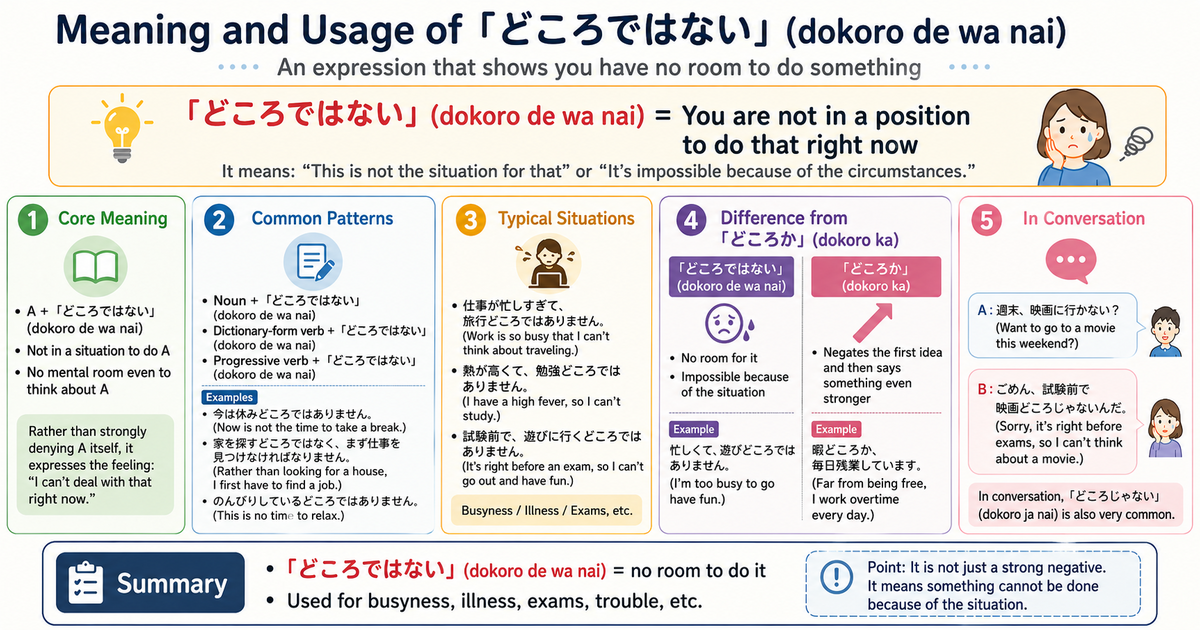
It means “to be in no position to do something” or “this is not the time for that.”
It is used when someone cannot do something because another situation is too serious, busy, or urgent.
Basic meaning
「Aどころではない」 means “I cannot do A now” or “I do not have the time or mental space for A.”
Examples:
仕事が忙しすぎて、旅行どころではありません。
I am too busy with work to even think about traveling.
熱が高くて、勉強どころではありません。
I have a high fever, so studying is out of the question.
試験前で、遊びに行くどころではありません。
The exam is coming, so this is not the time to go out and have fun.
The expression does not simply deny A. It means the situation makes A impossible or unrealistic.
Common patterns
Noun + どころではない
Dictionary-form verb + どころではない
ている-form verb + どころではない
Examples:
今は休みどころではありません。
This is not the time to take a break.
家を探すどころではなく、まず仕事を見つけなければなりません。
I am in no position to look for a house; first I need to find a job.
のんびりしているどころではありません。
This is not the time to relax.
Difference from 「どころか」
「どころか」 is used to deny the first idea and introduce something even stronger.
Example:
暇どころか、毎日残業しています。
Far from being free, I work overtime every day.
「どころではない」 focuses on not having enough time, energy, or mental space.
Example:
忙しくて、遊びどころではありません。
I am too busy to play.
Conversation use
In casual speech, 「どころじゃない」 is also common.
Example:
A:週末、映画に行かない?
B:ごめん、試験前で映画どころじゃないんだ。
A: Do you want to go to a movie this weekend?
B: Sorry, I have exams soon. This is not the time for movies.
Summary
「どころではない」 means that someone is in no position to do something.
Use it when work, illness, exams, trouble, or another serious situation makes an action impossible.
Related guide:JLPT Negative Expressions That Learners Often Confuse
%E3%80%8C%E6%9C%9F%E9%99%90%E3%82%92%E5%AE%88%E3%82%8B%E3%80%8D%E3%81%A8%E3%80%8C%E7%B7%A0%E3%82%81%E5%88%87%E3%82%8A%E3%81%AB%E9%96%93%E3%81%AB%E5%90%88%E3%81%86%E3%80%8D%E3%81%AE%E9%81%95%E3%81%84%EF%BC%88%E8%8B%B1%EF%BC%89.png)
%E3%80%8C%E4%BA%88%E5%AE%9A%E3%81%8C%E5%85%A5%E3%82%8B%E3%80%8D%E3%81%A8%E3%80%8C%E4%BA%88%E5%AE%9A%E3%82%92%E5%85%A5%E3%82%8C%E3%82%8B%E3%80%8D%E3%81%AE%E9%81%95%E3%81%84%EF%BC%88%E8%8B%B1%EF%BC%89.png)
%E3%80%8C%E8%87%AA%E4%BF%A1%E3%81%8C%E3%81%82%E3%82%8B%E3%80%8D%E3%81%A8%E3%80%8C%E8%87%AA%E4%BF%A1%E3%82%92%E6%8C%81%E3%81%A4%E3%80%8D%E3%81%AE%E9%81%95%E3%81%84%EF%BC%88%E8%8B%B1%EF%BC%89.png)
%E3%80%8C%E5%BF%85%E8%A6%81%E3%81%8C%E3%81%82%E3%82%8B%E3%80%8D%E3%81%A8%E3%80%8C%E5%BF%85%E8%A6%81%E3%81%AB%E3%81%AA%E3%82%8B%E3%80%8D%E3%81%AE%E9%81%95%E3%81%84%EF%BC%88%E8%8B%B1%EF%BC%89.png)
%E3%80%8C%E5%8F%AF%E8%83%BD%E6%80%A7%E3%81%8C%E9%AB%98%E3%81%84%E3%80%8D%E3%81%A8%E3%80%8C%E5%8F%AF%E8%83%BD%E6%80%A7%E3%81%8C%E3%81%82%E3%82%8B%E3%80%8D%E3%81%AE%E9%81%95%E3%81%84%EF%BC%88%E8%8B%B1%EF%BC%89.png)
%E3%80%8C%E7%B5%90%E8%AB%96%E3%82%92%E5%87%BA%E3%81%99%E3%80%8D%E3%81%A8%E3%80%8C%E7%B5%90%E8%AB%96%E3%81%AB%E9%81%94%E3%81%99%E3%82%8B%E3%80%8D%E3%81%AE%E9%81%95%E3%81%84%EF%BC%88%E8%8B%B1%EF%BC%89.png)