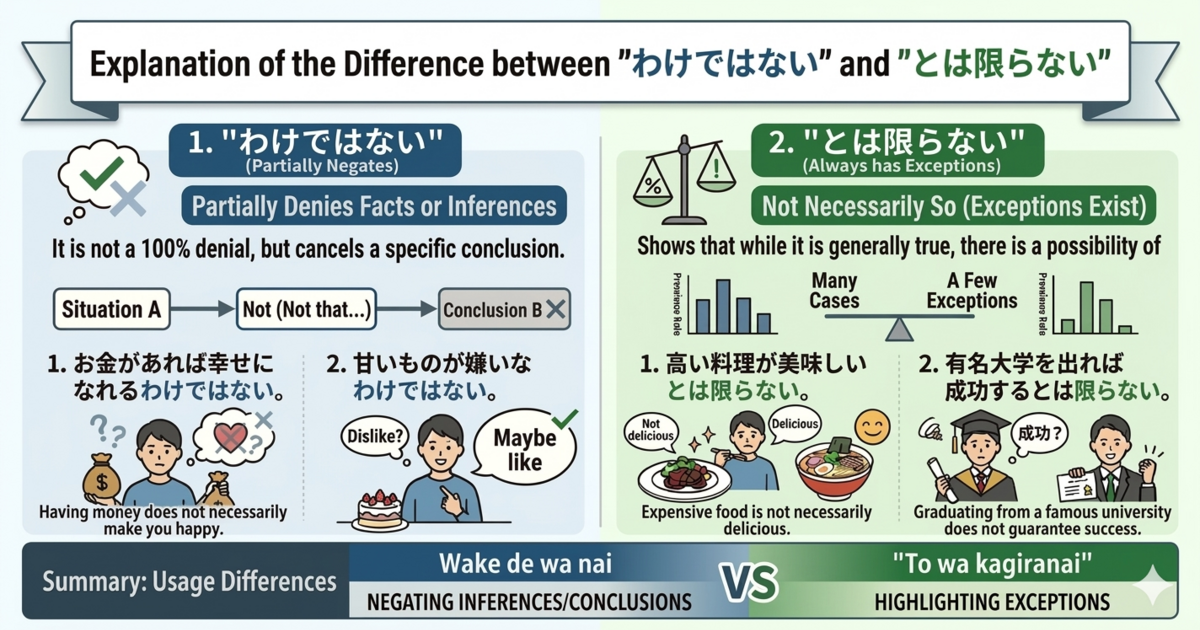
When studying Japanese, you may come across grammar patterns that both seem to weaken a strong statement.
Two common examples are:
「わけではない」
「とは限らない」
For example:
高いレストランが、おいしいわけではない。
An expensive restaurant is not necessarily delicious.
高いレストランが、おいしいとは限らない。
An expensive restaurant is not always delicious.
These two sentences look very close in meaning.
However, in Japanese, the point they focus on is slightly different.
Once you understand this difference, it becomes much easier to see how much the speaker is denying, correcting, or limiting a statement in reading and conversation.
First, the conclusion
「わけではない」 is used when the speaker does not fully accept a certain interpretation, assumption, or conclusion.
「とは限らない」 is used when the speaker says that something is not always true, and that there are exceptions.
In simple terms:
「わけではない」
→ The speaker corrects a conclusion someone might make.
「とは限らない」
→ The speaker says that even if something seems generally true, it is not always true.
They are similar, but the direction is different.
「わけではない」 corrects how something is understood.
「とは限らない」 limits a general rule or assumption by pointing out exceptions.
「わけではない」 softly denies an overstatement
「わけではない」 is used to say:
It does not mean that it is completely so.
It is not necessarily the case that this conclusion is true.
That is not exactly what I mean.
The important point is that 「わけではない」 does not always completely deny everything.
Example
彼は野球が嫌いなわけではない。
忙しくて、最近見ていないだけだ。
It is not that he dislikes baseball.
He has just been busy and has not watched it recently.
In this sentence, the speaker denies the interpretation:
彼は野球が嫌いだ。
He dislikes baseball.
However, the speaker is not saying that he loves baseball either.
The expression softly rejects a strong assumption.
Another example
日本で長く暮らしているからといって、日本語が完璧なわけではない。
Just because someone has lived in Japan for a long time, it does not mean their Japanese is perfect.
Here, the speaker corrects the assumption:
長く住んでいる = 日本語が完璧だ
Living there for a long time means their Japanese is perfect.
The sentence says that their Japanese is not perfect.
But it does not mean that they cannot speak Japanese at all.
In this way, 「わけではない」 does not divide things simply into black and white.
It gently pulls back an overstatement and places the meaning in a more balanced position.
「とは限らない」 shows that there are exceptions
「とは限らない」 means:
It is not always true.
That may happen, but not in every case.
There are exceptions.
This expression is used when a rule, assumption, or general idea is not true 100 percent of the time.
Example
お金があれば幸せになれるとは限らない。
Having money does not always mean you can become happy.
This sentence responds to the idea:
お金があれば幸せになれる。
If you have money, you can become happy.
The speaker says that this may be true for some people, but not for everyone.
The key point here is the existence of exceptions.
Another example
日本語の文法がわかっていても、会話が上手にできるとは限らない。
Even if you understand Japanese grammar, it does not necessarily mean you can speak well.
This does not mean grammar is useless.
It means that understanding grammar and being good at conversation do not always match.
So 「とは限らない」 prevents a general idea from being treated as a universal truth.
Comparing the two expressions
Let’s compare the following pairs.
Pair 1
高いレストランが、おいしいわけではない。
It is not that expensive restaurants are always delicious.
高いレストランが、おいしいとは限らない。
Expensive restaurants are not always delicious.
The first sentence has the nuance:
The idea “expensive means delicious” should not be accepted as it is.
The second sentence more clearly focuses on the existence of exceptions:
Even if a restaurant is expensive, there are cases where it is not delicious.
Pair 2
彼が怒っているわけではない。
It is not that he is angry.
彼が怒っているとは限らない。
It is not necessarily true that he is angry.
These two are not used in exactly the same way.
「彼が怒っているわけではない」 sounds natural.
It corrects someone’s impression, such as:
Is he angry?
The speaker responds:
No, that is not really the case.
On the other hand, 「彼が怒っているとは限らない」 can sound a little unnatural in an ordinary situation.
This is because the sentence is not about a general rule.
It is about how to understand one person’s feeling in a specific moment.
「とは限らない」 is better suited to saying:
There are exceptions to this judgment or general idea.
It is less suited to correcting one specific misunderstanding in the moment.
How to use them correctly
When you are not sure which one to use, think in this way.
Use 「わけではない」 when you want to correct someone’s interpretation
Use it when someone might think:
So, that means this, right?
And you want to respond:
No, I am not saying that much.
That is not exactly what I mean.
For example:
嫌いなわけではない。
It is not that I dislike it.
反対しているわけではない。
It is not that I am against it.
できないわけではない。
It is not that I cannot do it.
Use 「とは限らない」 when you want to show that a general idea has exceptions
Use it when you want to say:
People may usually think so, but it is not always true.
For example:
努力すれば必ず成功するとは限らない。
Even if you make an effort, you do not always succeed.
有名だからといって、いい商品とは限らない。
Just because something is famous does not mean it is a good product.
早く答えた人が正しいとは限らない。
The person who answers quickly is not always correct.
In one sentence:
「わけではない」 corrects an interpretation.
「とは限らない」 adds a reservation to a general statement.
Common misunderstandings
「わけではない」 does not mean complete denial
This is very important.
When someone says:
好きなわけではない。
It is not that I like it.
You might think:
Then they hate it.
But that is not necessarily true.
It may mean:
I do not like it that much.
I like it a little, but not strongly.
It is not that simple.
「わけではない」 often leaves some ambiguity.
It softens a strong interpretation instead of replacing it with the exact opposite.
「とは限らない」 does not mean “probably not”
「とは限らない」 does not completely deny a possibility.
For example:
明日、雨が降るとは限らない。
It is not certain that it will rain tomorrow.
This does not mean:
It will not rain.
It means:
It is not decided that it will rain.
The expression avoids making a definite statement.
It does not reduce the possibility to zero.
More example sentences
Let’s finish by looking at examples where the difference is clear.
「わけではない」
毎日勉強しているからといって、すぐに上達するわけではない。
Just because you study every day does not mean you will improve immediately.
彼女は人づきあいが苦手なわけではないが、一人の時間も大切にしている。
It is not that she is bad at socializing, but she also values time alone.
日本語が難しいわけではない。ただ、慣れるまで時間がかかる。
It is not that Japanese is difficult. It just takes time to get used to it.
「とは限らない」
毎日勉強していても、必ず成績が上がるとは限らない。
Even if you study every day, your grades do not always go up.
有名な大学を出たからといって、仕事ができるとは限らない。
Just because someone graduated from a famous university does not necessarily mean they are good at work.
先生の説明を聞いただけで、みんなが理解できるとは限らない。
Just because everyone listened to the teacher’s explanation does not mean everyone can understand it.
When you compare them like this, the difference becomes clearer.
「わけではない」 softens or corrects an overstatement.
「とは限らない」 points out exceptions.
For a broader overview of negative patterns, see the guide to confusing JLPT negative expressions. Confusing JLPT Negative Expressions
Summary
「わけではない」 is used when the speaker does not accept a certain conclusion exactly as it is, and wants to correct it softly.
「とは限らない」 is used when the speaker points out that a general idea or assumption has exceptions.
They look similar because both weaken a statement.
However, they do not look in the same direction.
Do you want to gently correct someone’s understanding?
Or do you want to say that a general idea is not always true?
If you notice this difference, you can use them much more naturally.
Subtle Japanese nuances become much easier to understand when you can catch these small differences.
If you want to learn subtle differences like 「わけではない」 and 「とは限らない」 through examples and practice questions, check actual usage with RJT.
Related grammar guide: JLPT Negative and Limitation Expressions
%E3%80%8C%E6%9C%9F%E9%99%90%E3%82%92%E5%AE%88%E3%82%8B%E3%80%8D%E3%81%A8%E3%80%8C%E7%B7%A0%E3%82%81%E5%88%87%E3%82%8A%E3%81%AB%E9%96%93%E3%81%AB%E5%90%88%E3%81%86%E3%80%8D%E3%81%AE%E9%81%95%E3%81%84%EF%BC%88%E8%8B%B1%EF%BC%89.png)
%E3%80%8C%E4%BA%88%E5%AE%9A%E3%81%8C%E5%85%A5%E3%82%8B%E3%80%8D%E3%81%A8%E3%80%8C%E4%BA%88%E5%AE%9A%E3%82%92%E5%85%A5%E3%82%8C%E3%82%8B%E3%80%8D%E3%81%AE%E9%81%95%E3%81%84%EF%BC%88%E8%8B%B1%EF%BC%89.png)
%E3%80%8C%E8%87%AA%E4%BF%A1%E3%81%8C%E3%81%82%E3%82%8B%E3%80%8D%E3%81%A8%E3%80%8C%E8%87%AA%E4%BF%A1%E3%82%92%E6%8C%81%E3%81%A4%E3%80%8D%E3%81%AE%E9%81%95%E3%81%84%EF%BC%88%E8%8B%B1%EF%BC%89.png)
%E3%80%8C%E5%BF%85%E8%A6%81%E3%81%8C%E3%81%82%E3%82%8B%E3%80%8D%E3%81%A8%E3%80%8C%E5%BF%85%E8%A6%81%E3%81%AB%E3%81%AA%E3%82%8B%E3%80%8D%E3%81%AE%E9%81%95%E3%81%84%EF%BC%88%E8%8B%B1%EF%BC%89.png)
%E3%80%8C%E5%8F%AF%E8%83%BD%E6%80%A7%E3%81%8C%E9%AB%98%E3%81%84%E3%80%8D%E3%81%A8%E3%80%8C%E5%8F%AF%E8%83%BD%E6%80%A7%E3%81%8C%E3%81%82%E3%82%8B%E3%80%8D%E3%81%AE%E9%81%95%E3%81%84%EF%BC%88%E8%8B%B1%EF%BC%89.png)
%E3%80%8C%E7%B5%90%E8%AB%96%E3%82%92%E5%87%BA%E3%81%99%E3%80%8D%E3%81%A8%E3%80%8C%E7%B5%90%E8%AB%96%E3%81%AB%E9%81%94%E3%81%99%E3%82%8B%E3%80%8D%E3%81%AE%E9%81%95%E3%81%84%EF%BC%88%E8%8B%B1%EF%BC%89.png)