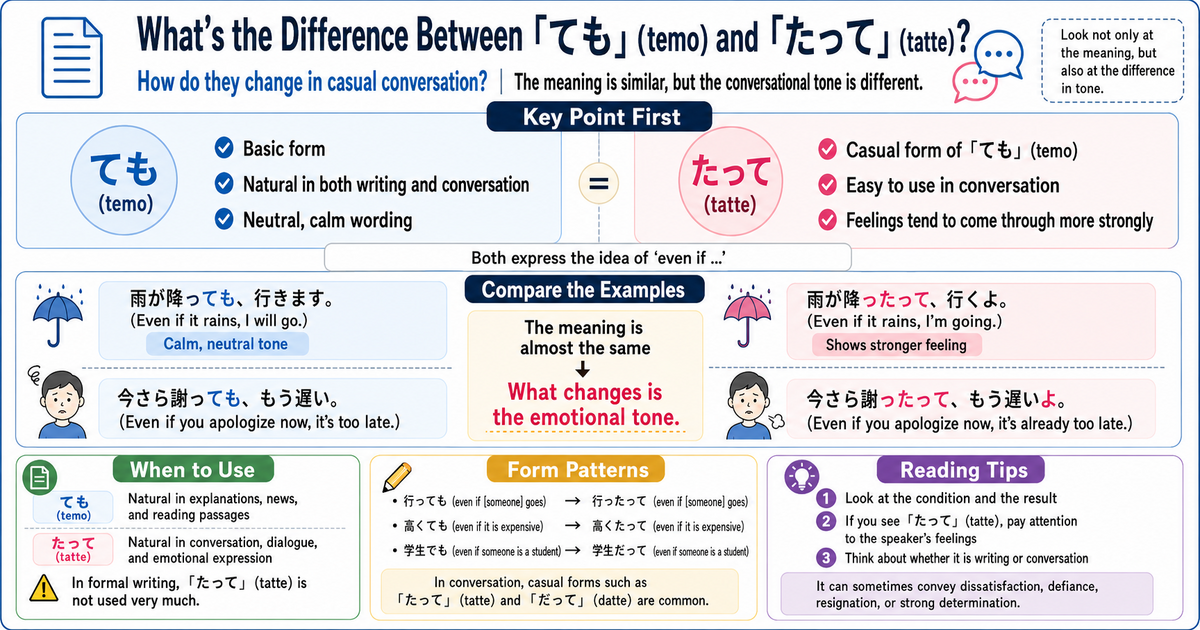
Have you ever felt this while studying for the JLPT?
You understand the words.
You understand the sentence.
But when you look at the answer choices, you still hesitate.
This often happens because JLPT reading is not only about “meaning.”
It is also about nuance, tone, and the speaker’s feeling.
In this article, we will look at two similar expressions:
ても (temo / even if)
たって (tatte / even if, in casual speech)
Both can express the idea of “even if something happens,” but they are not exactly the same. The key difference is this:
ても (temo) is neutral, standard, and widely used.
たって (tatte) is more casual, conversational, and often carries stronger emotion.
For JLPT N3–N2 learners, this small difference can be the key to choosing the correct answer in reading questions.
First, Understand the Basic Meaning of ても (temo)
ても (temo / even if) is a very common grammar pattern in JLPT N3–N2.
It means:
“Even if A happens, B does not change.”
In other words, a certain condition exists, but the result remains the same.
Look at these examples.
-
雨が降っても、試合は行われます。
Even if it rains, the match will be held. -
忙しくても、毎日少しずつ日本語を勉強しています。
Even when I am busy, I study Japanese little by little every day. -
値段が高くても、品質がよければ買う人はいます。
Even if the price is high, some people will buy it if the quality is good.
In each sentence, the first part sounds like something that could change the result.
If it rains, a match might be canceled.
If someone is busy, they might stop studying.
If something is expensive, people might not buy it.
But with ても (temo), the result does not change.
So the basic function of ても (temo) is to show a condition and a result in a calm, neutral way.
It can be used in writing, conversation, news articles, explanations, business situations, and JLPT reading passages.
たって (tatte) Is a More Casual, Conversational Form
たって (tatte / even if) is often used as a casual version of ても (temo).
It appears naturally in daily conversation, novels, dialogues, and situations where the speaker’s feeling is important.
Compare these two sentences.
-
雨が降っても、行きます。
Even if it rains, I will go. -
雨が降ったって、行くよ。
Even if it rains, I’m going.
The basic meaning is similar.
However, the feeling is different.
雨が降っても、行きます。 sounds calm and neutral.
雨が降ったって、行くよ。 sounds more emotional and personal.
It can suggest determination, resistance, or a strong feeling like:
“No matter what, I’m going.”
“Rain will not stop me.”
“You can’t change my mind.”
This is why たって (tatte) is important in JLPT reading. It often helps you understand the speaker’s attitude.
The Biggest Difference: Meaning vs. Tone
The most important point is this:
ても (temo) and たって (tatte) are close in meaning, but different in tone.
ても (temo) is standard and neutral.
たって (tatte) is casual and often emotional.
Let’s compare another example.
-
今さら謝っても、もう遅い。
Even if you apologize now, it is already too late. -
今さら謝ったって、もう遅いよ。
Even if you apologize now, it’s already too late.
The meaning is almost the same.
But 謝ったって (ayamatta tte / even if you apologize) sounds more like spoken Japanese. It may include frustration, disappointment, anger, or resignation.
The speaker is not just explaining a fact.
The speaker is expressing a feeling.
That is exactly the kind of nuance that often appears in JLPT reading questions.
How to Form たって (tatte)
Here are common forms that JLPT learners should recognize.
-
行っても → 行ったって
even if someone goes -
見ても → 見たって
even if someone sees -
高くても → 高くたって
even if something is expensive -
忙しくても → 忙しくたって
even if someone is busy -
学生でも → 学生だって
even if someone is a student / even students
Now let’s look at them in sentences.
-
何度説明しても、彼は分かってくれない。
No matter how many times I explain, he does not understand. -
何度説明したって、彼は分かってくれないよ。
No matter how many times I explain, he just won’t understand.
The second sentence sounds more conversational and emotional.
Another example:
-
いくら安くても、必要ないものは買いません。
No matter how cheap it is, I do not buy things I do not need. -
いくら安くたって、必要ないものは買わないよ。
No matter how cheap it is, I’m not buying something I don’t need.
And one more:
-
子どもでも、このルールは分かります。
Even children can understand this rule. -
子どもだって、このルールは分かるよ。
Even children can understand this rule, you know.
In conversation, だって (datte) is very natural. It can also sound slightly defensive or emphatic depending on the context.
Reading Tip 1: First, Find the Condition and the Result
When you see ても (temo) or たって (tatte) in a JLPT passage, first identify the structure.
“What condition appears?”
“What result does not change?”
Example:
- 反対されても、彼は留学するつもりだ。
Even if people oppose him, he intends to study abroad.
Here, the condition is:
反対されても (hantai saretemo / even if people oppose him)
The result is:
彼は留学するつもりだ (kare wa ryūgaku suru tsumori da / he intends to study abroad)
The basic meaning is that opposition does not change his plan.
This is the first step.
Reading Tip 2: If You See たって, Look for Emotion
When the sentence uses たって (tatte), look more carefully at the speaker’s feeling.
Example:
- 反対されたって、私は留学する。
Even if people oppose me, I will study abroad.
This does not sound like a simple explanation. It sounds like strong determination.
The speaker may be saying:
“I know people may oppose me, but I will still go.”
In JLPT reading, answer choices may include ideas such as:
- strong determination
- dissatisfaction
- frustration
- resignation
- resistance
- emotional emphasis
If たって (tatte) appears, check whether one of these feelings matches the context.
Reading Tip 3: Check the Type of Passage
In formal writing, explanations, and news-style passages, ても (temo) is more common.
In conversations, stories, and character dialogue, たって (tatte) is more natural.
Compare:
-
どんなに努力しても、結果が出ないこともある。
No matter how hard you try, sometimes you may not get results. -
どんなに努力したって、結果が出ないこともあるよ。
No matter how hard you try, sometimes you just don’t get results.
The first sentence sounds like a general explanation.
The second sounds like someone speaking from personal experience.
For JLPT reading, this difference helps you understand the mood of the passage.
A Common Mistake JLPT Learners Make
Many learners remember たって (tatte) simply as “the same as ても (temo).”
That is partly true, but not enough.
For example:
そんなことを今さら言ったって、状況は変わらない。
Even if you say that now, the situation will not change.
This sentence does not only mean “even if you say that.”
It also suggests the speaker’s feeling:
“It’s too late.”
“That won’t help.”
“I’m frustrated or disappointed.”
In JLPT reading, the correct answer often depends on this emotional layer.
So when you see たって (tatte), do not stop at the dictionary meaning. Ask yourself:
“What kind of feeling is behind this sentence?”
For a broader overview of limitation patterns, see the guide to confusing JLPT limitation expressions. Confusing JLPT Limitation Expressions
Summary: ても Is Basic, たって Adds Conversational Energy
Let’s review the key points.
- ても (temo) means “even if” and is neutral, standard, and widely used.
- たって (tatte) also means “even if,” but it is casual and conversational.
- たって (tatte) often adds emotion such as determination, frustration, resistance, or resignation.
- In JLPT reading, the difference between ても (temo) and たって (tatte) can help you understand the speaker’s attitude.
- Do not only translate the sentence. Read the tone behind it.
JLPT N3–N2 reading becomes much easier when you stop reading grammar as isolated rules and start reading it as communication.
That is exactly what RJT (Rapid Japanese Training) is designed to help you do.
With RJT, you can practice grammar, vocabulary, and reading questions in a way that trains you to notice meaning, nuance, and context step by step.
If you often think, “I understand the sentence, but I still choose the wrong answer,” now is the time to change how you practice.
%E3%80%8C%E6%9C%9F%E9%99%90%E3%82%92%E5%AE%88%E3%82%8B%E3%80%8D%E3%81%A8%E3%80%8C%E7%B7%A0%E3%82%81%E5%88%87%E3%82%8A%E3%81%AB%E9%96%93%E3%81%AB%E5%90%88%E3%81%86%E3%80%8D%E3%81%AE%E9%81%95%E3%81%84%EF%BC%88%E8%8B%B1%EF%BC%89.png)
%E3%80%8C%E4%BA%88%E5%AE%9A%E3%81%8C%E5%85%A5%E3%82%8B%E3%80%8D%E3%81%A8%E3%80%8C%E4%BA%88%E5%AE%9A%E3%82%92%E5%85%A5%E3%82%8C%E3%82%8B%E3%80%8D%E3%81%AE%E9%81%95%E3%81%84%EF%BC%88%E8%8B%B1%EF%BC%89.png)
%E3%80%8C%E8%87%AA%E4%BF%A1%E3%81%8C%E3%81%82%E3%82%8B%E3%80%8D%E3%81%A8%E3%80%8C%E8%87%AA%E4%BF%A1%E3%82%92%E6%8C%81%E3%81%A4%E3%80%8D%E3%81%AE%E9%81%95%E3%81%84%EF%BC%88%E8%8B%B1%EF%BC%89.png)
%E3%80%8C%E5%BF%85%E8%A6%81%E3%81%8C%E3%81%82%E3%82%8B%E3%80%8D%E3%81%A8%E3%80%8C%E5%BF%85%E8%A6%81%E3%81%AB%E3%81%AA%E3%82%8B%E3%80%8D%E3%81%AE%E9%81%95%E3%81%84%EF%BC%88%E8%8B%B1%EF%BC%89.png)
%E3%80%8C%E5%8F%AF%E8%83%BD%E6%80%A7%E3%81%8C%E9%AB%98%E3%81%84%E3%80%8D%E3%81%A8%E3%80%8C%E5%8F%AF%E8%83%BD%E6%80%A7%E3%81%8C%E3%81%82%E3%82%8B%E3%80%8D%E3%81%AE%E9%81%95%E3%81%84%EF%BC%88%E8%8B%B1%EF%BC%89.png)
%E3%80%8C%E7%B5%90%E8%AB%96%E3%82%92%E5%87%BA%E3%81%99%E3%80%8D%E3%81%A8%E3%80%8C%E7%B5%90%E8%AB%96%E3%81%AB%E9%81%94%E3%81%99%E3%82%8B%E3%80%8D%E3%81%AE%E9%81%95%E3%81%84%EF%BC%88%E8%8B%B1%EF%BC%89.png)