When you study Japanese, you may find expressions that both seem to describe “something happening at a certain time,” but actually work in very different ways.
A good example is 「たびに」 and 「ときどき」.
For example:
「この写真を見るたびに、学生時代を思い出します。」
“Every time I look at this photo, I remember my school days.”
「私はときどき、この写真を見返します。」
“I sometimes look back at this photo.”
Both sentences include the action “looking at a photo.”
But they do not say the same thing.
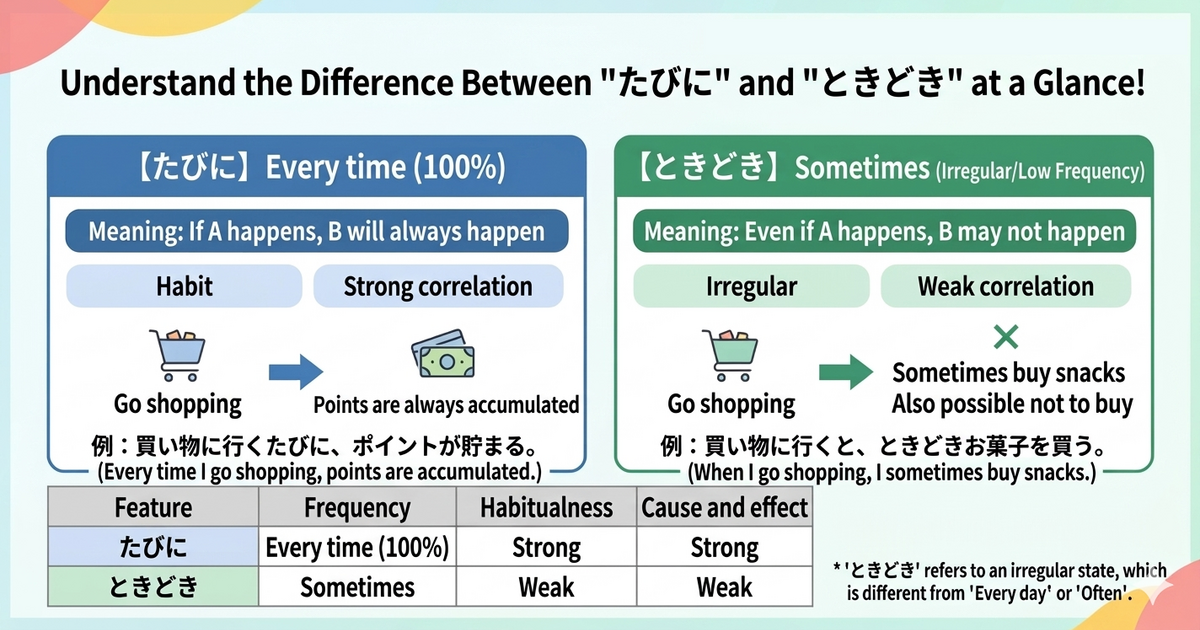
「たびに」 means that whenever something happens, the following thing happens every time.
On the other hand, 「ときどき」 means that something happens sometimes, but not always.
In other words, 「たびに」 describes a repeated reaction to each occurrence, while 「ときどき」 describes frequency.
「たびに」 means “every time that happens”
「たびに」 is used when something happens every time a certain event occurs.
The common forms are:
Verb dictionary form + たびに
Noun + のたびに
Examples
-
「母は孫に会うたびに、うれしそうに笑います。」
“Every time my mother sees her grandchild, she smiles happily.” -
「この歌を聞くたびに、故郷を思い出します。」
“Every time I hear this song, I remember my hometown.” -
「旅行のたびに、お土産を買います。」
“Every time I travel, I buy souvenirs.” -
「試験のたびに、緊張してしまいます。」
“Every time there is an exam, I get nervous.”
The important point is that 「たびに」 contains the feeling of “every time.”
For example:
「この歌を聞くたびに、故郷を思い出します。」
“Every time I hear this song, I remember my hometown.”
This does not mean that you remember your hometown only on one occasion.
It means that whenever you hear the song, you always remember your hometown.
So 「たびに」 does not describe something random. It describes a repeated connection between two events.
「ときどき」 means “sometimes” or “occasionally”
「ときどき」 is an adverb of frequency.
It is close to “sometimes” in English.
It is not as frequent as “every day,” but not as rare as “hardly ever.” It is somewhere in the middle.
Examples
-
「私はときどき、一人でカフェに行きます。」
“I sometimes go to a cafe alone.” -
「彼はときどき、授業に遅れます。」
“He is sometimes late for class.” -
「忙しいですが、ときどき映画を見ます。」
“I am busy, but I sometimes watch movies.” -
「日本語で日記を書いていますが、ときどき中国語も使います。」
“I write my diary in Japanese, but I sometimes use Chinese too.”
「ときどき」 means that an action does not always happen.
Sometimes it happens, and sometimes it does not.
So it is useful to think of 「ときどき」 as “happening irregularly from time to time,” not “every time.”
The most important difference is “every time” or “sometimes”
The difference between these two expressions can be summarized like this:
「たびに」
Every time something happens, another thing happens too.
「ときどき」
Something happens sometimes, but not always.
Compare these two sentences:
-
「先生に会うたびに、あいさつします。」
“Every time I see my teacher, I greet them.” -
「先生には、ときどきメールをします。」
“I sometimes email my teacher.”
In sentence 1, each time the event “seeing the teacher” happens, the speaker greets the teacher.
In sentence 2, the speaker is only talking about the frequency of sending emails.
The first sentence is based on a trigger event.
The second sentence simply describes frequency.
This is the major difference.
「たびに」 connects two events
When 「たびに」 is used, the first part and the second part have a strong connection.
For example:
「買い物に行くたびに、何か忘れます。」
“Every time I go shopping, I forget something.”
In this sentence, going shopping and forgetting something happen almost like a set.
In this way, 「たびに」 creates the pattern:
When A happens,
B happens every time.
So, if you only want to say “I do something sometimes,” you cannot use 「たびに」 by itself.
「ときどき」 does not create a connection between events
On the other hand, 「ときどき」 does not especially connect two events.
For example:
「私はときどき、散歩します。」
“I sometimes take a walk.”
This sentence only tells us how often the speaker takes a walk.
It does not mean “whenever something happens, I take a walk.”
So 「ときどき」 is easy to use by itself.
It softly expresses how often something happens.
Sentences that look similar but cannot be exchanged
Look at this sentence:
「その先生の話を聞くたびに、やる気が出ます。」
“Every time I listen to that teacher’s talk, I feel motivated.”
This is natural.
Every time the speaker listens to that teacher, they feel motivated.
However:
「その先生の話を聞くときどき、やる気が出ます。」
This is unnatural.
「ときどき」 is an adverb, so it does not fit this position or this meaning.
On the other hand:
「私はときどき、その先生の話を聞きます。」
“I sometimes listen to that teacher’s talk.”
This is natural.
It means that the speaker sometimes listens to that teacher.
However:
「私はたびに、その先生の話を聞きます。」
This is unnatural.
「たびに」 cannot be used alone. It needs an event before it, such as 「授業のたびに」 or 「会うたびに」.
Common mistakes learners make
1. Using 「たびに」 as a simple frequency expression
For example:
「私はたびに日本語を勉強します。」
This is unnatural.
With 「たびに」, you need to say “every time what happens.”
More natural sentences are:
「私はときどき日本語を勉強します。」
“I sometimes study Japanese.”
Or:
「授業のたびに、日本語を勉強します。」
“Every time I have class, I study Japanese.”
2. Using 「ときどき」 to mean “every time”
For example:
「この薬を飲むときどき、眠くなります。」
This is very unnatural.
If you mean “I get sleepy every time I take this medicine,” you should use 「たびに」.
The correct sentence is:
「この薬を飲むたびに、眠くなります。」
“Every time I take this medicine, I get sleepy.”
3. Forgetting that 「たびに」 has a strong repeated meaning
「たびに」 is usually not used for a one-time event.
It assumes repetition.
For example, if you are talking about a trip you took only once, you cannot say:
「この旅行のたびに楽しかったです。」
This is unnatural because 「旅行のたびに」 assumes that you travel many times.
How to understand the nuance
When you are not sure which one to use, think like this:
「たびに」
A happens. Every time A happens, B also happens.
「ときどき」
B happens sometimes, but not always.
With this pattern, the difference becomes much easier to see.
For example:
「電車に乗るたびに、本を読みます。」
“Every time I ride the train, I read a book.”
Here, A is riding the train.
B is reading a book.
They are connected every time.
On the other hand:
「私はときどき、電車の中で本を読みます。」
“I sometimes read a book on the train.”
This sentence only describes how often the speaker reads on the train.
It does not say that the speaker reads every time.
Let’s compare more examples
-
「彼女は出張のたびに、家族に電話します。」
“Every time she goes on a business trip, she calls her family.” -
「彼女はときどき、家族に電話します。」
“She sometimes calls her family.”
Sentence 1 means that she calls her family every time she goes on a business trip.
Sentence 2 means that she calls her family from time to time.
Here is another pair:
-
「このページを開くたびに、単語を一つ覚えます。」
“Every time I open this page, I learn one word.” -
「私はときどき、このページを開いて復習します。」
“I sometimes open this page and review.”
Sentence 1 shows a repeated pattern: every time the page is opened, one word is learned.
Sentence 2 talks about frequency: the speaker sometimes opens the page to review.
Final thoughts
「たびに」 and 「ときどき」 both appear often in daily conversation and reading.
However, their roles are clearly different.
「たびに」 is used when the same thing happens every time a certain event occurs.
「ときどき」 means that something happens sometimes, but not always.
Once you understand this difference, you can express yourself more accurately in both writing and conversation.
You will also be able to read the difference between “every time” and “sometimes” more clearly in Japanese texts.
To practice subtle Japanese differences like this with examples and questions, visit https://rapid-jt.com/ and build your understanding step by step.
For a broader view of Japanese negative expressions, see the guide to confusing JLPT negative expressions. Confusing JLPT Negative Expressions
For a broader view of cause and reason expressions, see the guide to confusing JLPT reason expressions. Confusing JLPT Reason and Cause Expressions
%E3%80%8C%E6%9C%9F%E9%99%90%E3%82%92%E5%AE%88%E3%82%8B%E3%80%8D%E3%81%A8%E3%80%8C%E7%B7%A0%E3%82%81%E5%88%87%E3%82%8A%E3%81%AB%E9%96%93%E3%81%AB%E5%90%88%E3%81%86%E3%80%8D%E3%81%AE%E9%81%95%E3%81%84%EF%BC%88%E8%8B%B1%EF%BC%89.png)
%E3%80%8C%E4%BA%88%E5%AE%9A%E3%81%8C%E5%85%A5%E3%82%8B%E3%80%8D%E3%81%A8%E3%80%8C%E4%BA%88%E5%AE%9A%E3%82%92%E5%85%A5%E3%82%8C%E3%82%8B%E3%80%8D%E3%81%AE%E9%81%95%E3%81%84%EF%BC%88%E8%8B%B1%EF%BC%89.png)
%E3%80%8C%E8%87%AA%E4%BF%A1%E3%81%8C%E3%81%82%E3%82%8B%E3%80%8D%E3%81%A8%E3%80%8C%E8%87%AA%E4%BF%A1%E3%82%92%E6%8C%81%E3%81%A4%E3%80%8D%E3%81%AE%E9%81%95%E3%81%84%EF%BC%88%E8%8B%B1%EF%BC%89.png)
%E3%80%8C%E5%BF%85%E8%A6%81%E3%81%8C%E3%81%82%E3%82%8B%E3%80%8D%E3%81%A8%E3%80%8C%E5%BF%85%E8%A6%81%E3%81%AB%E3%81%AA%E3%82%8B%E3%80%8D%E3%81%AE%E9%81%95%E3%81%84%EF%BC%88%E8%8B%B1%EF%BC%89.png)
%E3%80%8C%E5%8F%AF%E8%83%BD%E6%80%A7%E3%81%8C%E9%AB%98%E3%81%84%E3%80%8D%E3%81%A8%E3%80%8C%E5%8F%AF%E8%83%BD%E6%80%A7%E3%81%8C%E3%81%82%E3%82%8B%E3%80%8D%E3%81%AE%E9%81%95%E3%81%84%EF%BC%88%E8%8B%B1%EF%BC%89.png)
%E3%80%8C%E7%B5%90%E8%AB%96%E3%82%92%E5%87%BA%E3%81%99%E3%80%8D%E3%81%A8%E3%80%8C%E7%B5%90%E8%AB%96%E3%81%AB%E9%81%94%E3%81%99%E3%82%8B%E3%80%8D%E3%81%AE%E9%81%95%E3%81%84%EF%BC%88%E8%8B%B1%EF%BC%89.png)