As you continue studying Japanese, you will often meet expressions that look similar but have completely different meanings.
A good example is 「たところ」 and 「ところだった」.
For example:
先生に聞いたところ、すぐに答えてくれました。
When I asked the teacher, they answered right away.
もう少しで電車に乗り遅れるところでした。
I almost missed the train.
Both expressions contain 「ところ」.
However, if you try to understand them in the same way, you will get confused.
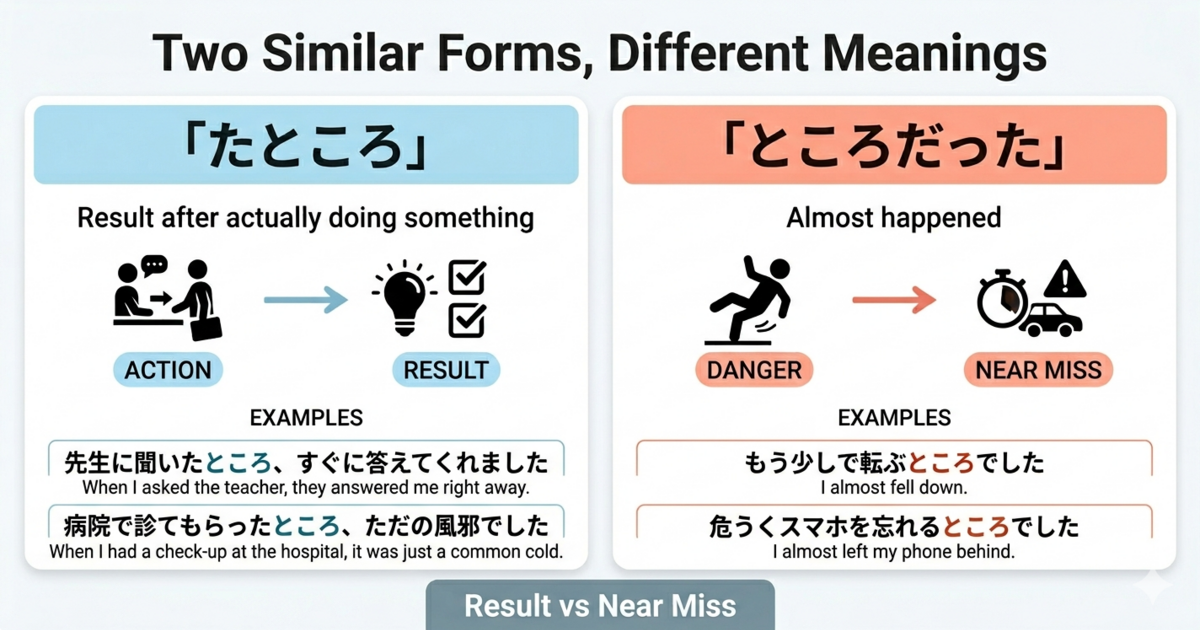
「たところ」 is used when you actually do something and then report what happened as a result.
On the other hand, 「ところだった」 means that something was just about to happen. It often describes a close call or a situation that was narrowly avoided.
In other words, they only look similar.
The direction of meaning is quite different.
This article explains the difference between 「たところ」 and 「ところだった」 with example sentences. We will also look at a simple way to tell them apart in exams and real communication.
First, the conclusion: 「たところ」 is about a result, 「ところだった」 is about the moment just before something happens
The most important point is this:
- 「たところ」 means that after actually doing something, the result became clear.
- 「ところだった」 means that something was about to happen, but in many cases it did not actually happen.
If you keep this difference in mind, the expressions become much easier to organize.
「たところ」 looks at what happened after an action.
「ところだった」 looks at the moment just before an event.
In simple terms:
- 「たところ」 looks backward to the result.
- 「ところだった」 looks at the point right before something happens.
「たところ」 means “when I did it, this was the result”
「たところ」 is used when someone actually does something and then states the result or what was found out.
Examples
先生に聞いたところ、ていねいに教えてくれました。
When I asked the teacher, they explained it carefully.
病院で診てもらったところ、ただの風邪でした。
When I had a doctor examine me, it turned out to be just a cold.
新しい店に行ってみたところ、とても人気がありました。
When I tried going to the new shop, it was very popular.
The important point here is that there is an action first.
聞いた
asked
診てもらった
had someone examine me
行ってみた
tried going
After that, a result appears.
So 「たところ」 has the flow:
I actually did something
→ As a result, this happened or became clear
Image
Action
→ Result or discovery
When this order is clear, 「たところ」 is natural.
「たところ」 fits reports and explanations
「たところ」 is often used when calmly reporting a result.
It appears especially often in the following situations.
1. Reporting the result of checking or investigating something
調べたところ、原因は設定ミスでした。
When we investigated it, the cause turned out to be a setting error.
確認したところ、予約は入っていませんでした。
When we checked, there was no reservation.
2. Reporting the result of asking someone
本人に聞いたところ、問題ないとのことでした。
When I asked the person directly, they said there was no problem.
駅員に聞いたところ、次の電車は10分後だそうです。
When I asked the station staff, they said the next train would come in ten minutes.
3. Saying the result of actually trying something
使ってみたところ、思ったより便利でした。
When I tried using it, it was more convenient than I expected.
食べてみたところ、かなり辛かったです。
When I tried eating it, it was quite spicy.
As you can see, 「たところ」 is a very practical expression.
It is used in both conversation and writing, especially in reports, explanations, and confirmations.
「ところだった」 means “it was about to happen”
Now let’s look at 「ところだった」.
This expression means that something was just about to happen.
Examples
もう少しで転ぶところでした。
I almost fell.
危うく大事なメールを消すところでした。
I almost deleted an important email.
あと1分遅かったら、飛行機に乗り遅れるところでした。
If I had been one minute later, I would have missed the plane.
In these sentences, the event has not actually happened.
However, it came very close to happening.
So 「ところだった」 often describes a situation that was narrowly avoided or stopped at the last moment.
Image
Dangerous or critical situation
→ Stopped just before it happened
The main point is not the actual result.
The main point is that something was about to happen.
「ところだった」 often has a feeling of danger, failure, or a close call
「ところだった」 often appears with actions or situations such as these:
転ぶ
to fall
忘れる
to forget
間違える
to make a mistake
ぶつかる
to bump into something
遅れる
to be late
事故にあう
to have an accident
In many cases, it is connected to something undesirable.
Examples
危うく財布を落とすところでした。
I almost dropped my wallet.
もう少しで約束を忘れるところでした。
I almost forgot the appointment.
ブレーキが遅れていたら、大事故になるところでした。
If the brakes had been applied later, it could have become a serious accident.
Of course, 「ところだった」 is not always limited to bad situations.
However, it is very often used when the speaker feels “That was close” or “That was dangerous.”
Comparing the two expressions
Let’s compare 「たところ」 and 「ところだった」.
「たところ」
医者に診てもらったところ、すぐ治ると言われました。
When I had a doctor examine me, I was told that it would heal quickly.
店に電話したところ、今日は休みでした。
When I called the shop, it turned out to be closed today.
These sentences describe the result after someone actually did something.
「ところだった」
もう少しで階段から落ちるところでした。
I almost fell down the stairs.
危うくスマホを電車に忘れるところでした。
I almost left my smartphone on the train.
These sentences describe a situation that almost happened, but did not actually happen.
So the difference is:
- 「たところ」 reports a result.
- 「ところだった」 describes something that almost happened.
This is the most important point.
Points learners often find confusing
Both contain 「ところ」, so they look similar
Many learners are pulled by the shared word 「ところ」.
However, what you need to focus on is the meaning before and after it.
- 「たところ」 means after doing something.
- 「ところだった」 means just before something happens.
Even though both contain 「ところ」, the time position is different.
「ところだった」 is past form, but the event often did not happen
This can feel strange at first.
Because 「でした」 is used, it looks like a past fact.
But the basic meaning is:
It looked like it would happen, but it did not happen.
For example:
もう少しで転ぶところでした。
I almost fell.
This does not mean “I fell.”
It means “I was about to fall, but I did not.”
This point is very important.
「たところ」 can be close to 「たら」, but they are not exactly the same
Some learners may feel that 「たところ」 and 「たら」 are similar.
In some sentences, they are indeed close in meaning.
行ってみたら、休みだった。
When I went there, it was closed.
行ってみたところ、休みだった。
When I went there, it turned out to be closed.
The basic meaning is similar.
However, 「たところ」 sounds a little more formal and more like a report.
「たら」 sounds more casual and conversational.
So you can think of them like this:
- 「たら」 is closer to everyday conversation.
- 「たところ」 is closer to reporting a result.
「ところだった」 goes well with 「危うく」, 「もう少しで」, and 「あと少しで」
「ところだった」 is often used with expressions like 「危うく」, 「もう少しで」, and 「あと少しで」.
Examples
危うく転ぶところでした。
I almost fell.
もう少しで大事な会議に遅れるところでした。
I almost arrived late for an important meeting.
あと少しで答えを間違えるところでした。
I almost chose the wrong answer.
When you see these expressions before the verb, it is easier to recognize 「ところだった」.
On the other hand, if the sentence begins with an actual action such as 「聞いた」, 「調べた」, 「確認した」, or 「行ってみた」, it is probably 「たところ」.
How to tell them apart in exams
When you are not sure, try thinking in this order.
1. Did someone actually do something and then report the result?
聞いたところ
when I asked
調べたところ
when I checked or investigated
行ってみたところ
when I tried going
If the sentence has this flow, it is 「たところ」.
2. Was something just about to happen?
転ぶところだった
was about to fall
忘れるところだった
was about to forget
遅れるところだった
was about to be late
If the sentence has this flow, it is 「ところだった」.
3. Are there expressions like 「危うく」 or 「もう少しで」?
If there are expressions such as 「危うく」, 「もう少しで」, or 「あと少しで」, the answer is very likely 「ところだった」.
4. Is the sentence reporting a result or describing a close call?
- If it reports a result, use 「たところ」.
- If it describes something that almost happened, use 「ところだった」.
This way of thinking makes the distinction much easier in exams.
Memory tip
The memory tip is very simple.
- 「たところ」 means “after doing it, this was the result.”
- 「ところだった」 means “it was about to happen.”
Even shorter:
- 「たところ」 is about the result.
- 「ところだった」 is about the moment just before.
If you keep these two meanings side by side, the forms may look similar, but the meanings will not become confused.
For a broader view of similar inference and judgment expressions, see the guide to confusing JLPT inference expressions. JLPT Inference and Judgment Expressions
For a broader view of cause and reason expressions, see the guide to confusing JLPT reason expressions. Confusing JLPT Reason and Cause Expressions
Summary
「たところ」 and 「ところだった」 look a little similar.
However, their meanings go in very different directions.
「たところ」 describes what happened after someone actually did something.
「ところだった」 describes a situation where something was just about to happen.
In short:
- 「たところ」 looks at what happens after an action.
- 「ところだった」 looks at the point just before an event.
Once you understand this difference, reading and conversation become much easier.
If you memorize grammar only by form, similar expressions can easily confuse you.
But if you pay attention to the time flow and the direction of meaning, the difference becomes much clearer.
If you want to practice confusing Japanese expressions like 「たところ」 and 「ところだった」 with example sentences and questions, try learning with RJT. You can learn these subtle differences not only as knowledge, but as practical usage.
%E3%80%8C%E6%9C%9F%E9%99%90%E3%82%92%E5%AE%88%E3%82%8B%E3%80%8D%E3%81%A8%E3%80%8C%E7%B7%A0%E3%82%81%E5%88%87%E3%82%8A%E3%81%AB%E9%96%93%E3%81%AB%E5%90%88%E3%81%86%E3%80%8D%E3%81%AE%E9%81%95%E3%81%84%EF%BC%88%E8%8B%B1%EF%BC%89.png)
%E3%80%8C%E4%BA%88%E5%AE%9A%E3%81%8C%E5%85%A5%E3%82%8B%E3%80%8D%E3%81%A8%E3%80%8C%E4%BA%88%E5%AE%9A%E3%82%92%E5%85%A5%E3%82%8C%E3%82%8B%E3%80%8D%E3%81%AE%E9%81%95%E3%81%84%EF%BC%88%E8%8B%B1%EF%BC%89.png)
%E3%80%8C%E8%87%AA%E4%BF%A1%E3%81%8C%E3%81%82%E3%82%8B%E3%80%8D%E3%81%A8%E3%80%8C%E8%87%AA%E4%BF%A1%E3%82%92%E6%8C%81%E3%81%A4%E3%80%8D%E3%81%AE%E9%81%95%E3%81%84%EF%BC%88%E8%8B%B1%EF%BC%89.png)
%E3%80%8C%E5%BF%85%E8%A6%81%E3%81%8C%E3%81%82%E3%82%8B%E3%80%8D%E3%81%A8%E3%80%8C%E5%BF%85%E8%A6%81%E3%81%AB%E3%81%AA%E3%82%8B%E3%80%8D%E3%81%AE%E9%81%95%E3%81%84%EF%BC%88%E8%8B%B1%EF%BC%89.png)
%E3%80%8C%E5%8F%AF%E8%83%BD%E6%80%A7%E3%81%8C%E9%AB%98%E3%81%84%E3%80%8D%E3%81%A8%E3%80%8C%E5%8F%AF%E8%83%BD%E6%80%A7%E3%81%8C%E3%81%82%E3%82%8B%E3%80%8D%E3%81%AE%E9%81%95%E3%81%84%EF%BC%88%E8%8B%B1%EF%BC%89.png)
%E3%80%8C%E7%B5%90%E8%AB%96%E3%82%92%E5%87%BA%E3%81%99%E3%80%8D%E3%81%A8%E3%80%8C%E7%B5%90%E8%AB%96%E3%81%AB%E9%81%94%E3%81%99%E3%82%8B%E3%80%8D%E3%81%AE%E9%81%95%E3%81%84%EF%BC%88%E8%8B%B1%EF%BC%89.png)