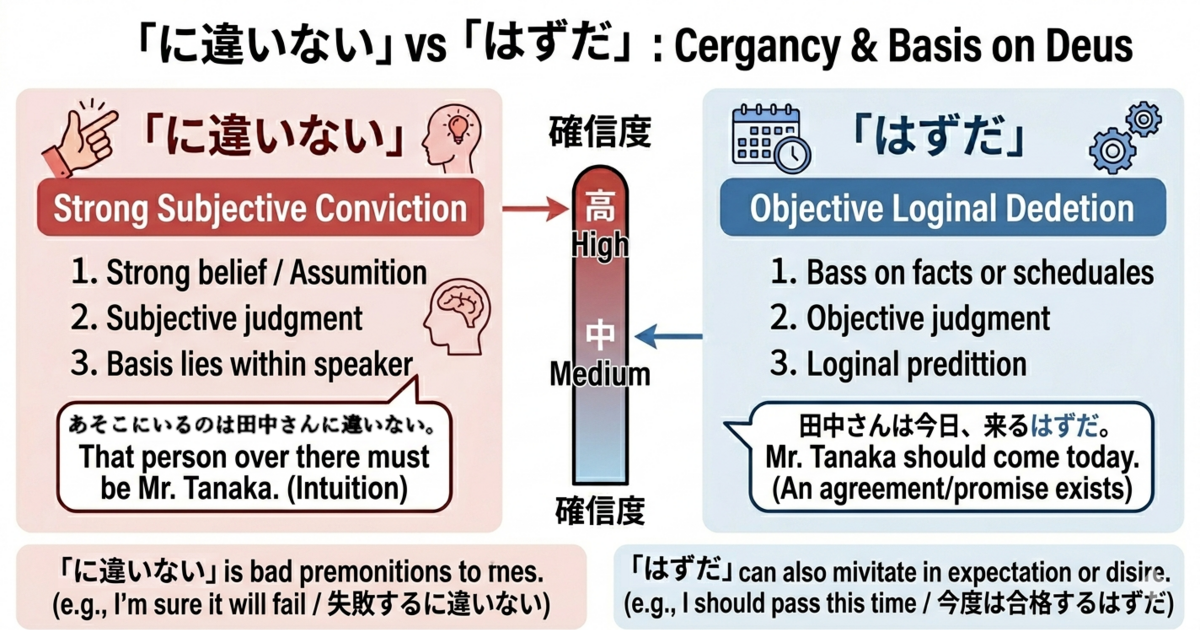
When studying Japanese, you may come across expressions that both seem to mean “surely” or “it must be true.”
Two common examples are:
「に違いない」
「はずだ」
For example:
「彼はもう家に帰ったに違いない。」
English: He must have already gone home.
「彼はもう家に帰ったはずだ。」
English: He should have already gone home.
At first glance, both sentences seem to mean “He has probably already gone home.”
However, in Japanese, the basis for the speaker’s judgment is slightly different.
Once you understand this difference, it becomes easier to see what kind of evidence or reasoning the speaker is using in reading and conversation.
First, the main point
「に違いない」 is used when the speaker strongly feels, “This must be true.”
「はずだ」 is used when the speaker thinks, “Based on the information, schedule, rule, or situation I know, this is the natural conclusion.”
In simple terms:
「に違いない」
Strong conviction. The speaker’s personal certainty comes forward.
「はずだ」
Logical expectation. The speaker thinks it is natural or reasonable for something to be true.
They are similar, but they are not the same.
「に違いない」 expresses strong conviction
「に違いない」 is used when the speaker sees some clues and strongly thinks:
“This must be the case.”
The important point here is the strength of the speaker’s certainty.
Example
「あの店はいつも並んでいる。おいしいに違いない。」
English: There is always a line at that restaurant. It must be delicious.
In this sentence, the speaker may not have actually eaten there yet.
However, after seeing the long line, the speaker strongly believes:
“It must be delicious.”
Another example
「彼は顔色が悪い。昨日、ほとんど寝ていないに違いない。」
English: He looks pale. He must have barely slept last night.
Here, the speaker has not directly confirmed that he did not sleep.
But from his appearance, the speaker strongly judges that this is probably true.
In other words, 「に違いない」 is not simply an objective explanation of a fact.
It is an expression where the speaker’s strong conviction is clearly shown.
「はずだ」 expresses a natural expectation based on information
On the other hand, 「はずだ」 is used when the speaker makes a judgment based on information such as a schedule, knowledge, promise, rule, or common sense.
Here, the logical path is more important than the speaker’s feeling.
Example
「田中さんは九時に来ると言っていたから、もうすぐ来るはずだ。」
English: Tanaka said he would come at nine, so he should arrive soon.
In this sentence, the basis is clear.
The speaker knows that Tanaka said he would come at nine.
That information leads naturally to the expectation that he will arrive soon.
Another example
「この電車は十時に新宿に着くはずです。」
English: This train should arrive in Shinjuku at ten.
This is also based on information such as a timetable or schedule.
It does not mean “I just feel that it will arrive at ten.”
It means:
“Based on the information I have, it should arrive at ten.”
So, 「はずだ」 is an expression where the reasoning in the speaker’s mind is clearly connected.
Comparing the two expressions
Let’s compare similar sentences to see the difference more clearly.
1
「彼はまじめだから、約束を守るに違いない。」
English: He is serious and responsible, so he must keep his promise.
「彼はまじめだから、約束を守るはずだ。」
English: He is serious and responsible, so he should keep his promise.
The first sentence sounds like:
“I strongly believe he will keep his promise.”
The second sentence sounds like:
“Because he is serious and responsible, it is natural to expect that he will keep his promise.”
2
「電気がついている。彼は家にいるに違いない。」
English: The light is on. He must be at home.
「今日は休みの日だから、彼は家にいるはずだ。」
English: Today is his day off, so he should be at home.
The first sentence is a strong judgment based on what the speaker can see right now.
The second sentence is a natural expectation based on the fact that today is his day off.
So, it is useful to think of them this way:
「に違いない」 means strong conviction based on clues.
「はずだ」 means a natural expectation based on information, plans, or logic.
「に違いない」 often sounds stronger
In many cases, 「に違いない」 sounds stronger than 「はずだ」.
「はずだ」 also shows a fairly strong expectation.
However, it usually includes the feeling of:
“Based on the information, this should be the result.”
In contrast, 「に違いない」 puts more emphasis on:
“I am strongly convinced that this is true.”
Because of this, 「に違いない」 can sound a little formal in conversation.
In everyday speech, expressions like 「たぶん」, 「きっと」, and 「はず」 are often used more frequently.
「に違いない」 often appears in written language, explanations, or emotionally strong statements.
「はずだ」 is often used for plans and expectations
「はずだ」 is not only used for predictions.
It is also often used when something is expected to happen according to a plan, normal situation, rule, or arrangement.
Examples
「注文した本は、今日届くはずです。」
English: The book I ordered should arrive today.
「このボタンを押せば、画面が変わるはずだ。」
English: If you press this button, the screen should change.
「彼女は事情を知っているはずです。」
English: She should know the situation.
In each sentence, there is background information.
The book was ordered.
The button is designed to work that way.
She was there and had access to the information.
That is why 「はずだ」 sounds natural.
Common misunderstandings
「はずだ」 does not mean “absolutely true”
「はずだ」 means that something is logically expected to be true.
However, the expectation can still turn out to be wrong.
For example:
「電車はもう着いているはずだ。」
English: The train should have arrived by now.
Even if the speaker says this, the train may not have arrived because of an accident or delay.
So, 「はずだ」 is a strong expectation, but it is not the same as a confirmed fact.
「に違いない」 does not mean the evidence is perfect
「に違いない」 is a strong expression.
However, it does not mean that the speaker has perfect evidence like proof in court.
It means the speaker strongly believes:
“With this much evidence, this must be true.”
So, the strength of the expression and the objective strength of the evidence are not always the same.
How to choose between them
When you are not sure which one to use, think like this:
If there is a clear reason you can explain, such as a schedule, promise, knowledge, rule, or system, 「はずだ」 is usually natural.
If you strongly feel “This must be true” based on what you see, feel, or notice, 「に違いない」 is usually natural.
To summarize in one sentence:
「に違いない」 expresses strong conviction.
「はずだ」 expresses logical expectation.
This image will help you organize the difference clearly.
Final examples
Let’s finish with examples that show the difference clearly.
「に違いない」
「あの声は山田さんに違いない。」
English: That voice must be Yamada-san’s.
「こんなに静かだから、みんなもう寝たに違いない。」
English: It is so quiet, so everyone must have already gone to sleep.
「あんなにうれしそうなら、試験に合格したに違いない。」
English: If she looks that happy, she must have passed the exam.
「はずだ」
「山田さんは七時に来ると言っていたから、もう着くはずだ。」
English: Yamada-san said he would come at seven, so he should arrive soon.
「地図ではこの先に駅があるはずです。」
English: According to the map, there should be a station up ahead.
「説明を聞いたから、彼もルールを知っているはずだ。」
English: He listened to the explanation, so he should know the rules too.
When you compare them, you can see that 「に違いない」 brings out the speaker’s strong feeling of certainty, while 「はずだ」 brings out the flow of reasoning.
Summary
「に違いない」 is used when the speaker strongly believes, “This must be true.”
「はずだ」 is used when the speaker thinks, “Based on the information, schedule, or logic I know, this is the natural conclusion.”
They may look similar, but the basis of the judgment is different.
Is the speaker strongly convinced?
Or is the speaker making a logical expectation?
Once you pay attention to this point, it becomes much easier to use these two expressions naturally.
Related grammar guide: JLPT Inference and Judgment Expressions
If you want to learn subtle Japanese grammar differences through examples and practice questions, check out https://rapid-jt.com/.
%E3%80%8C%E6%9C%9F%E9%99%90%E3%82%92%E5%AE%88%E3%82%8B%E3%80%8D%E3%81%A8%E3%80%8C%E7%B7%A0%E3%82%81%E5%88%87%E3%82%8A%E3%81%AB%E9%96%93%E3%81%AB%E5%90%88%E3%81%86%E3%80%8D%E3%81%AE%E9%81%95%E3%81%84%EF%BC%88%E8%8B%B1%EF%BC%89.png)
%E3%80%8C%E4%BA%88%E5%AE%9A%E3%81%8C%E5%85%A5%E3%82%8B%E3%80%8D%E3%81%A8%E3%80%8C%E4%BA%88%E5%AE%9A%E3%82%92%E5%85%A5%E3%82%8C%E3%82%8B%E3%80%8D%E3%81%AE%E9%81%95%E3%81%84%EF%BC%88%E8%8B%B1%EF%BC%89.png)
%E3%80%8C%E8%87%AA%E4%BF%A1%E3%81%8C%E3%81%82%E3%82%8B%E3%80%8D%E3%81%A8%E3%80%8C%E8%87%AA%E4%BF%A1%E3%82%92%E6%8C%81%E3%81%A4%E3%80%8D%E3%81%AE%E9%81%95%E3%81%84%EF%BC%88%E8%8B%B1%EF%BC%89.png)
%E3%80%8C%E5%BF%85%E8%A6%81%E3%81%8C%E3%81%82%E3%82%8B%E3%80%8D%E3%81%A8%E3%80%8C%E5%BF%85%E8%A6%81%E3%81%AB%E3%81%AA%E3%82%8B%E3%80%8D%E3%81%AE%E9%81%95%E3%81%84%EF%BC%88%E8%8B%B1%EF%BC%89.png)
%E3%80%8C%E5%8F%AF%E8%83%BD%E6%80%A7%E3%81%8C%E9%AB%98%E3%81%84%E3%80%8D%E3%81%A8%E3%80%8C%E5%8F%AF%E8%83%BD%E6%80%A7%E3%81%8C%E3%81%82%E3%82%8B%E3%80%8D%E3%81%AE%E9%81%95%E3%81%84%EF%BC%88%E8%8B%B1%EF%BC%89.png)
%E3%80%8C%E7%B5%90%E8%AB%96%E3%82%92%E5%87%BA%E3%81%99%E3%80%8D%E3%81%A8%E3%80%8C%E7%B5%90%E8%AB%96%E3%81%AB%E9%81%94%E3%81%99%E3%82%8B%E3%80%8D%E3%81%AE%E9%81%95%E3%81%84%EF%BC%88%E8%8B%B1%EF%BC%89.png)