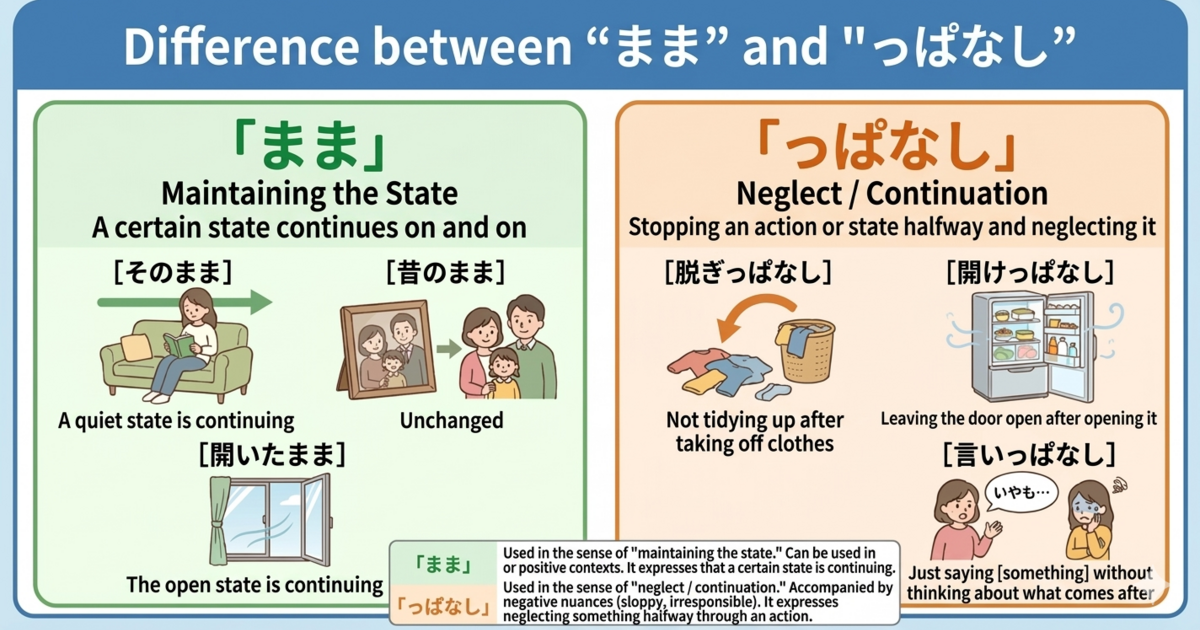
In Japanese, there are several expressions that describe a state continuing.
Among them, learners often have trouble distinguishing 「まま」 and 「っぱなし」.
For example:
「窓を開けたまま、寝てしまいました。」
“I fell asleep with the window open.”
「窓を開けっぱなしで、寝てしまいました。」
“I fell asleep leaving the window open.”
These two sentences seem very close.
In fact, both can mean that the speaker slept while the window was open.
However, they are not exactly the same.
「まま」 means that a certain state continues without changing.
On the other hand, 「っぱなし」 suggests that after doing something, the state was left as it was and not returned to normal.
In other words, 「まま」 focuses on the state itself.
「っぱなし」 often includes a nuance of leaving something unattended, being careless, or not taking care of it properly.
「まま」 describes an unchanged state
「まま」 is used to mean “in that state,” “without changing it,” or “while it remains unchanged.”
Examples
-
「テレビをつけたまま、寝てしまいました。」
“I fell asleep with the TV on.” -
「靴をはいたまま、部屋に入らないでください。」
“Please do not enter the room with your shoes on.” -
「昨日のまま、机の上に置いてあります。」
“It is still on the desk just as it was yesterday.” -
「彼は黙ったまま、外を見ていました。」
“He kept silent and looked outside.”
The important point is that 「まま」 does not necessarily contain criticism or dissatisfaction.
For example:
「彼は黙ったまま、外を見ていました。」
“He kept silent and looked outside.”
This sentence does not sound like someone left something messy or neglected something.
It simply describes that the state continued.
So 「まま」 is a very broad expression.
It can be used in neutral situations and also in soft, descriptive writing.
「っぱなし」 strongly suggests “doing something and leaving it that way”
「っぱなし」 means that after an action is done, the resulting state is left as it is.
It is a casual, spoken-style expression.
Examples
-
「電気をつけっぱなしで出かけてしまいました。」
“I went out leaving the lights on.” -
「ドアが開けっぱなしですよ。」
“The door has been left open.” -
「服を出しっぱなしにしないでください。」
“Please don’t leave your clothes out.” -
「水を出しっぱなしにしていたので、もったいなかったです。」
“I left the water running, so it was wasteful.”
With this expression, there is often a feeling that something should have been closed, turned off, put away, or stopped, but it was not.
Because of that, 「っぱなし」 often contains a nuance of carelessness, neglect, or messiness.
The key difference is “state” or “left unattended”
The difference between these two expressions can be summarized like this:
「まま」
A state continues without changing.
「っぱなし」
After someone does something, the state is left as it is without being returned to normal.
For example:
「窓を開けたままです。」
“The window is still open.”
「窓が開けっぱなしです。」
“The window has been left open.”
The first sentence focuses on the state: the window is open.
The second sentence strongly suggests that someone opened it and then left it without closing it.
This difference is very important.
「まま」 can be neutral
「まま」 does not always have a negative meaning.
Depending on the situation, it can describe a natural state, an intentional state, or simply a situation.
Examples
-
「子どもは立ったまま話を聞いていました。」
“The child listened while standing.” -
「この店は昔のまま残っています。」
“This shop remains just as it was in the old days.” -
「気持ちはあのときのままです。」
“My feelings are still the same as they were then.” -
「写真のままの景色が広がっていました。」
“The scenery looked exactly like the photo.”
These sentences do not mean that something was left carelessly.
They simply mean that something did not change or that a state continued.
This is a major difference from 「っぱなし」.
「っぱなし」 cannot be used in sentences like these.
For example:
「気持ちはあのときのっぱなしです。」
This is unnatural.
「っぱなし」 has a more limited pattern
「っぱなし」 may look convenient, but it is much more limited than 「まま」.
In many cases, it attaches to the stem of a verb.
Examples
開ける → 開けっぱなし
to open → left open
つける → つけっぱなし
to turn on → left on
出す → 出しっぱなし
to take out → left out
置く → 置きっぱなし
to put/place → left there
It is often used with verbs such as:
消す・つける
to turn off・to turn on
開ける・閉める
to open・to close
出す・しまう
to take out・to put away
置く・脱ぐ
to put/place・to take off
流す・止める
to let flow・to stop
In short, 「っぱなし」 is easy to use when someone does something once and then does not take the expected next step.
The same situation can sound quite different
Compare these two sentences:
-
「彼はコートを着たまま、ソファに座っていました。」
“He sat on the sofa with his coat on.” -
「彼はコートを着っぱなしで、ソファに座っていました。」
“He sat on the sofa still wearing his coat.”
Sentence 1 simply says that he was sitting while wearing his coat.
Sentence 2 suggests that he kept wearing it even though it might have been natural to take it off.
So 「っぱなし」 makes it easier to feel a slight sense of carelessness, awkwardness, or unnatural continuation.
Common mistakes learners make
1. Thinking 「まま」 and 「っぱなし」 are exactly the same
They can be used in similar situations.
But they are not completely the same.
For example:
「テレビをつけたまま寝た」
“I slept with the TV on.”
This simply describes the state.
「テレビをつけっぱなしで寝た」
“I slept leaving the TV on.”
This clearly suggests that the TV was not turned off and was left that way.
The second sentence more easily shows the speaker’s carelessness or regret.
2. Using 「っぱなし」 for neutral description
For example:
「彼は黙りっぱなしでした。」
“He stayed silent the whole time.”
This sentence is natural.
However, even here, it gives a slightly strong impression: he kept silent and did not try to speak.
On the other hand:
「彼は黙ったままでした。」
“He remained silent.”
This sounds more neutral and descriptive.
So even when both can be used, the feeling is not the same.
3. Trying to attach 「っぱなし」 to nouns or adjectives
「まま」 can be used widely, as in:
昔のまま
just as it was in the past
そのまま
as it is
静かなまま
remaining quiet
But 「っぱなし」 is not like this.
It is basically used in situations where the result of an action is left as it is.
When 「まま」 is useful
「まま」 is useful in situations like these:
When you want to describe a state quietly
When you want to say something has not changed
When you want to describe something neutrally
When you want to describe the state of a noun or adjective
Examples
-
「彼女は笑顔のまま、手を振りました。」
“She waved with a smile still on her face.” -
「部屋は昨日のままでした。」
“The room was just as it was yesterday.” -
「その問題は未解決のまま残っています。」
“That problem remains unsolved.” -
「目を閉じたまま、音を聞いてください。」
“Please listen to the sound with your eyes closed.”
When 「っぱなし」 is useful
「っぱなし」 sounds natural in situations like these:
When something has not been returned to normal after an action
When you want to express neglect or carelessness
When you want a casual, conversational feeling
Examples
-
「エアコンをつけっぱなしで外出しました。」
“I went out leaving the air conditioner on.” -
「本を出しっぱなしにしないでください。」
“Please don’t leave books out.” -
「蛇口をひねりっぱなしだったので、水があふれました。」
“The faucet was left running, so the water overflowed.” -
「最近ずっと働きっぱなしで、全然休んでいません。」
“I’ve been working nonstop recently and haven’t rested at all.”
As in the last example, 「っぱなし」 is not only used for objects.
It can also be used when a person’s action continues without a break.
Common expressions include:
「働きっぱなし」
working nonstop
「しゃべりっぱなし」
talking nonstop
「立ちっぱなし」
standing the whole time
In these cases too, 「っぱなし」 gives the feeling that something continues without a proper break.
How to choose between them
When you are not sure which one to use, think like this:
「まま」
You are focusing on the state itself.
「っぱなし」
You are focusing on the fact that the state has been left as it is.
For example:
「ドアが開いたままです。」
“The door is open.”
This is a description of the state.
「ドアが開けっぱなしです。」
“The door has been left open.”
This sounds like “Did someone forget to close it?”
Just being aware of this difference will make your Japanese sound much more natural.
Let’s compare more examples
-
「電気をつけたまま、勉強していました。」
“I was studying with the light on.” -
「電気をつけっぱなしで、部屋を出てしまいました。」
“I left the room leaving the light on.”
Sentence 1 simply says that the light was on while the person was studying.
Sentence 2 strongly suggests that the person left without turning it off.
Here is another pair:
-
「彼は立ったまま、話を聞いていました。」
“He listened while standing.” -
「彼は立ちっぱなしで、足が痛くなりました。」
“He was standing the whole time, so his legs started to hurt.”
Sentence 1 is simply a description of a state.
Sentence 2 means that he kept standing for a long time and became tired or uncomfortable.
Final thoughts
「まま」 and 「っぱなし」 are both related to a state continuing.
However, they focus on different things.
「まま」 is a broad and neutral expression that describes the state itself.
「っぱなし」 strongly suggests that after doing something, the state was left as it was without being fixed, stopped, closed, or put away.
Once you understand this difference, your Japanese in conversation and writing will sound much more natural.
Especially when choosing between them, ask yourself:
Do I simply want to describe a state?
Or do I want to express that something was left unattended?
To practice subtle Japanese differences like this with examples and questions, visit https://rapid-jt.com/ and build your understanding step by step.
For a broader view of similar inference and judgment expressions, see the guide to confusing JLPT inference expressions. JLPT Inference and Judgment Expressions
For a broader view of cause and reason expressions, see the guide to confusing JLPT reason expressions. Confusing JLPT Reason and Cause Expressions
%E3%80%8C%E6%9C%9F%E9%99%90%E3%82%92%E5%AE%88%E3%82%8B%E3%80%8D%E3%81%A8%E3%80%8C%E7%B7%A0%E3%82%81%E5%88%87%E3%82%8A%E3%81%AB%E9%96%93%E3%81%AB%E5%90%88%E3%81%86%E3%80%8D%E3%81%AE%E9%81%95%E3%81%84%EF%BC%88%E8%8B%B1%EF%BC%89.png)
%E3%80%8C%E4%BA%88%E5%AE%9A%E3%81%8C%E5%85%A5%E3%82%8B%E3%80%8D%E3%81%A8%E3%80%8C%E4%BA%88%E5%AE%9A%E3%82%92%E5%85%A5%E3%82%8C%E3%82%8B%E3%80%8D%E3%81%AE%E9%81%95%E3%81%84%EF%BC%88%E8%8B%B1%EF%BC%89.png)
%E3%80%8C%E8%87%AA%E4%BF%A1%E3%81%8C%E3%81%82%E3%82%8B%E3%80%8D%E3%81%A8%E3%80%8C%E8%87%AA%E4%BF%A1%E3%82%92%E6%8C%81%E3%81%A4%E3%80%8D%E3%81%AE%E9%81%95%E3%81%84%EF%BC%88%E8%8B%B1%EF%BC%89.png)
%E3%80%8C%E5%BF%85%E8%A6%81%E3%81%8C%E3%81%82%E3%82%8B%E3%80%8D%E3%81%A8%E3%80%8C%E5%BF%85%E8%A6%81%E3%81%AB%E3%81%AA%E3%82%8B%E3%80%8D%E3%81%AE%E9%81%95%E3%81%84%EF%BC%88%E8%8B%B1%EF%BC%89.png)
%E3%80%8C%E5%8F%AF%E8%83%BD%E6%80%A7%E3%81%8C%E9%AB%98%E3%81%84%E3%80%8D%E3%81%A8%E3%80%8C%E5%8F%AF%E8%83%BD%E6%80%A7%E3%81%8C%E3%81%82%E3%82%8B%E3%80%8D%E3%81%AE%E9%81%95%E3%81%84%EF%BC%88%E8%8B%B1%EF%BC%89.png)
%E3%80%8C%E7%B5%90%E8%AB%96%E3%82%92%E5%87%BA%E3%81%99%E3%80%8D%E3%81%A8%E3%80%8C%E7%B5%90%E8%AB%96%E3%81%AB%E9%81%94%E3%81%99%E3%82%8B%E3%80%8D%E3%81%AE%E9%81%95%E3%81%84%EF%BC%88%E8%8B%B1%EF%BC%89.png)