%E3%80%8C%E7%BF%92%E6%85%A3%E3%80%8D%E3%81%A8%E3%80%8C%E6%85%A3%E7%BF%92%E3%80%8D%E3%81%AE%E9%81%95%E3%81%84%E3%81%AF%EF%BC%9F%E5%80%8B%E4%BA%BA%E3%81%A8%E7%A4%BE%E4%BC%9A%E3%81%AE%E4%BD%BF%E3%81%84%E5%88%86%E3%81%91%EF%BC%88%E8%8B%B1%EF%BC%89.png)
Introduction
The Japanese words 習慣 (shūkan / habit) and 慣習 (kanshū / custom or convention) both describe something that continues or is repeated over time.
Because their meanings overlap, Japanese learners often assume that they can be used in the same situations.
You may think:
Both words can be translated as “habit” or “custom,” so aren’t they basically interchangeable?
However, the two words focus on different things.
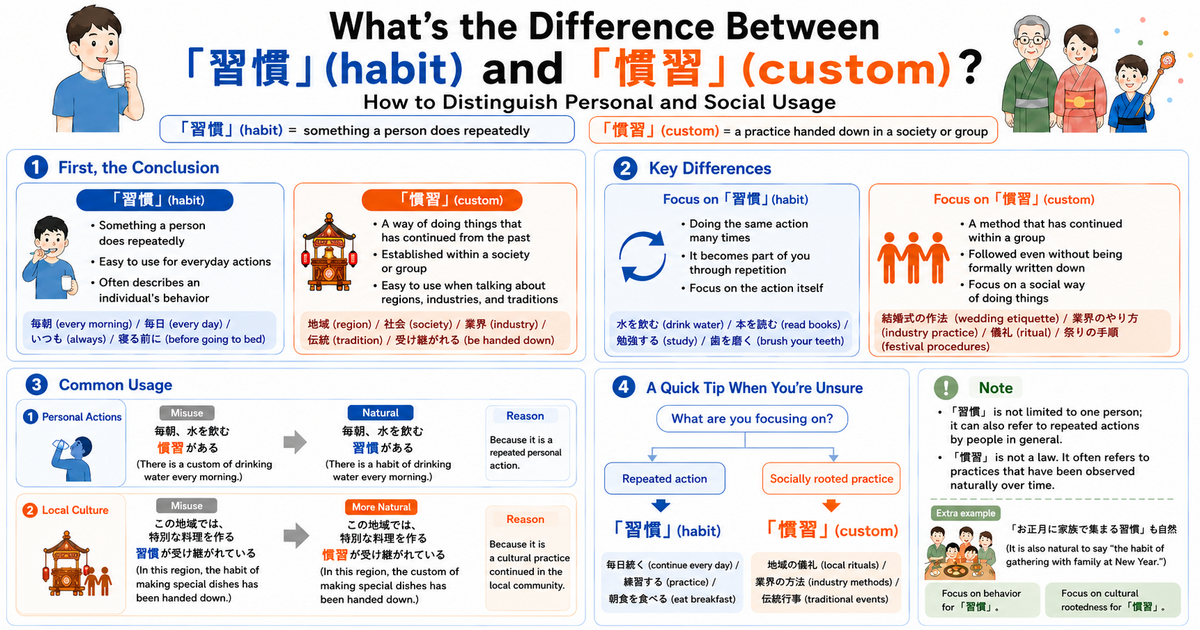
習慣 (shūkan) usually refers to an action that a person or group repeatedly performs. 慣習 (kanshū), on the other hand, usually refers to an established practice that has taken root in a society, region, organization, or industry.
Because the meanings are close, using the wrong word will not always make your sentence impossible to understand. Still, it can make the sentence sound slightly unnatural to a native Japanese speaker.
Let us begin with some common learner mistakes and see how to correct them.
Common Mistakes
Consider the following sentence.
私は毎朝、起きたら水を飲む慣習があります。
I have a custom of drinking water every morning after I wake up.
The meaning is understandable, but 慣習 (kanshū / social custom) sounds too formal and social for this situation.
Drinking water every morning is a repeated action performed by an individual. Therefore, 習慣 (shūkan / habit) is the natural choice.
Here is another example.
この地域では、結婚式の前に特別な料理を作る習慣が昔から受け継がれています。
In this region, the habit of preparing special food before weddings has been passed down for generations.
Using 習慣 (shūkan) here is not completely incorrect. However, the sentence describes a cultural practice that has been passed down within a community.
For this reason, 慣習 (kanshū / custom or convention) is more appropriate.
Why Do These Sentences Sound Unnatural?
The difference between 習慣 and 慣習 is not simply a perfect division between “individual” and “society.”
The important question is what the speaker is focusing on.
習慣 (shūkan) focuses on a repeated action. It can also describe something that a person has done so often that it has become almost automatic.
Typical examples include:
- Drinking water after waking up
- Reading before going to bed
- Studying Japanese every day
- Brushing your teeth after meals
慣習 (kanshū), by contrast, focuses on an established way of doing things within a society, organization, region, or other group.
A 慣習 does not necessarily have to be written down as a law or official rule. It may simply be something that people have done for a long time and therefore regard as the normal or expected way to behave.
Typical examples include:
- Traditional wedding practices in a region
- Long-established business practices within an industry
- Social ceremonies and rituals
- Traditional procedures used during festivals and events
In simple terms:
- 習慣 focuses on repeated behavior.
- 慣習 focuses on an established social or cultural practice.
Natural Corrections
Let us correct the earlier examples.
Mistake 1
私は毎朝、起きたら水を飲む慣習があります。
I have a custom of drinking water every morning after I wake up.
Natural Japanese
私は毎朝、起きたら水を飲む習慣があります。
I have a habit of drinking water every morning after I wake up.
This sentence describes something that one person repeatedly does, so 習慣 (shūkan / habit) is natural.
Words and expressions such as 毎朝 (maiasa / every morning), 毎日 (mainichi / every day), いつも (itsumo / always), and 寝る前に (neru mae ni / before going to bed) often appear with 習慣 because they describe repeated personal behavior.
Mistake 2
この地域では、結婚式の前に特別な料理を作る習慣が昔から受け継がれています。
In this region, the habit of preparing special food before weddings has been passed down for generations.
More Natural Japanese
この地域では、結婚式の前に特別な料理を作る慣習が昔から受け継がれています。
In this region, the custom of preparing special food before weddings has been passed down for generations.
This sentence is not about one person’s repeated behavior. It describes a cultural practice inherited by a regional community.
Words such as 地域 (chiiki / region), 社会 (shakai / society), 業界 (gyōkai / industry), 伝統 (dentō / tradition), and 昔から受け継がれる (mukashi kara uketsugareru / to be passed down over generations) often suggest that 慣習 is the better choice.
The Basic Difference Between 習慣 and 慣習
習慣 (shūkan / habit) refers to an action that is repeated regularly or a behavior that has become established through repetition.
It is often used for everyday personal behavior. It can describe both good and bad habits.
For example, 運動する習慣 (undō suru shūkan / the habit of exercising) is generally positive, while 夜更かしをする習慣 (yofukashi o suru shūkan / the habit of staying up late) may be unhealthy.
慣習 (kanshū / custom, convention, or established practice) refers to a way of doing things that has continued for a long time within a society, region, organization, or industry.
Unlike a 法律 (hōritsu / law) or 規則 (kisoku / regulation), a 慣習 may not be officially written down. People follow it because it has become socially or culturally established.
A useful way to remember the difference is:
- 習慣: something a person or group repeatedly does
- 慣習: something a society or group has traditionally accepted as the normal way of doing things
However, 習慣 is not limited to individuals.
For example:
日本では、家に入るときに靴を脱ぐ習慣がある。
In Japan, people have the habit of taking off their shoes when entering a home.
This sentence is natural because the speaker views the action as something that people in Japan repeatedly do.
If 慣習 were used, the sentence would place more emphasis on the fact that removing shoes is a socially and culturally established practice.
When you are unsure, ask yourself:
Am I talking about repeated behavior, or an established social practice?
Learn the Difference Through Examples
Examples with 習慣
私は寝る前に、その日覚えた日本語を復習する習慣があります。
I have a habit of reviewing the Japanese I learned that day before going to bed.
This describes a repeated action performed by one learner, so 習慣 is natural.
毎日少しずつ文章を読む習慣をつけましょう。
Let’s develop the habit of reading a little every day.
習慣をつける (shūkan o tsukeru) means to develop a regular habit by repeating an action until it becomes part of your routine.
健康のために、夜更かしの習慣を改めました。
For the sake of my health, I changed my habit of staying up late.
習慣を改める (shūkan o aratameru) means to reconsider and change a repeated pattern of behavior.
子どものころから、朝食を必ず食べる習慣がある。
I have had the habit of always eating breakfast since I was a child.
This sentence describes a behavior that has continued for a long time in one person’s daily life.
Examples with 慣習
この地方には、春の祭りで特別な衣装を着る慣習があります。
This region has a custom of wearing special clothing during its spring festival.
This is a cultural practice that has continued within a regional community, so 慣習 is natural.
古い慣習を見直す必要があるという意見が出ました。
Some people expressed the opinion that old customs need to be reconsidered.
The sentence refers to established practices that have continued within a society or organization.
業界の慣習として、契約前に詳しい条件を確認します。
As an industry practice, detailed conditions are confirmed before a contract is signed.
This describes an established way of doing things within a particular industry.
その制度には、当時の社会的な慣習が強く影響しています。
The social customs of that time had a strong influence on the system.
The sentence refers not to one person’s repeated behavior, but to ways of thinking and behaving that were established throughout society.
Cases Where Both Words May Seem Possible
日本では、お正月に家族で集まる習慣があります。
In Japan, people have a habit of gathering with their families during the New Year holidays.
Here, the speaker focuses on an action that many people repeatedly perform, so 習慣 is natural.
お正月に親族が集まる慣習は、地域によって少しずつ異なります。
The custom of relatives gathering during the New Year holidays differs slightly from region to region.
Here, the speaker focuses on a cultural practice that has been passed down within communities, so 慣習 is natural.
Even when the action itself is similar, the correct word may change depending on what aspect the speaker wants to emphasize.
How These Words Can Appear in the JLPT
In JLPT vocabulary and reading questions, 習慣 and 慣習 may appear together as answer choices.
Because both words relate to things that continue over time, they can be difficult to distinguish if you consider only their general dictionary meanings.
Consider this example.
毎朝30分歩くことを、健康のための___にしている。
I make walking for 30 minutes every morning part of my healthy ______.
If 習慣 and 慣習 are both choices, the correct answer is 習慣.
The sentence describes an action that an individual repeatedly performs every morning.
Now consider this sentence.
この村には、収穫した作物の一部を神社に納める___が残っている。
In this village, the ______ of offering part of the harvest to a Shinto shrine still remains.
In this case, 慣習 is the natural answer.
The words この村 (kono mura / this village) and 残っている (nokotte iru / still remains) indicate a traditional practice that has continued within a community.
When answering JLPT questions, pay close attention to the words surrounding the blank.
Expressions such as the following often point toward 習慣:
- 毎日 (mainichi / every day)
- いつも (itsumo / always)
- 生活 (seikatsu / daily life)
- 健康 (kenkō / health)
- 身につける (mi ni tsukeru / to acquire)
Expressions such as the following often point toward 慣習:
- 地域 (chiiki / region)
- 社会 (shakai / society)
- 伝統 (dentō / tradition)
- 業界 (gyōkai / industry)
- 昔から (mukashi kara / since long ago)
- 受け継ぐ (uketsugu / to pass down)
Do not choose an answer simply because the two words have similar translations. Ask who performs the action, why it continues, and whether it is an individual routine or a socially established practice.
Summary
習慣 and 慣習 both describe something that continues over time, but they emphasize different ideas.
- 習慣 describes repeated behavior performed by an individual or group.
- 慣習 describes an established practice within a society, region, organization, or industry.
- Use 習慣 when discussing everyday routines and repeated actions.
- Use 慣習 when discussing traditions, conventions, and socially established ways of doing things.
When you are unsure, ask yourself:
Is this a repeated behavior, or a practice rooted in society?
Learning a translation alone is not enough to master similar Japanese vocabulary. You also need to practice identifying who is acting, what kind of situation is being described, and why the action has continued.
RJT (Rapid Japanese Training) helps you practice easily confused JLPT vocabulary and grammar through realistic multiple-choice questions. By comparing similar answer choices in context, you can build the skills needed to recognize natural Japanese and avoid tempting distractors.
Start strengthening your Japanese vocabulary and JLPT decision-making skills here:
%E3%80%8C%E6%9C%9F%E9%99%90%E3%82%92%E5%AE%88%E3%82%8B%E3%80%8D%E3%81%A8%E3%80%8C%E7%B7%A0%E3%82%81%E5%88%87%E3%82%8A%E3%81%AB%E9%96%93%E3%81%AB%E5%90%88%E3%81%86%E3%80%8D%E3%81%AE%E9%81%95%E3%81%84%EF%BC%88%E8%8B%B1%EF%BC%89.png)
%E3%80%8C%E4%BA%88%E5%AE%9A%E3%81%8C%E5%85%A5%E3%82%8B%E3%80%8D%E3%81%A8%E3%80%8C%E4%BA%88%E5%AE%9A%E3%82%92%E5%85%A5%E3%82%8C%E3%82%8B%E3%80%8D%E3%81%AE%E9%81%95%E3%81%84%EF%BC%88%E8%8B%B1%EF%BC%89.png)
%E3%80%8C%E8%87%AA%E4%BF%A1%E3%81%8C%E3%81%82%E3%82%8B%E3%80%8D%E3%81%A8%E3%80%8C%E8%87%AA%E4%BF%A1%E3%82%92%E6%8C%81%E3%81%A4%E3%80%8D%E3%81%AE%E9%81%95%E3%81%84%EF%BC%88%E8%8B%B1%EF%BC%89.png)
%E3%80%8C%E5%BF%85%E8%A6%81%E3%81%8C%E3%81%82%E3%82%8B%E3%80%8D%E3%81%A8%E3%80%8C%E5%BF%85%E8%A6%81%E3%81%AB%E3%81%AA%E3%82%8B%E3%80%8D%E3%81%AE%E9%81%95%E3%81%84%EF%BC%88%E8%8B%B1%EF%BC%89.png)
%E3%80%8C%E5%8F%AF%E8%83%BD%E6%80%A7%E3%81%8C%E9%AB%98%E3%81%84%E3%80%8D%E3%81%A8%E3%80%8C%E5%8F%AF%E8%83%BD%E6%80%A7%E3%81%8C%E3%81%82%E3%82%8B%E3%80%8D%E3%81%AE%E9%81%95%E3%81%84%EF%BC%88%E8%8B%B1%EF%BC%89.png)
%E3%80%8C%E7%B5%90%E8%AB%96%E3%82%92%E5%87%BA%E3%81%99%E3%80%8D%E3%81%A8%E3%80%8C%E7%B5%90%E8%AB%96%E3%81%AB%E9%81%94%E3%81%99%E3%82%8B%E3%80%8D%E3%81%AE%E9%81%95%E3%81%84%EF%BC%88%E8%8B%B1%EF%BC%89.png)