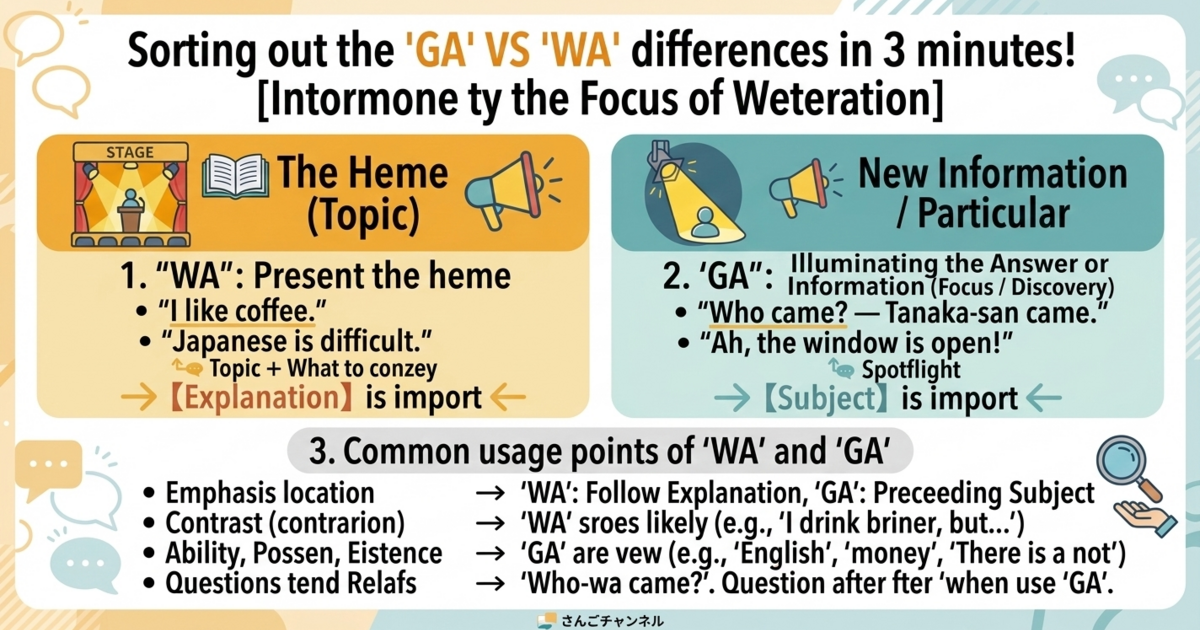
「が」 and 「は」 often confuse learners because both can appear after the subject-like part of a sentence.
However, their roles are fundamentally different.
Think of 「は」 as setting the stage, or the topic.
Think of 「が」 as a spotlight that shines directly on the main character, the new information.
1. 「は」: Presenting the topic of the sentence
「は」 is a signal that means, “This is what I am going to talk about.”
It often presents information that is already known or easy for the listener to identify. The important information usually comes after 「は」.
Examples
私はコーヒーが好きです。
I like coffee.
Topic = 私 / what I want to say = コーヒーが好き
日本語は難しいですね。
Japanese is difficult, isn’t it?
Topic = 日本語 / what I want to say = 難しい
In these sentences, 「は」 creates the topic first. Then the sentence explains something about that topic.
2. 「が」: Highlighting the answer or new information
「が」 puts the spotlight on new information, discovery, or the answer to a question.
It often shows “this is the important part” or “this is what has just been found.”
Examples
誰が来ましたか? — 田中さんが来ました。
Who came? — Tanaka came.
「田中さんが」 is the answer to 「誰」.
あ、窓が開いている!
Oh, the window is open!
「窓が」 shows something the speaker has just noticed.
Here, 「が」 does not simply set a topic. It highlights the thing that matters most in that moment.
3. Key points for choosing 「は」 or 「が」
Where is the focus?
With 「は」, the focus is usually on what comes after it.
Example:
私はコーヒーが好きです。
As for me, I like coffee.
The important part is 「コーヒーが好き」.
With 「が」, the focus is usually on the noun before it.
Example:
田中さんが来ました。
Tanaka came.
The important part is 「田中さん」.
Contrast
「は」 is often used when comparing or contrasting things.
Example:
ビールは飲むが、酒は飲まない。
I drink beer, but I do not drink sake.
Here, 「ビールは」 and 「酒は」 are being contrasted.
Ability, possession, and existence
「が」 is often used with ability, possession, and existence.
Examples:
英語が分かる。
I understand English.
お金がある。
I have money.
猫がいる。
There is a cat.
In these cases, 「が」 naturally marks the thing involved in the ability, state, or existence.
Question words
After question words such as 「誰」, 「どこ」, and 「いつ」, use 「が」.
Correct:
誰が来ましたか?
Who came?
Incorrect:
誰は来ましたか?
This is one of the clearest rules for learners.
4. The “magic questions” for choosing between 「は」 and 「が」
When you are not sure which one to use, ask yourself these questions.
What am I going to talk about?
If the answer is 「〇〇」, use 「〇〇は」.
Example:
日本語は難しいです。
As for Japanese, it is difficult.
Who or what is the answer?
If the answer is 「〇〇」, use 「〇〇が」.
Example:
田中さんが来ました。
Tanaka is the one who came.
This way of thinking makes the difference much easier to feel.
5. Why this matters for JLPT reading
In JLPT reading passages, 「は」 and 「が」 are not just small particles.
They help you see what the writer is talking about and where the real focus is.
「は」 tells you the topic.
「が」 tells you the key new information.
Once you get used to this difference, you can understand the flow of Japanese sentences much faster.
For a broader view of cause and reason expressions, see the guide to confusing JLPT reason expressions. Confusing JLPT Reason and Cause Expressions
For formal written expressions often seen in N2, see the guide to formal JLPT written expressions. JLPT Formal and Written Expressions: Common Grammar Differences
Summary
「は」 creates the stage.
「が」 shines the spotlight.
Use 「は」 when you want to introduce the topic.
Use 「が」 when you want to highlight the answer, new information, discovery, ability, possession, or existence.
If you can feel this difference, 「が」 and 「は」 will become much easier to understand in both JLPT grammar questions and reading passages.
Studying for the JLPT?
If you want to study JLPT grammar more efficiently, check out RJT.
RJT helps you practice Japanese grammar, vocabulary, and reading through short questions and clear explanations.
You can also use helpful features such as a pop-up dictionary, audio, answer time display, and learning logs.
%E3%80%8C%E6%9C%9F%E9%99%90%E3%82%92%E5%AE%88%E3%82%8B%E3%80%8D%E3%81%A8%E3%80%8C%E7%B7%A0%E3%82%81%E5%88%87%E3%82%8A%E3%81%AB%E9%96%93%E3%81%AB%E5%90%88%E3%81%86%E3%80%8D%E3%81%AE%E9%81%95%E3%81%84%EF%BC%88%E8%8B%B1%EF%BC%89.png)
%E3%80%8C%E4%BA%88%E5%AE%9A%E3%81%8C%E5%85%A5%E3%82%8B%E3%80%8D%E3%81%A8%E3%80%8C%E4%BA%88%E5%AE%9A%E3%82%92%E5%85%A5%E3%82%8C%E3%82%8B%E3%80%8D%E3%81%AE%E9%81%95%E3%81%84%EF%BC%88%E8%8B%B1%EF%BC%89.png)
%E3%80%8C%E8%87%AA%E4%BF%A1%E3%81%8C%E3%81%82%E3%82%8B%E3%80%8D%E3%81%A8%E3%80%8C%E8%87%AA%E4%BF%A1%E3%82%92%E6%8C%81%E3%81%A4%E3%80%8D%E3%81%AE%E9%81%95%E3%81%84%EF%BC%88%E8%8B%B1%EF%BC%89.png)
%E3%80%8C%E5%BF%85%E8%A6%81%E3%81%8C%E3%81%82%E3%82%8B%E3%80%8D%E3%81%A8%E3%80%8C%E5%BF%85%E8%A6%81%E3%81%AB%E3%81%AA%E3%82%8B%E3%80%8D%E3%81%AE%E9%81%95%E3%81%84%EF%BC%88%E8%8B%B1%EF%BC%89.png)
%E3%80%8C%E5%8F%AF%E8%83%BD%E6%80%A7%E3%81%8C%E9%AB%98%E3%81%84%E3%80%8D%E3%81%A8%E3%80%8C%E5%8F%AF%E8%83%BD%E6%80%A7%E3%81%8C%E3%81%82%E3%82%8B%E3%80%8D%E3%81%AE%E9%81%95%E3%81%84%EF%BC%88%E8%8B%B1%EF%BC%89.png)
%E3%80%8C%E7%B5%90%E8%AB%96%E3%82%92%E5%87%BA%E3%81%99%E3%80%8D%E3%81%A8%E3%80%8C%E7%B5%90%E8%AB%96%E3%81%AB%E9%81%94%E3%81%99%E3%82%8B%E3%80%8D%E3%81%AE%E9%81%95%E3%81%84%EF%BC%88%E8%8B%B1%EF%BC%89.png)