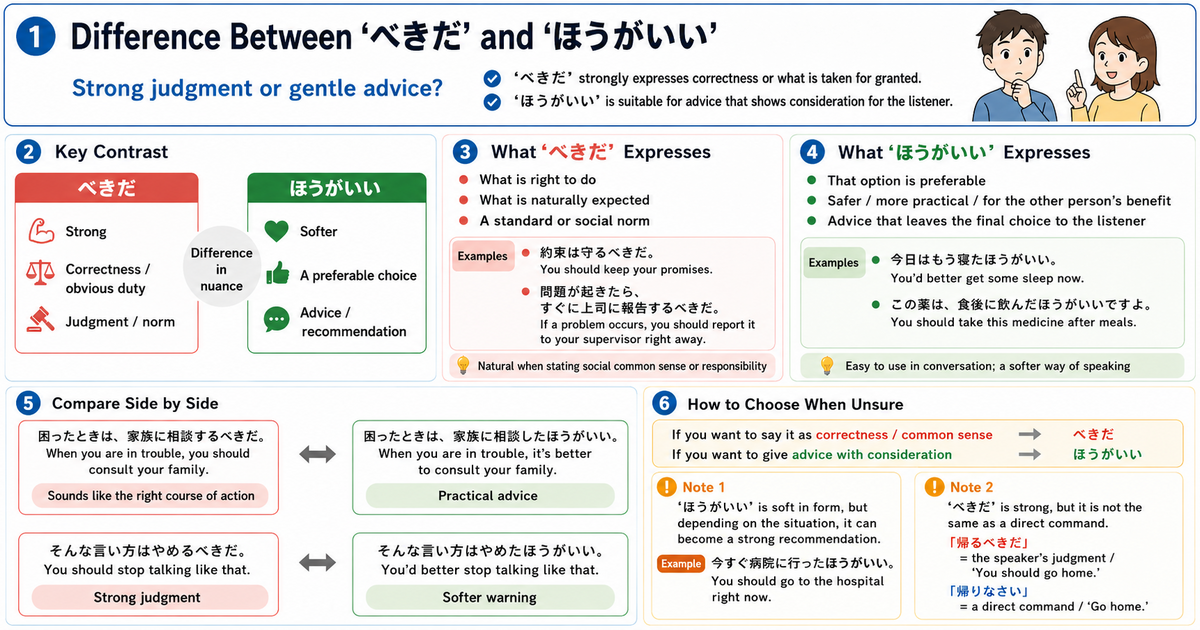
When studying Japanese, you often meet expressions that both seem to give advice.
Among them, 「べきだ」 and 「ほうがいい」 are especially easy to confuse.
For example:
「約束は守るべきだ。」
You should keep promises.
It is right and expected to keep promises.
「約束は守ったほうがいい。」
You had better keep promises.
It is better to keep promises.
At first glance, both sentences seem to say that keeping promises is desirable.
However, the way they sound is quite different.
「べきだ」 sounds strong.
「ほうがいい」 sounds softer.
「べきだ」 is closer to a judgment about what is right.
「ほうがいい」 is closer to advice.
Once you understand this difference, it becomes easier to choose expressions that do not sound rude. It also helps you understand the speaker’s attitude in reading passages.
First, the Main Point
「べきだ」 expresses a strong judgment that something is natural, correct, expected, or desirable.
「ほうがいい」 expresses advice. It means that among several possible choices, one option is better, safer, more practical, or more desirable.
In simple terms:
「べきだ」
Strong. It has a sense of duty, correctness, or what should naturally be done.
「ほうがいい」
Softer. It is suitable for giving advice to someone.
This is the basic difference.
「べきだ」 Strongly Expresses Correctness or What Should Be Done
「べきだ」 is used when the speaker clearly thinks:
“That is the right thing to do.”
“That is what should naturally be done.”
“Not doing it would be wrong or inappropriate.”
It is not just a light recommendation. It includes a judgment or standard.
Example
学生は、授業中は私語を慎むべきだ。
Students should refrain from private conversation during class.
In this sentence, the speaker is not simply expressing a personal preference.
The sentence suggests that, as proper classroom behavior, students are expected to refrain from private conversation.
There is a sense of rule, standard, or correctness.
Another Example
問題が起きたら、すぐに上司に報告するべきだ。
If a problem occurs, you should report it to your boss immediately.
Here, the meaning is not simply “It would be convenient if you did that.”
Rather, it sounds like:
“As a working adult, or as someone in an organization, that is what you are expected to do.”
In other words, 「べきだ」 brings the speaker’s standard or sense of what is proper to the front.
「ほうがいい」 Gives Softer, More Considerate Advice
On the other hand, 「ほうがいい」 is a softer expression.
It is used when the speaker wants to say:
“That choice will probably lead to a better result.”
“That option is safer.”
“That is what I would recommend.”
“It would be better for you.”
Example
明日は早いから、今日はもう寝たほうがいい。
You have to get up early tomorrow, so you should go to bed now.
This is not a command.
The speaker is thinking about the other person’s health or schedule and is giving advice.
Another Example
この薬は、食後に飲んだほうがいいですよ。
You should take this medicine after meals.
This does not sound like a strong moral judgment.
It sounds like useful guidance or advice given for the other person’s benefit.
「ほうがいい」 leaves room for the listener to choose. That is why it is very useful in conversation.
Comparing the Two Expressions
Even when the content is similar, the impression changes greatly depending on which expression you use.
Example 1
困ったときは、家族に相談するべきだ。
When you are in trouble, you should consult your family.
困ったときは、家族に相談したほうがいい。
When you are in trouble, it is better to consult your family.
The first sentence strongly shows the speaker’s belief that consulting one’s family is the right thing to do.
The second sentence sounds more like practical advice: “That would probably help you.”
Example 2
そんな言い方はやめるべきだ。
You should stop speaking like that.
そんな言い方はやめたほうがいい。
You had better stop speaking like that.
The first sentence sounds quite strong. The speaker clearly judges that the way of speaking is not good.
The second sentence is still a warning, but it sounds softer.
In daily conversation, 「やめたほうがいい」 often causes less friction than 「やめるべきだ」.
「べきだ」 Can Sound Too Strong
This is an important point for Japanese learners.
The grammar of 「べきだ」 itself is not difficult, but in real conversation it can sound strong.
Especially when you say it directly to another person, you need to be careful.
For example:
もっと勉強するべきです。
You should study more.
Depending on the situation, this may sound like a lecture or criticism.
On the other hand:
もう少し勉強したほうがいいです。
It would be better to study a little more.
This is easier to receive as advice.
Of course, 「べきだ」 is natural when talking about rules, ethics, social responsibility, or strong opinions.
However, in everyday conversation, 「ほうがいい」 is often easier and safer to use.
When 「べきだ」 Sounds Natural
「べきだ」 is often used in situations like the following.
When Talking About Social Norms or Common Sense
人の悪口を簡単に広めるべきではない。
You should not casually spread bad things about others.
子どもの安全を最優先に考えるべきだ。
We should give top priority to children’s safety.
When Making a Strong Argument or Expressing an Opinion
この問題は、もっと真剣に議論されるべきだ。
This issue should be discussed more seriously.
重要な情報は、最初にはっきり説明するべきだ。
Important information should be explained clearly at the beginning.
In this way, 「べきだ」 fits well in essays, opinion statements, formal writing, and discussions about principles.
When 「ほうがいい」 Sounds Natural
「ほうがいい」 is very natural when giving advice to someone.
Everyday Advice
疲れているなら、今日は休んだほうがいい。
If you are tired, you should rest today.
この道は暗いから、昼に行ったほうがいいよ。
This road is dark, so it is better to go during the day.
Light Warnings or Recommendations
そのファイルは、名前を変えて保存したほうがいいです。
It would be better to save that file under a different name.
初めてなら、このコースから始めたほうがいいと思います。
If it is your first time, I think it would be better to start with this course.
Adding 「と思います」 makes the sentence even softer.
In real conversation, this pattern is very common.
Common Misunderstandings
「ほうがいい」 Does Not Always Mean Weak Advice
「ほうがいい」 is a soft form, but depending on the situation, it can be a strong warning.
For example:
今すぐ病院に行ったほうがいい。
You should go to the hospital right now.
Grammatically, this is advice.
But in context, it may sound very urgent.
So, although 「ほうがいい」 is softer in form, the content is not always weak.
「べきだ」 Is Not Exactly the Same as a Command
「べきだ」 is strong, but it is not exactly the same as a direct command.
「帰るべきだ」
You should go home.
The speaker judges that going home is the right thing to do.
「帰りなさい」
Go home.
This directly orders the listener to act.
This difference is important.
「べきだ」 expresses judgment.
A command directly demands action.
How to Choose Between Them
When you are not sure which one to use, think like this:
If you want to express what is right, natural, or socially expected, use 「べきだ」.
If you want to give advice while being considerate of the listener, use 「ほうがいい」.
In one phrase:
「べきだ」 is judgment.
「ほうがいい」 is advice.
If you keep this image in mind, the difference becomes much easier to understand.
Final Example Sentences
Let’s review with some examples.
「べきだ」
約束したことは守るべきだ。
You should keep what you have promised.
大事なメールには早めに返信するべきだ。
You should reply to important emails early.
子どもの前では、言葉づかいに気をつけるべきだ。
You should be careful with your language in front of children.
「ほうがいい」
明日の会議の前に、もう一度資料を見たほうがいい。
You should look over the materials once more before tomorrow’s meeting.
雨が降りそうだから、傘を持っていったほうがいいよ。
It looks like it may rain, so you should take an umbrella.
この漢字は、書いて覚えたほうがいいかもしれません。
You might want to learn this kanji by writing it.
When placed side by side, 「べきだ」 sounds clearer and stronger, while 「ほうがいい」 feels more considerate and advice oriented.
For a broader view of similar inference and judgment expressions, see the guide to confusing JLPT inference expressions. JLPT Inference and Judgment Expressions
For a broader view of Japanese negative expressions, see the guide to confusing JLPT negative expressions. Confusing JLPT Negative Expressions
Summary
「べきだ」 expresses the speaker’s strong judgment that something is right, natural, or expected.
「ほうがいい」 expresses softer advice that something is preferable, safer, or more practical.
They may look similar, but the impression they give to the listener is quite different.
Do you want to make a strong statement?
Or do you want to give gentle advice?
Just being aware of this difference will make your Japanese sound much more natural.
If you want to learn subtle Japanese grammar differences through examples and practice questions, try studying with RJT.
%E3%80%8C%E6%9C%9F%E9%99%90%E3%82%92%E5%AE%88%E3%82%8B%E3%80%8D%E3%81%A8%E3%80%8C%E7%B7%A0%E3%82%81%E5%88%87%E3%82%8A%E3%81%AB%E9%96%93%E3%81%AB%E5%90%88%E3%81%86%E3%80%8D%E3%81%AE%E9%81%95%E3%81%84%EF%BC%88%E8%8B%B1%EF%BC%89.png)
%E3%80%8C%E4%BA%88%E5%AE%9A%E3%81%8C%E5%85%A5%E3%82%8B%E3%80%8D%E3%81%A8%E3%80%8C%E4%BA%88%E5%AE%9A%E3%82%92%E5%85%A5%E3%82%8C%E3%82%8B%E3%80%8D%E3%81%AE%E9%81%95%E3%81%84%EF%BC%88%E8%8B%B1%EF%BC%89.png)
%E3%80%8C%E8%87%AA%E4%BF%A1%E3%81%8C%E3%81%82%E3%82%8B%E3%80%8D%E3%81%A8%E3%80%8C%E8%87%AA%E4%BF%A1%E3%82%92%E6%8C%81%E3%81%A4%E3%80%8D%E3%81%AE%E9%81%95%E3%81%84%EF%BC%88%E8%8B%B1%EF%BC%89.png)
%E3%80%8C%E5%BF%85%E8%A6%81%E3%81%8C%E3%81%82%E3%82%8B%E3%80%8D%E3%81%A8%E3%80%8C%E5%BF%85%E8%A6%81%E3%81%AB%E3%81%AA%E3%82%8B%E3%80%8D%E3%81%AE%E9%81%95%E3%81%84%EF%BC%88%E8%8B%B1%EF%BC%89.png)
%E3%80%8C%E5%8F%AF%E8%83%BD%E6%80%A7%E3%81%8C%E9%AB%98%E3%81%84%E3%80%8D%E3%81%A8%E3%80%8C%E5%8F%AF%E8%83%BD%E6%80%A7%E3%81%8C%E3%81%82%E3%82%8B%E3%80%8D%E3%81%AE%E9%81%95%E3%81%84%EF%BC%88%E8%8B%B1%EF%BC%89.png)
%E3%80%8C%E7%B5%90%E8%AB%96%E3%82%92%E5%87%BA%E3%81%99%E3%80%8D%E3%81%A8%E3%80%8C%E7%B5%90%E8%AB%96%E3%81%AB%E9%81%94%E3%81%99%E3%82%8B%E3%80%8D%E3%81%AE%E9%81%95%E3%81%84%EF%BC%88%E8%8B%B1%EF%BC%89.png)