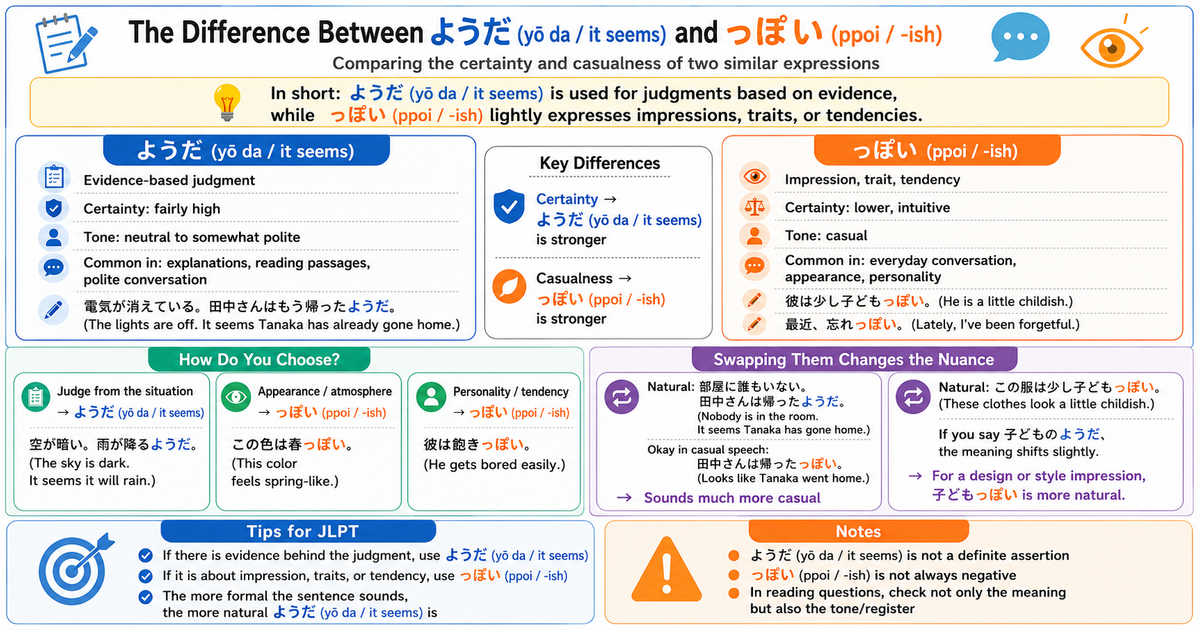
%E3%80%8C%E3%82%88%E3%81%86%E3%81%A0%E3%80%8D%E3%81%A8%E3%80%8C%E3%81%A3%E3%81%BD%E3%81%84%E3%80%8D%E3%81%AE%E9%81%95%E3%81%84%E3%81%AF%EF%BC%9F%E4%BC%BC%E3%81%A6%E3%81%84%E3%82%8B%E8%A1%A8%E7%8F%BE%E3%81%AE%E8%BB%BD%E3%81%95%E3%81%A8%E7%A2%BA%E3%81%8B%E3%81%95%E3%82%92%E6%AF%94%E8%BC%83%EF%BC%88%E8%8B%B1%EF%BC%89.png)
When reading Japanese, you may encounter expressions that seem almost interchangeable at first glance.
Two common examples are:
- ようだ (yō da / it seems; apparently)
- っぽい (ppoi / -ish; prone to; having the feel of)
Both expressions can be used when something is not stated as an absolute fact. However, their tone, meaning, and suitable situations are different.
Compare these sentences:
電気が消えている。田中さんはもう帰ったようだ。
Denki ga kiete iru. Tanaka-san wa mō kaetta yō da.
The lights are off. It seems that Mr. Tanaka has already gone home.
このバッグは革っぽいが、実は合成素材でできている。
Kono baggu wa kawa-ppoi ga, jitsu wa gōsei sozai de dekite iru.
This bag looks like leather, but it is actually made of synthetic material.
In the first example, the speaker makes a judgment based on evidence.
In the second example, the speaker describes an impression.
This difference is especially important for learners preparing for the JLPT N3 or N2. Even when you understand every word in a sentence, choosing the correct answer can be difficult unless you notice the speaker’s intention and the level of formality.
Let us examine the difference step by step.
The Main Difference: Judgment vs. Impression
The basic distinction is simple:
- ようだ (yō da): a careful judgment based on information or evidence
- っぽい (ppoi): a casual impression, noticeable characteristic, or repeated tendency
The expression ようだ often suggests that the speaker has observed something and reached a conclusion.
The expression っぽい is more intuitive and conversational. It often means that something has the feel, appearance, or tendency of something else.
How to Use ようだ (yō da)
The expression ようだ is frequently used when the speaker makes an inference based on visible signs, sounds, reported information, or the surrounding situation.
Example 1: A judgment based on the situation
電気が消えている。田中さんはもう帰ったようだ。
Denki ga kiete iru. Tanaka-san wa mō kaetta yō da.
The lights are off. It seems that Mr. Tanaka has already gone home.
The speaker does not know with complete certainty that Mr. Tanaka has left. However, the lights are off, so there is a clear reason for the conclusion.
Example 2: A judgment based on appearance
山田さんは顔色が悪い。少し疲れているようだ。
Yamada-san wa kao-iro ga warui. Sukoshi tsukarete iru yō da.
Ms. Yamada looks pale. She seems to be a little tired.
The speaker notices Ms. Yamada’s complexion and makes a careful inference.
Example 3: A judgment based on information
天気予報によると、明日は雪になるようだ。
Tenki yohō ni yoru to, ashita wa yuki ni naru yō da.
According to the weather forecast, it appears that it will snow tomorrow.
Here, the weather forecast is the source of information.
When ようだ is commonly used
The expression ようだ is suitable when:
- You are explaining a situation objectively
- You want to make a cautious judgment
- You are writing a report, article, or formal message
- You are reading an explanatory passage or narrative text in the JLPT
It is widely used in both spoken and written Japanese.
How to Use っぽい (ppoi)
The expression っぽい is often attached to a noun or a verb stem. It describes an impression, a noticeable characteristic, or a tendency.
It is usually more casual than ようだ.
Meaning 1: Something Looks or Feels Like Something Else
このバッグは革っぽいが、実は合成素材でできている。
Kono baggu wa kawa-ppoi ga, jitsu wa gōsei sozai de dekite iru.
This bag looks like leather, but it is actually made of synthetic material.
The bag is not made of real leather. It simply gives that impression.
この服は少し子どもっぽい。
Kono fuku wa sukoshi kodomo-ppoi.
These clothes look a little childish.
The speaker feels that the design has a childlike quality.
春っぽい明るい色を選んだ。
Haru-ppoi akarui iro o eranda.
I chose a bright color that feels like spring.
The color gives the impression of spring.
Meaning 2: A Certain Feature Is Too Noticeable
このスープは少し水っぽい。
Kono sūpu wa sukoshi mizu-ppoi.
This soup is a little watery.
The soup seems to contain too much water or lacks richness.
この料理は少し油っぽい。
Kono ryōri wa sukoshi abura-ppoi.
This dish is a little greasy.
The oily quality is noticeable.
部屋がほこりっぽい。
Heya ga hokori-ppoi.
The room is dusty.
In these examples, っぽい often carries a mildly negative nuance.
Meaning 3: Someone Has a Strong Tendency
最近、忘れっぽくなった。
Saikin, wasure-ppoku natta.
I have become forgetful recently.
彼は飽きっぽい。
Kare wa aki-ppoi.
He gets bored easily.
彼女は少し怒りっぽい。
Kanojo wa sukoshi okori-ppoi.
She tends to get angry easily.
These sentences describe repeated behavior or a general tendency, not a one-time event.
Can ようだ and っぽい Be Interchanged?
Sometimes they appear similar, but they are not freely interchangeable.
Case 1: Making a Judgment About a Situation
部屋に誰もいない。田中さんは帰ったようだ。
Heya ni dare mo inai. Tanaka-san wa kaetta yō da.
Nobody is in the room. It seems that Mr. Tanaka has gone home.
This is natural and neutral. The conclusion is based on the situation.
部屋に誰もいない。田中さんは帰ったっぽい。
Heya ni dare mo inai. Tanaka-san wa kaetta ppoi.
Nobody is in the room. Looks like Mr. Tanaka went home.
This can be heard in casual conversation. However, it sounds informal and somewhat light.
In a JLPT reading passage, a report, or a polite conversation, ようだ is usually the safer choice.
Case 2: Describing an Impression
この服は少し子どもっぽい。
Kono fuku wa sukoshi kodomo-ppoi.
These clothes look a little childish.
This sentence naturally describes the impression created by the design.
この服は少し子どものようだ。
Kono fuku wa sukoshi kodomo no yō da.
These clothes are somewhat like a child.
This sentence is grammatically possible, but the meaning changes. It can sound as if the clothes themselves are being compared to a child.
When describing a childlike style or quality, 子どもっぽい is much more natural.
Case 3: Describing a Habit or Personality Trait
彼は飽きっぽい。
Kare wa aki-ppoi.
He gets bored easily.
This describes a recurring personality trait.
彼は飽きるようだ。
Kare wa akiru yō da.
It seems that he gets bored.
This sounds more like a judgment about a particular situation. It does not clearly express a stable personality trait.
A Useful JLPT Strategy
When you see ようだ or っぽい in a JLPT question, do not focus only on the dictionary meaning.
Ask yourself the following questions.
1. Is the speaker making a judgment based on evidence?
Choose ようだ when there is a reason, observation, or source of information behind the conclusion.
店の電気が消えている。今日は休みのようだ。
Mise no denki ga kiete iru. Kyō wa yasumi no yō da.
The shop lights are off. It seems that the shop is closed today.
The lights being off provide evidence.
2. Is the speaker describing an impression?
Choose っぽい when something looks, feels, or sounds like something else.
このデザインは少し大人っぽい。
Kono dezain wa sukoshi otona-ppoi.
This design looks a little mature.
3. Is the sentence describing a repeated tendency?
Choose っぽい when a person frequently behaves in a certain way.
彼は忘れっぽいので、予定を何度も確認する。
Kare wa wasure-ppoi node, yotei o nando mo kakunin suru.
He is forgetful, so he checks his schedule repeatedly.
4. Is the text formal or casual?
The expression っぽい is common in everyday conversation.
In formal writing, expressions such as ようだ, ように見える (yō ni mieru / appear to), or 傾向がある (keikō ga aru / have a tendency to) are often more appropriate.
Do Not Confuse ようだ with みたいだ
Another similar expression is みたいだ (mitai da / it seems; it looks like).
Compare:
雨が降るようだ。
Ame ga furu yō da.
It seems that it will rain.
雨が降るみたいだ。
Ame ga furu mitai da.
Looks like it is going to rain.
Both expressions can describe an inference. However, みたいだ is more conversational and relaxed than ようだ.
Now compare:
雨が降るっぽい。
Ame ga furu ppoi.
Looks like it is going to rain.
This form may appear in very casual conversation, but it sounds much lighter. It is not usually the best answer in a formal JLPT passage.
Common Mistakes
Mistake 1: Replacing Every っぽい with ようだ
彼は忘れっぽい。
Kare wa wasure-ppoi.
He is forgetful.
This describes a tendency.
Changing it to:
彼は忘れるようだ。
Kare wa wasureru yō da.
It seems that he forgets.
changes the nuance. The second sentence sounds like an observation or judgment about a particular situation.
Mistake 2: Thinking ようだ Means a Confirmed Fact
電車が遅れているようだ。
Densha ga okurete iru yō da.
It seems that the train is delayed.
The speaker has a reason to think the train is delayed, but the situation has not been stated as a confirmed fact.
Mistake 3: Assuming っぽい Is Always Negative
The expression っぽい can be negative:
このスープは水っぽい。
Kono sūpu wa mizu-ppoi.
This soup is watery.
However, it can also be positive:
この服は大人っぽくて素敵だ。
Kono fuku wa otona-ppokute suteki da.
These clothes look mature and stylish.
春っぽい色がきれいだ。
Haru-ppoi iro ga kirei da.
The spring-like color is beautiful.
Mini Quiz
Choose ようだ or っぽい.
Question 1
空が急に暗くなった。もうすぐ雨が降る( )。
Sora ga kyū ni kuraku natta. Mōsugu ame ga furu ( ).
The sky suddenly became dark. It seems that it will rain soon.
Answer: ようだ
The dark sky is evidence for the speaker’s judgment.
Question 2
このジュースは少し水( )ので、あまりおいしくない。
Kono jūsu wa sukoshi mizu ( ) node, amari oishikunai.
This juice is a little watery, so it does not taste very good.
Answer: っぽい
The speaker describes a noticeable watery quality.
Question 3
兄は昔から飽き( )性格で、趣味が長く続かない。
Ani wa mukashi kara aki ( ) seikaku de, shumi ga nagaku tsuzukanai.
My older brother has always become bored easily, so his hobbies do not last long.
Answer: っぽい
The sentence describes a recurring personality trait.
Question 4
会議室から声が聞こえる。まだ会議が続いている( )。
Kaigishitsu kara koe ga kikoeru. Mada kaigi ga tsuzuite iru ( ).
I can hear voices from the meeting room. It seems that the meeting is still going on.
Answer: ようだ
The voices provide evidence for the conclusion.
Summary: Pay Attention to Evidence, Tone, and Tendency
The expressions ようだ and っぽい both avoid making a completely direct statement, but they do different jobs.
- ようだ: a cautious judgment based on evidence or information
- っぽい: a casual impression, noticeable feature, or recurring tendency
When solving JLPT questions, ask yourself:
- Is there evidence behind the judgment?
- Is the speaker describing an impression?
- Is the sentence about a repeated habit?
- Is the tone formal or conversational?
Japanese reading ability is not only about memorizing more vocabulary.
The real breakthrough comes when you can recognize subtle differences between similar expressions and understand why one answer fits the context better than another.
RJT (Rapid Japanese Training) helps you build this skill through short, focused JLPT practice sessions. By solving questions regularly, you can improve your vocabulary, grammar, and reading judgment without feeling overwhelmed.
Related grammar guide: JLPT Inference and Judgment Expressions
Train your Japanese instincts with RJT and make every study session count
%E3%80%8C%E6%9C%9F%E9%99%90%E3%82%92%E5%AE%88%E3%82%8B%E3%80%8D%E3%81%A8%E3%80%8C%E7%B7%A0%E3%82%81%E5%88%87%E3%82%8A%E3%81%AB%E9%96%93%E3%81%AB%E5%90%88%E3%81%86%E3%80%8D%E3%81%AE%E9%81%95%E3%81%84%EF%BC%88%E8%8B%B1%EF%BC%89.png)
%E3%80%8C%E4%BA%88%E5%AE%9A%E3%81%8C%E5%85%A5%E3%82%8B%E3%80%8D%E3%81%A8%E3%80%8C%E4%BA%88%E5%AE%9A%E3%82%92%E5%85%A5%E3%82%8C%E3%82%8B%E3%80%8D%E3%81%AE%E9%81%95%E3%81%84%EF%BC%88%E8%8B%B1%EF%BC%89.png)
%E3%80%8C%E8%87%AA%E4%BF%A1%E3%81%8C%E3%81%82%E3%82%8B%E3%80%8D%E3%81%A8%E3%80%8C%E8%87%AA%E4%BF%A1%E3%82%92%E6%8C%81%E3%81%A4%E3%80%8D%E3%81%AE%E9%81%95%E3%81%84%EF%BC%88%E8%8B%B1%EF%BC%89.png)
%E3%80%8C%E5%BF%85%E8%A6%81%E3%81%8C%E3%81%82%E3%82%8B%E3%80%8D%E3%81%A8%E3%80%8C%E5%BF%85%E8%A6%81%E3%81%AB%E3%81%AA%E3%82%8B%E3%80%8D%E3%81%AE%E9%81%95%E3%81%84%EF%BC%88%E8%8B%B1%EF%BC%89.png)
%E3%80%8C%E5%8F%AF%E8%83%BD%E6%80%A7%E3%81%8C%E9%AB%98%E3%81%84%E3%80%8D%E3%81%A8%E3%80%8C%E5%8F%AF%E8%83%BD%E6%80%A7%E3%81%8C%E3%81%82%E3%82%8B%E3%80%8D%E3%81%AE%E9%81%95%E3%81%84%EF%BC%88%E8%8B%B1%EF%BC%89.png)
%E3%80%8C%E7%B5%90%E8%AB%96%E3%82%92%E5%87%BA%E3%81%99%E3%80%8D%E3%81%A8%E3%80%8C%E7%B5%90%E8%AB%96%E3%81%AB%E9%81%94%E3%81%99%E3%82%8B%E3%80%8D%E3%81%AE%E9%81%95%E3%81%84%EF%BC%88%E8%8B%B1%EF%BC%89.png)