N3%E9%A0%BB%E5%87%BA%E3%80%8C%E5%89%8D%E4%BB%B6%E3%81%AE%E5%BD%A2%E3%80%8D%E3%81%AE%E6%94%BB%E7%95%A5%EF%BC%9A%E6%84%8F%E5%91%B3%E3%82%88%E3%82%8A%E5%85%88%E3%81%AB%E3%80%8C%E6%8E%A5%E7%B6%9A%E3%80%8D%E3%82%92%E4%B8%80%E6%B0%97%E3%81%AB%E6%95%B4%E7%90%86%E3%81%99%E3%82%8B.png)
1. Once you know the connection pattern, grammar becomes like solving a puzzle
Even when two grammar patterns have similar meanings, they become completely different questions if the form that comes before them is different. Many learners who struggle with grammar get stuck on meaning, while stronger learners narrow down the choices by looking at form first. That is why the best place to start is by organizing these connection patterns.
2. Three categories that remove confusion
N3 grammar can be broadly divided into the following three connection patterns.
-
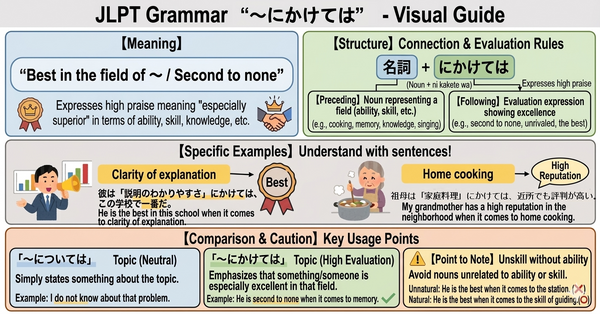
Noun connection
This pattern uses forms such as noun + の or noun + に.
Expressions like “〜の際” and “〜に対して” belong to this group, and they should be memorized together with nouns. -
Plain-form connection
This pattern connects to the plain form of verbs and adjectives.
Expressions like “〜反面” and “〜わけだ” belong to this group, which is the largest one. Be careful to notice that the plain form is used here, not the polite ます-form. -
Verb ます-stem connection
This pattern connects to the ます-stem of verbs.
Expressions like “〜がたい” and “〜抜く” are typical examples. Since the number of patterns in this group is limited, memorizing them first can quickly turn into easy points on the test.
3. The most effective way to memorize them in practice
If you want to study efficiently, change the order of learning.
Instead of the traditional pattern of
grammar point → meaning
use this order:
connection form → short example sentence → meaning
This is the most efficient way to remember them as a set. Once the form is already in your head, the correct answer becomes much easier to see during the test, even before you spend too much time thinking deeply about the meaning of the sentence.
4. Summary: once you master the form before the grammar point, grammar stops being scary
The foundation of grammar lies in connection, the framework that holds everything together. Once you strengthen this part, your reading and writing skills also improve at the same time.
“If I am still not confident about which grammar point matches which connection pattern...”
Then try the grammar drills on Rapid Japanese. You can review connection rules again and again in a game-like way, and reach the point where you can choose the correct answer almost automatically in the shortest possible time.
For more reading connectors, see the guide to Japanese connection expressions that improve JLPT reading. Connection Expressions That Improve JLPT Reading
%E6%96%87%E5%9E%8B%E3%81%AF%E3%80%8C%E6%84%8F%E5%91%B3%E3%80%8D%E3%82%88%E3%82%8A%E3%80%8C%E6%8E%A5%E7%B6%9A%E3%80%8D%E3%81%8B%E3%82%89%E8%A6%9A%E3%81%88%E3%82%8B%E3%81%AE%E3%81%8C%E6%AD%A3%E8%A7%A3%E3%80%82%E4%B8%80%E6%B0%97%E3%81%AB%E6%A5%BD%E3%81%AB%E3%81%AA%E3%82%8B%E7%90%86%E7%94%B1%E3%81%A8%E7%B7%B4%E7%BF%92%E6%B3%95%20(1).png)
%E3%80%8C%E6%9C%9F%E9%99%90%E3%82%92%E5%AE%88%E3%82%8B%E3%80%8D%E3%81%A8%E3%80%8C%E7%B7%A0%E3%82%81%E5%88%87%E3%82%8A%E3%81%AB%E9%96%93%E3%81%AB%E5%90%88%E3%81%86%E3%80%8D%E3%81%AE%E9%81%95%E3%81%84%EF%BC%88%E8%8B%B1%EF%BC%89.png)
%E3%80%8C%E4%BA%88%E5%AE%9A%E3%81%8C%E5%85%A5%E3%82%8B%E3%80%8D%E3%81%A8%E3%80%8C%E4%BA%88%E5%AE%9A%E3%82%92%E5%85%A5%E3%82%8C%E3%82%8B%E3%80%8D%E3%81%AE%E9%81%95%E3%81%84%EF%BC%88%E8%8B%B1%EF%BC%89.png)
%E3%80%8C%E8%87%AA%E4%BF%A1%E3%81%8C%E3%81%82%E3%82%8B%E3%80%8D%E3%81%A8%E3%80%8C%E8%87%AA%E4%BF%A1%E3%82%92%E6%8C%81%E3%81%A4%E3%80%8D%E3%81%AE%E9%81%95%E3%81%84%EF%BC%88%E8%8B%B1%EF%BC%89.png)