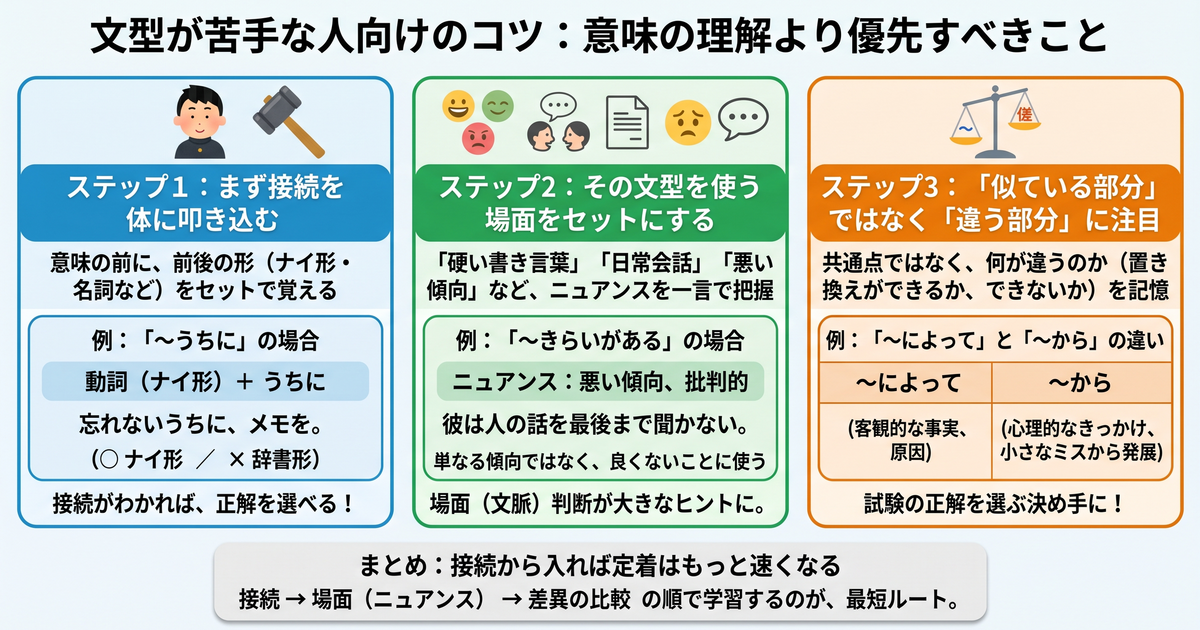
If you try to understand grammar patterns only through dictionary-style meanings, you may panic when several patterns with similar meanings appear together. To choose the correct answer confidently on a test, what you should prioritize first is not meaning, but connection: what form comes before the pattern.
Let’s look at three practical study steps that help grammar patterns stick, along with concrete examples.
Step 1: First, memorize the connection patterns
Before thinking about the meaning, memorize the form that comes before and after the grammar pattern as a set. Ask yourself: does it follow the dictionary form, the nai-form, or a noun?
Example: うちに
Connection: Verb in nai-form + うちに
Example sentence
忘れないうちに、メモをしてください。
Please make a note before you forget.
Correct: 忘れない + うちに
Incorrect: 忘れる + うちに
Once the connection pattern comes to mind instantly, you will be able to look at the choices and say, “This is not the nai-form, so it must be wrong,” without hesitation.
Step 2: Learn the situations where the pattern is used
Along with the form, understand the typical situation in which the pattern is used. Is it formal written language? Everyday conversation? Does it often describe a negative result?
Example: きらいがある
Nuance: a negative tendency, often with a critical tone
Example sentence
彼は人の話を最後まで聞かないきらいがある。
He tends not to listen to other people until the end.
Instead of memorizing it only as “has a tendency to,” it is much more useful to remember that it is often used for something undesirable. That becomes a major clue when you judge the context.
Step 3: Focus not on what is similar, but on what is different
When several grammar patterns have similar meanings, do not memorize only their common points. Focus on what is different: when they can be replaced, and when they cannot.
Example: によって and から
Both can express a cause, but they are used differently.
Example sentence 1: によって
不注意によって、事故が起きた。
An accident occurred due to carelessness.
Used to describe an objective fact or cause.
Example sentence 2: から
ちょっとした油断から、大失敗をしてしまった。
A small moment of carelessness led to a serious failure.
Used when something develops from a psychological trigger or a small mistake.
This difference in usage is exactly what helps you choose the correct answer on a test.
Conclusion: Starting with connection helps you learn faster
Rather than rushing to understand meaning first, the shortest path to mastering grammar patterns is to study in this order:
Connection → Situation and nuance → Differences from similar patterns
Why not test how far your current grammar skills can take you?
Rapid Japanese offers free grammar training.
Check your grammar pattern connections now
For a broader view of similar inference and judgment expressions, see the guide to confusing JLPT inference expressions. JLPT Inference and Judgment Expressions
For a broader view of cause and reason expressions, see the guide to confusing JLPT reason expressions. Confusing JLPT Reason and Cause Expressions
%E6%96%87%E5%9E%8B%E3%81%AF%E3%80%8C%E6%84%8F%E5%91%B3%E3%80%8D%E3%82%88%E3%82%8A%E3%80%8C%E6%8E%A5%E7%B6%9A%E3%80%8D%E3%81%8B%E3%82%89%E8%A6%9A%E3%81%88%E3%82%8B%E3%81%AE%E3%81%8C%E6%AD%A3%E8%A7%A3%E3%80%82%E4%B8%80%E6%B0%97%E3%81%AB%E6%A5%BD%E3%81%AB%E3%81%AA%E3%82%8B%E7%90%86%E7%94%B1%E3%81%A8%E7%B7%B4%E7%BF%92%E6%B3%95%20(1).png)
N3%E9%A0%BB%E5%87%BA%E3%80%8C%E5%89%8D%E4%BB%B6%E3%81%AE%E5%BD%A2%E3%80%8D%E3%81%AE%E6%94%BB%E7%95%A5%EF%BC%9A%E6%84%8F%E5%91%B3%E3%82%88%E3%82%8A%E5%85%88%E3%81%AB%E3%80%8C%E6%8E%A5%E7%B6%9A%E3%80%8D%E3%82%92%E4%B8%80%E6%B0%97%E3%81%AB%E6%95%B4%E7%90%86%E3%81%99%E3%82%8B.png)
%E3%80%8C%E3%82%82%E3%81%AE%E3%81%AA%E3%82%89%E3%80%8D%E3%81%A8%E3%80%8C%E3%82%88%E3%81%86%E3%82%82%E3%81%AE%E3%81%AA%E3%82%89%E3%80%8D%E3%81%AE%E9%81%95%E3%81%84%E3%81%AF%EF%BC%9F%E4%BB%AE%E5%AE%9A%E3%81%AE%E5%8E%B3%E3%81%97%E3%81%95%E3%82%92%E3%81%A9%E3%81%86%E8%AA%AD%E3%81%BF%E5%88%86%E3%81%91%E3%82%8B%EF%BC%9F%EF%BC%88%E8%8B%B1%EF%BC%89.png)
JLPT%E3%81%A7%E8%A6%8B%E8%90%BD%E3%81%A8%E3%81%97%E3%82%84%E3%81%99%E3%81%84%E6%8E%A5%E7%B6%9A%E8%A1%A8%E7%8F%BE%E3%81%A8%E3%81%AF%EF%BC%9F%20%E3%80%8C%E3%81%A7%E3%82%82%E3%80%8D%E3%80%8C%E3%81%9D%E3%81%97%E3%81%A6%E3%80%8D%E6%84%9F%E8%A6%9A%E3%82%92%E5%8D%92%E6%A5%AD%E3%81%99%E3%82%8B%E8%AA%AD%E3%81%BF%E5%88%86%E3%81%91%20(%E8%8B%B1%EF%BC%89.png)
JLPT%E3%81%A7%E6%B7%B7%E4%B9%B1%E3%81%97%E3%82%84%E3%81%99%E3%81%84%E6%9D%A1%E4%BB%B6%E8%A1%A8%E7%8F%BE%E3%81%BE%E3%81%A8%E3%82%81%20%E3%83%BC%E3%80%8C%E3%81%A8%E3%80%8D%E3%80%8C%E3%81%B0%E3%80%8D%E3%80%8C%E3%81%9F%E3%82%89%E3%80%8D%E3%80%8C%E3%81%AA%E3%82%89%E3%80%8D%E3%81%AE%E9%81%95%E3%81%84%E3%82%92%E6%95%B4%E7%90%86%E3%81%99%E3%82%8B%E3%83%BC%EF%BC%88%E8%8B%B1%EF%BC%89.png)
%E3%81%B0%E3%81%8B%E3%82%8A%E3%81%8BVS%E3%81%A0%E3%81%91%E3%81%A7%E3%81%AA%E3%81%8F%EF%BC%88%E8%8B%B1%EF%BC%89.png)