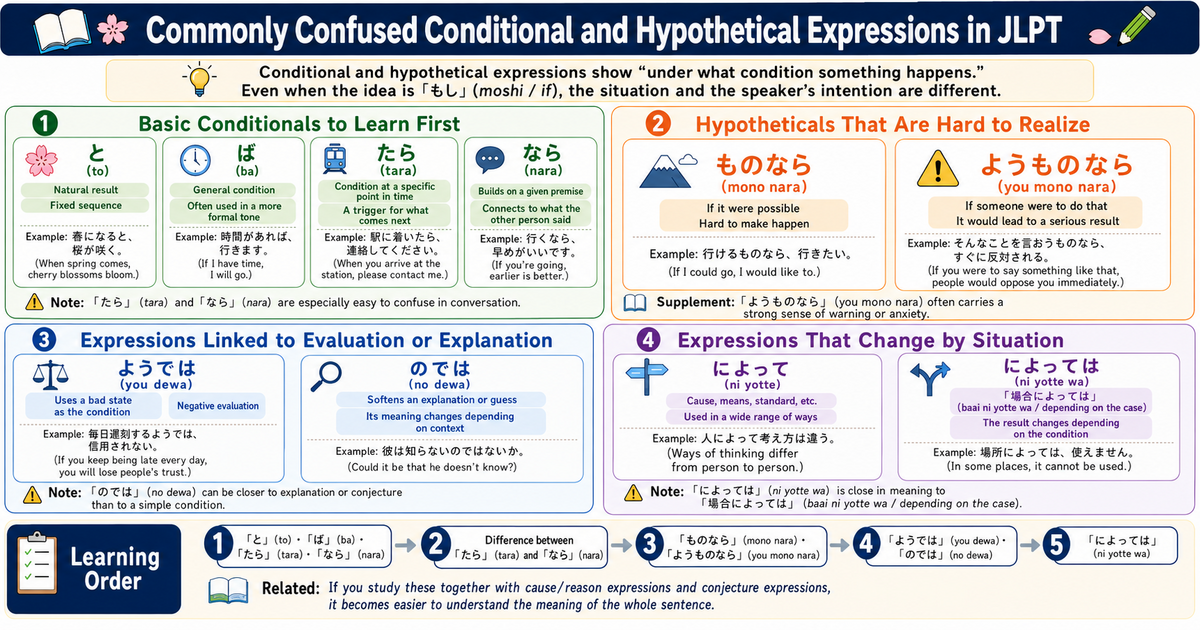
JLPT%E3%81%A7%E8%BF%B7%E3%81%84%E3%82%84%E3%81%99%E3%81%84%E6%9D%A1%E4%BB%B6%E3%83%BB%E4%BB%AE%E5%AE%9A%E8%A1%A8%E7%8F%BE%E3%81%BE%E3%81%A8%E3%82%81%EF%BC%88%E8%8B%B1%EF%BC%89.png)
Conditional and hypothetical expressions show when something happens
JLPT grammar often tests conditional expressions such as 「と」, 「ば」, 「たら」, and 「なら」.
They may all be translated as “if” or “when,” but in Japanese they differ in situation, speaker intention, and sentence pattern.
This page organizes related RJT articles so you can review conditional and hypothetical expressions together.
Start with the basic conditionals
と, ば, たら, and なら
First, review the four conditional expressions that learners often confuse.
「と」 is often used for natural or predictable results. 「ば」 presents a condition. 「たら」 can refer to a condition or a point in time. 「なら」 often responds to what someone has said or to a given assumption.
Hypothetical situations that are hard to realize
ものなら and ようものなら
At N2 and above, some expressions do more than state a condition. They show difficulty, risk, or seriousness.
「ものなら」 is used for a difficult hypothetical situation, as in “if it were possible.” 「ようものなら」 suggests that if something happened, the result would be serious or troublesome.
Conditions connected to evaluation and explanation
ようでは and のでは
Conditional expressions can also connect to evaluation, concern, or explanation.
「ようでは」 is used when evaluating an undesirable state. 「のでは」 is often used to give an explanation or soft guess.
Expressions that change by case
によって and によっては
「によっては」 means that the result may change depending on the case or condition.
「によって」 has several uses, including cause, means, and standard. 「によっては」 focuses on case-by-case variation.
Recommended study order
A good order for learning these expressions is:
- Learn the basic differences among 「と」, 「ば」, 「たら」, and 「なら」
- Compare 「たら」 and 「なら」 in conversation
- Study difficult hypothetical expressions with 「ものなら」 and 「ようものなら」
- Check how 「ようでは」 and 「のでは」 connect to evaluation and explanation
- Practice reading case-by-case meaning with 「によっては」
Related grammar guides
Conditional expressions often appear together with reason, cause, and inference expressions. Studying them together will help you understand the whole sentence more accurately.
%E3%80%8C%E6%9C%9F%E9%99%90%E3%82%92%E5%AE%88%E3%82%8B%E3%80%8D%E3%81%A8%E3%80%8C%E7%B7%A0%E3%82%81%E5%88%87%E3%82%8A%E3%81%AB%E9%96%93%E3%81%AB%E5%90%88%E3%81%86%E3%80%8D%E3%81%AE%E9%81%95%E3%81%84%EF%BC%88%E8%8B%B1%EF%BC%89.png)
%E3%80%8C%E4%BA%88%E5%AE%9A%E3%81%8C%E5%85%A5%E3%82%8B%E3%80%8D%E3%81%A8%E3%80%8C%E4%BA%88%E5%AE%9A%E3%82%92%E5%85%A5%E3%82%8C%E3%82%8B%E3%80%8D%E3%81%AE%E9%81%95%E3%81%84%EF%BC%88%E8%8B%B1%EF%BC%89.png)
%E3%80%8C%E8%87%AA%E4%BF%A1%E3%81%8C%E3%81%82%E3%82%8B%E3%80%8D%E3%81%A8%E3%80%8C%E8%87%AA%E4%BF%A1%E3%82%92%E6%8C%81%E3%81%A4%E3%80%8D%E3%81%AE%E9%81%95%E3%81%84%EF%BC%88%E8%8B%B1%EF%BC%89.png)
%E3%80%8C%E5%BF%85%E8%A6%81%E3%81%8C%E3%81%82%E3%82%8B%E3%80%8D%E3%81%A8%E3%80%8C%E5%BF%85%E8%A6%81%E3%81%AB%E3%81%AA%E3%82%8B%E3%80%8D%E3%81%AE%E9%81%95%E3%81%84%EF%BC%88%E8%8B%B1%EF%BC%89.png)
%E3%80%8C%E5%8F%AF%E8%83%BD%E6%80%A7%E3%81%8C%E9%AB%98%E3%81%84%E3%80%8D%E3%81%A8%E3%80%8C%E5%8F%AF%E8%83%BD%E6%80%A7%E3%81%8C%E3%81%82%E3%82%8B%E3%80%8D%E3%81%AE%E9%81%95%E3%81%84%EF%BC%88%E8%8B%B1%EF%BC%89.png)
%E3%80%8C%E7%B5%90%E8%AB%96%E3%82%92%E5%87%BA%E3%81%99%E3%80%8D%E3%81%A8%E3%80%8C%E7%B5%90%E8%AB%96%E3%81%AB%E9%81%94%E3%81%99%E3%82%8B%E3%80%8D%E3%81%AE%E9%81%95%E3%81%84%EF%BC%88%E8%8B%B1%EF%BC%89.png)